
There is no single cosmogonic origin for ma in the available sources; rather ma arise socially and morally from particular death circumstances and ritual failures. The literature and ethnographic summaries indicate that people who die away from home, violently or unnaturally, or who do not receive proper burial rites and offerings may become restless ma. Proper funerary rites and ongoing offerings transform such souls into venerated ancestors, while lack of ritual produces wandering 'hungry ghosts' that continue to seek what they lack.
Source material does not provide a single standardized visual description for ma; instead, ma are described as a lexical and cultural category encompassing diverse forms. The terms ma, hồn, vong, and bóng ma occupy overlapping semantic space for spirits and ghosts, and in folk stories, poetry, and diasporic literature ma appear variously rather than as a consistent corporeal archetype. In practice they are more importantly characterized by relational and ritual status than by fixed physical traits.
Ma are credited with agency in everyday life rather than cosmic powers. According to the surveyed sources, they can influence household prosperity and individual luck, interfere with families and dwellings, and be invoked in the activity of fortune-tellers and spirit mediums. Souls neglected by ritual become 'hungry ghosts,' described as supernatural thieves wandering the countryside. Families consult mediums to locate missing persons (for example missing soldiers), indicating ma can convey information about the dead. Ritual specialists are called upon to 'make ghosts leave,' showing ma can be negotiated with or expelled through ritual intervention.
Weaknesses
- ritualProper burial and ongoing ancestor rites (incense, offerings, prayers)
- ritualSpecialist-led rituals to make ghosts leave (performed by spirit mediums or ritual specialists)
Wards
- ritualBurning incense, offering prayers, and making offerings
- ritualEngaging spirit mediums/ritual specialists to locate missing persons or to drive away ghosts
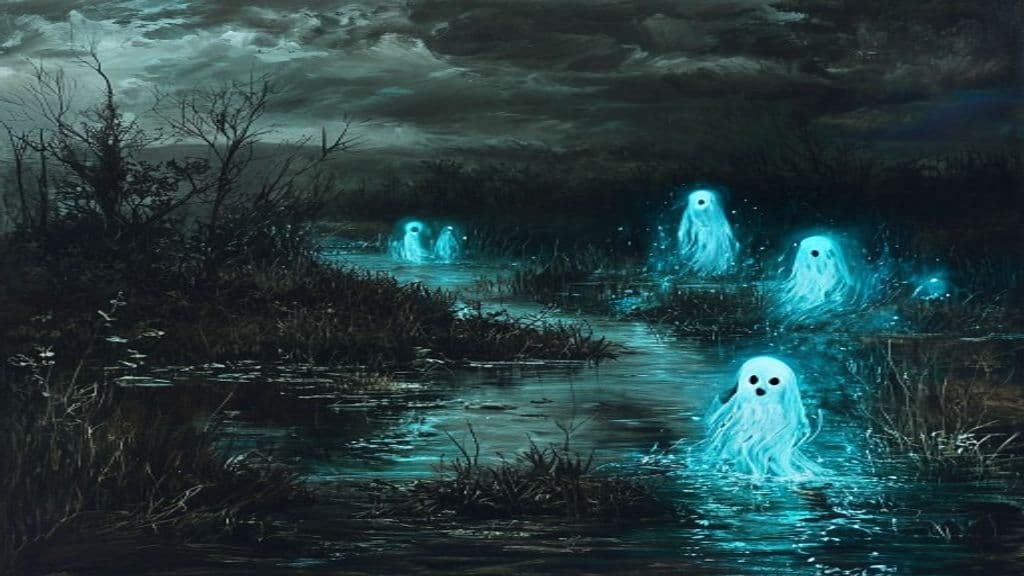
Will-o'-the-Wisp
A wandering light seen over marshy ground at night, leading travellers astray into bogs and fens. Possibly a spirit, possibly the soul of the unbaptised dead, possibly the devil himself.
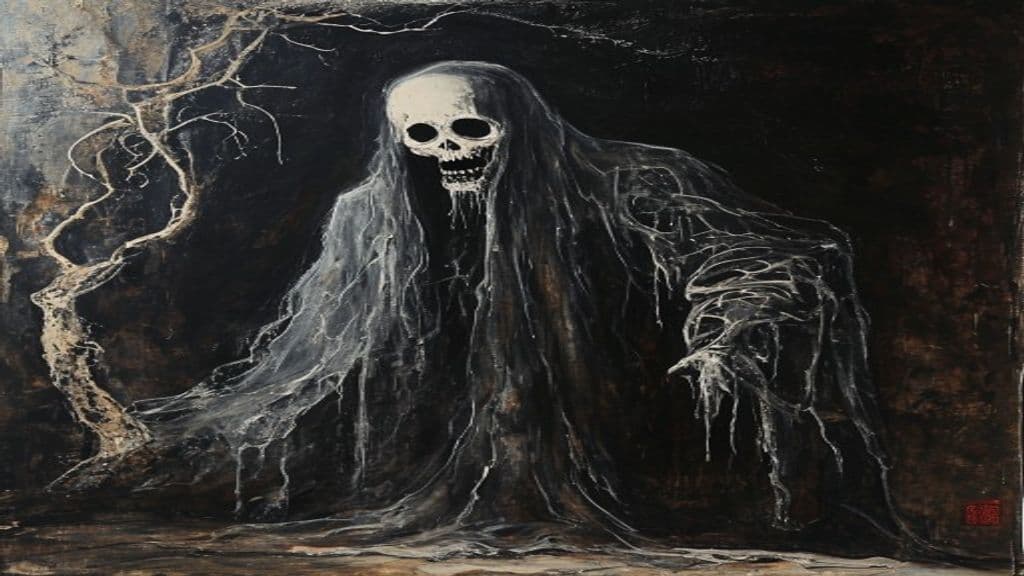
Hungry ghost (E gui)
Listed in a compiled catalogue of supernatural beings from Chinese folk culture and contemporary literature, 'hungry ghost (E gui)' appears as an itemized class of supernatural being in the provided sources. The supplied materials contain the name but do not give further descriptive or ritual detail.
Bà Chúa Xứ (Lady of the Realm)
Bà Chúa Xứ, also called Chúa Xứ Thánh Mẫu, is a localized tutelary and prosperity goddess in Vietnamese folk religion centered at Vĩnh Tế village at the foot of Sam Mountain, An Giang province. She is worshipped as a protector of business, health, and the Vietnamese border and attracts pilgrimages and a major three-day festival beginning on the 23rd day of the fourth lunar month.
Cá Ông (Whale spirit / Whale God)
Cá Ông is the Vietnamese folk-religious spirit associated with large whales, venerated as a guardian of fishing communities. Coastal communities perform funerary burials for beached whales and hold festivals in the whales' honor, reflecting a protective, reciprocal relationship between fishermen and these whale-spirits.
Hồn Ma (wandering spirit)
Hồn ma (also rendered ma, hồn, vong, or bóng ma) refers to wandering human souls in Vietnamese belief whose failure to be ritually integrated into the ancestor line leaves them roaming the living world. They are socially significant, implicated in everyday ritual practice, missing‑person searches, and the work of spirit mediums and ritual specialists.
Ma Da (ma đói) — Vietnamese "hungry ghost"
The supplied source corpus does not contain ethnographic or textual descriptions of Ma Da (ma đói) in Vietnamese tradition. Only two relevant fragments appear: the Vietnamese name for the Nīlakaṇṭha Dhāraṇī (Chú đại bi / Đại bi tâm đà la ni) and a note that auspicious/inauspicious days are recognized in Vietnam. No direct sourced information about ma đói’s attributes, rituals, or role is present in the provided materials.
Mụ bà (Mười hai Bà mụ)
A collective of twelve female tutelary figures in Vietnamese folk religion who act as midwives and household guardians of newborns, responsible for teaching infants early life skills and auspicious traits. They are ritually acknowledged in some regions at a special ceremony when a baby is one month old.
Thánh Gióng
Thánh Gióng is a legendary Vietnamese culture-hero and sainted warrior celebrated as a symbol of national courage and patriotism. Remembered as one of the canonical 'Four Immortals' of Vietnamese spirit, he functions in folk religion and public memory as a miraculous martial figure honored in festivals and communal veneration.
Thánh Trần
Vietnamese venerated ancestor spirit and national hero associated with bravery, loyalty, protection, and national pride. (Note: - Power tier: Minor Spirit (as it is an ancestor spirit and not a deity) - Abilities: add that these qualities are believed to be bestowed upon people through his worship, such as protection from harm)
Ông Trời
In Vietnamese tradition, Ông Trời is a high-ranking deity associated with the divine realm and later merged with the Jade Emperor. (Note: 1. The power tier should be Primordial, not Ancient, since Ông Trời is described as one of the most important gods in Vietnamese cosmology. 2. Add information about Ông Trời's appearance, abilities, s)
Ông Táo (Kitchen God)
Ông Táo is the Vietnamese household/kitchen deity who serves as the family's advocate before higher gods and as an emissary between heaven and earth, especially salient in New Year (Tết) ritual contexts.
Lākhe
Lākhe (Nepal Bhasa: लाखे, lā-khé) is a type of demon in Newar (Kathmandu Valley) folklore. Lākhe appear as ferocious masked figures in public festival performances; some named Lākhe, notably Majipa Lakhey, are ritually worshipped and function as civic protectors during festivals such as Yenya (Indra Jatra) and Gunla.
Lạc bird
A mythical creature in Vietnamese culture, considered the national bird of Vietnam. (Note: * Remove "national bird of Vietnam" from summary, as it only mentions the Lạc bird is considered one. * Power tier should be set to Unknown or Unspecified, as no information is available on its abilit)
Maaemä
Maaemä (Finnish) / Maaema (Estonian) is the personification of the earth as a maternal, generative principle in Finnish and Estonian runic-song and folk-ritual material; she functions as the 'earth mother' who receives offerings and is invoked regarding fertility, harvest, and things that come from the ground.
Community Record
- [1]Ghosts in Vietnamese culture (Wikipedia). Wikipedia, 'Ghosts in Vietnamese culture' (summary used throughout the entry)wiki
- [2]Poetry and fiction references to ma (diasporic literature). Uyen Dang — Ghost City Press (diasporic poetic reference cited in research notes)literary
- [3]Strange Horizons - 2086 By T.K. Lê. T.K. Lê, '2086' (fiction noted as cultural attestation of ma in literature)literary