
Accounts converge on the langsuyar as the spirit of a woman who died while pregnant, in childbirth, or after learning of a stillborn child; one recorded narrative (Walter William Skeat's informants, quoted in secondary summaries) recounts a woman who, upon hearing that her child was stillborn, died of shock and 'flew...to a tree, upon which she perched.' Traditions vary in detail, but the common causal nexus is maternal or peri‑natal death leading to a revenant condition; Skeat's story is one documented version among multiple traditional variants.
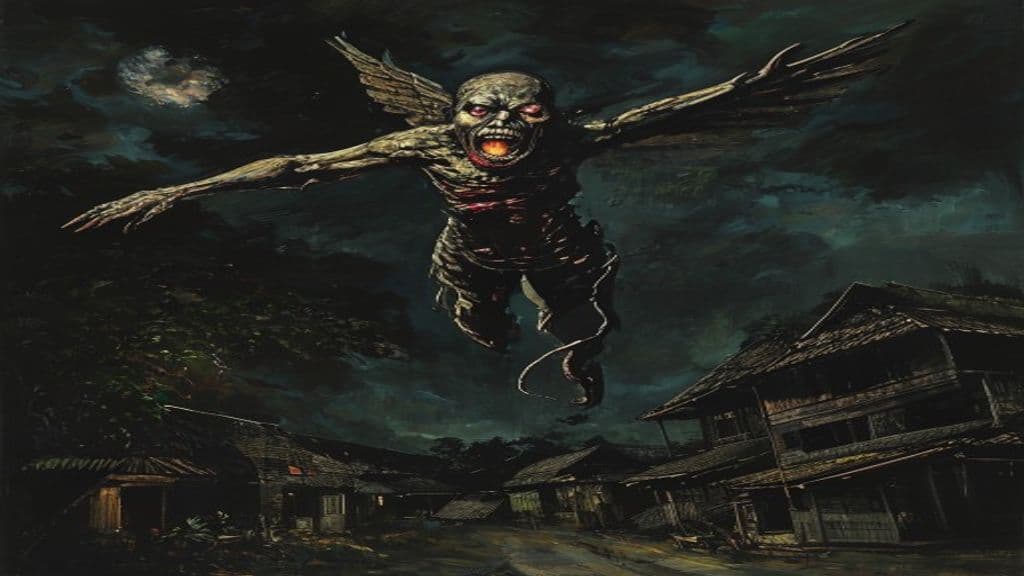
Descriptions vary across sources. Commonly the langsuyar appears as a beautiful woman wearing green robes, with extremely long jet‑black hair reaching to her ankles, very long (tapering) nails and hands that may extend low on the body. In other accounts she is described in more grotesque terms as a floating woman's head from which entrails and a spinal column trail (a visual likeness to the penanggalan). Skeat's account also mentions a hole in the back of the neck used to suck blood from children; the corpus of descriptions presents both seductive and monstrous aspects depending on the report.
The langsuyar is presented as vampiric: she preys on humans and is said to suck the blood of children, with traditional notes that newborn male infants are especially targeted though females may be taken as well. She is associated with flight and night‑bird behavior—taking or resembling a nighthawk/owl while perching on roofs or trees during attacks—and with haunting houses, roofs, and particular trees (including those bearing the parasitic 'sakat' fern or poisonous Rengas trees). Skeat's recorded variant includes a capacity to be physically captured and rendered harmless by cutting her nails and hair and stuffing them into the neck‑hole; other traditions emphasize repulsion or exorcism rather than transformation.
Weaknesses
- ritualcorpse preparations preventing transformation (glass beads in mouth; hen's egg under armpits; needles in palms)
- ritualcutting and stuffing of hair and nails into the neck‑hole (Skeat's recorded taming procedure)
- substancegandasuli leaves (declared a powerful charm by Sakai informants in summaries)
Wards
- ritualput glass beads in the mouth of the corpse
- ritualplace a hen's egg under the armpits of the corpse
- ritualplace needles in the palms of the corpse's hands
- symbolgandasuli leaf charm
- mantracharms or chants (Sakai practice; unspecified texts)
- ritualcommunal prayer (reported in a modern Kelantan incident as a collective protective response)
Penanggalan
A Malay vampire consisting of a detached human head with dangling organs that flies at night to feed on the blood of infants and new mothers, then soaks its organs in vinegar to reattach.

Pontianak (Kuntilanak)
A Southeast Asian female vengeful spirit common in Malay‑language traditions, often portrayed as the restless ghost of a woman who died in traumatic circumstances; she commonly appears as a beautiful woman who may reveal a monstrous form and is associated with banana and banyan trees.
Bisan
A female Malay/Jakun nature spirit who presides over camphor-bearing trees. She signals the presence of camphor by cicada-like song, is jealous of those seeking the resource, and must be propitiated or confused to allow harvest.
Hantu Raya
A Malay spirit-familiar (hantu) described as a "great" or potent double that serves and substitutes for a human master, especially associated in sources with practitioners of black magic. It performs labor, provides alibis, and requires regular offerings to be kept under control.
Hantu Tinggi
A Malay spirit-type characterized by extraordinary height, Hantu Tinggi is an ancient forest/swamp-associated unseen being in Malay-speaking areas of Malaysia. Folklore describes it as similar to Hantu Raya or Genderuwo but vastly larger; protective practice reported in sources centers on Qur'anic recitation and seeking traditional or Islamic healers.
Polong
A Malay familiar spirit produced from human blood and kept in a bottle by a human owner; it is deployed to afflict victims by possessing them, typically preceded by a smaller insect-like helper (pelesit). Victims are cured when the spirit is called off by its owner or through a shamanic exorcism that forces the polong to name its human 'parent.'
Lampetia
Lampetia is a figure in ancient Greek myth, described as a daughter/attendant of the sun-god Helios who, with her sister Phaethusa, guards Helios's sacred herd on the island Thrinacia. She functions as a divine herdswoman and reporter of transgressions against divine property in Homeric narrative and appears in variant genealogies in later mythography.
Lampus / Lampos
Lampus (Ancient Greek: Λάμπος) is not a single mythic being but a personal name applied across a range of classical Greek mythic figures — human and animal — whose name evokes 'brightness' or 'shine.' Attestations in classical mythographic and epic materials include royal mortals, hounds, and named horses associated with dawn and sun deities and with heroes.
Landvættir
Landvættir are place-bound spirits or 'land-beings' in Old Norse and Icelandic tradition whose favor was linked to the fertility and safety of particular locales. Attested in saga literature, law codes, and later folk practice, they are localized guardians or presences dwelling in stones, hills, skerries, and other landscape features and were addressed by offerings and social regulations.
Langsuir
A Malay banshee-vampire — the spirit of a woman who died in childbirth, transforming into a beautiful owl-woman who sucks the blood of infants through a hole in the back of her neck.
Lanka (Hindu tradition)
A city-state and island fortress capital in Hindu epics, ruled by the Rakshasa king Ravana. (Note: - Power tier: Lower than Greater (Lanka is a city-state and island fortress capital, not a powerful regional entity) - Abilities: Specify that Lanka's ruler Ravana has no supernatural powers beyond hu)
Laodamas
Laodamas (Ancient Greek Λᾱοδάμᾱς, lit. 'tamer of the people') is a personal name borne by multiple mortal figures in Greek mythic-historical traditions — princes, warriors, and a king — appearing in Theban, Trojan, and Phaeacian narratives rather than as a single supernatural being.
Laodamia
Laodamia (Ancient Greek: Λαοδάμεια) is a personal name borne by several mortal women in Greek myth whose stories sometimes intersect with gods, death, and brief post‑mortem visitations. Rather than a single supernatural class, Laodamia functions as an episodic figure in multiple genealogies and heroic narratives (e.g., a Lycian princess, the wife of Protesilaus).
Laodamia of Phylace
Laodamia of Phylace is a mortal woman in Greek myth, best known as the faithful wife of Protesilaus whose intense grief and devotion prompt the gods to grant her a brief, divinely mediated visit with her dead husband returned from Hades. Her story illustrates human access to the chthonic realm only by exceptional divine pity and emphasizes marital fidelity and mourning.
Community Record
- [1]Langsuyar (Wikipedia). Wikipedia article 'Langsuyar' summarizing traditional descriptions and citing Walter W. Skeat among other material.wiki
- [2]Walter William Skeat, Malay Magic (as quoted in summaries). Skeat's account of the Langsuir is quoted in the Wikipedia article and provides a recorded narrative and the cutting/ stuffing taming procedure (as presented in secondary summary).folk
- [3]Langsuyar of Malaysian Folklore | Into Horror History (J. A. Hernandez). Secondary popular‑historical summary referencing traditional descriptions and modern reports.other
- [4]Episode 130: More Southeast Asian Monsters | The Xenohistorian Weblog (October 2023). Comparative commentary on Southeast Asian monster traditions that lists the langsuyar among regional entities (used as supplementary comparative context).other
- [5]GeGeGe no Kitaro (2007) Southern Yokai settei (archive). Popular culture reference including a 'Langsuyar' entry in a roster of southern yokai; cited here only as a modern cultural mention, not as a primary ethnographic source.other