
No coherent mythic 'origin' narrative for Latarak survives in the provided sources. Attestations from the Old Babylonian through Neo-Assyrian periods show him functioning as a localized tutelary/protective deity rather than a creator or major state god. He is documented in ritual corpora and lexical lists and appears at cult sites and in ritual contexts at Uruk, Nippur, Assur, and in references from Emar and a trilingual Ugaritic list. A possible toponym (Bāb-Lātarāk or Ka-Lulal) may reflect cult places associated with him, but readings are uncertain. Over time his identity is variably equated with or paired with Lulal and allied apotropaic figures, indicating a fluid, locally variable cultic status.
Textual and lexical evidence presents two overlapping visual models: a leonine figure and a man clad in lion-skin. Lexical lists equate his name logographically with urgulû ('lion'), and iconographic descriptions report figures in lion garb holding a whip or staff — the lion-skin costume and whip/rod motif signaling his role in subduing hostile powers. Scholarship treats both a lion-like monster and a human in lion-skin as plausible representations in surviving material.
Latarak functions primarily as an apotropaic guardian: he is invoked to protect doorways and household thresholds, to prevent disease, and to subdue or repel hostile supernatural forces. He appears in anti-witchcraft and house-cleansing corpora (Maqlû, Bīt mēseri, Šēp lemutti), is named alongside other protective figures (Lulal, Lugaledinna, Muḫra, Šulak), and is used in formulaic invocations during rituals confronting malevolent magic. A Neo-Assyrian letter may allude to invoking him against the demoness Lamashtu, but that specific attestation is cautious and not fully confirmed in the summaries.
Weaknesses
- otherNo explicit vulnerabilities recorded in surviving summaries
Wards
- ritualPlacement of figures of Latarak (often paired with Lulal) at gates and doorways
- substance"black paste" used to decorate the two figures (prescribed in Šēp lemutti)
- ritualInvocation of Latarak in incantation series (Maqlû) and house-cleansing rites (Bīt mēseri) as a protective formulaic presence
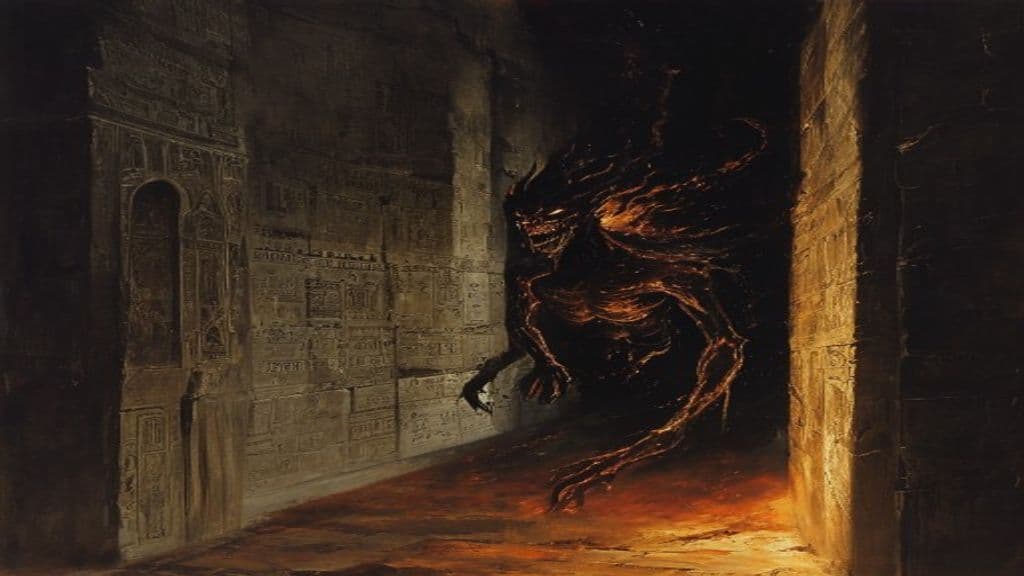
Asakku
A class of Sumerian disease-demons born from the union of heaven and earth, who lodged themselves in people's bodies and caused wasting fevers and convulsions.
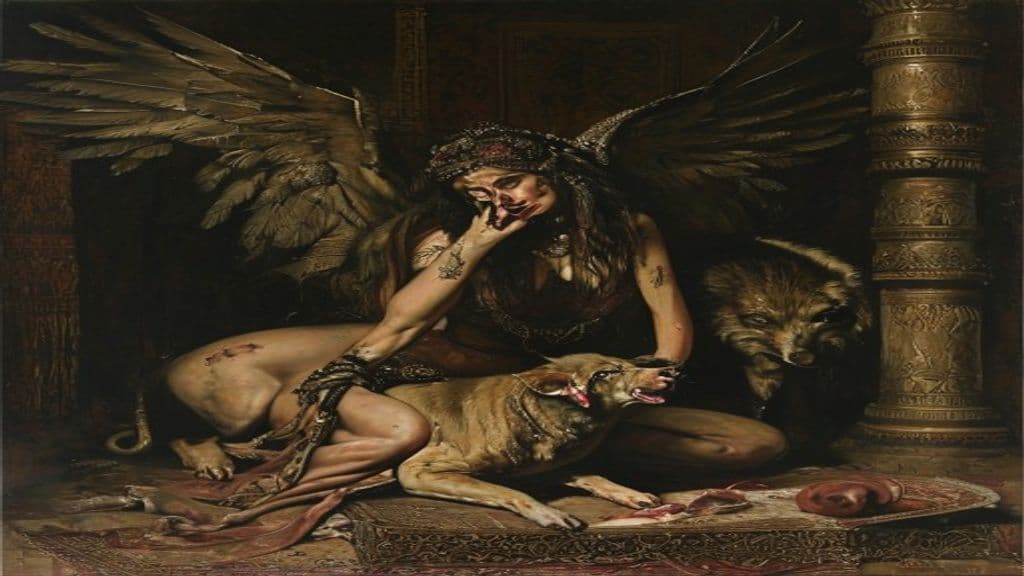
Lamashtu
The most feared demoness of ancient Mesopotamia — a divine daughter of Anu who preyed on pregnant women, caused miscarriages, and killed infants by nursing them with venom.
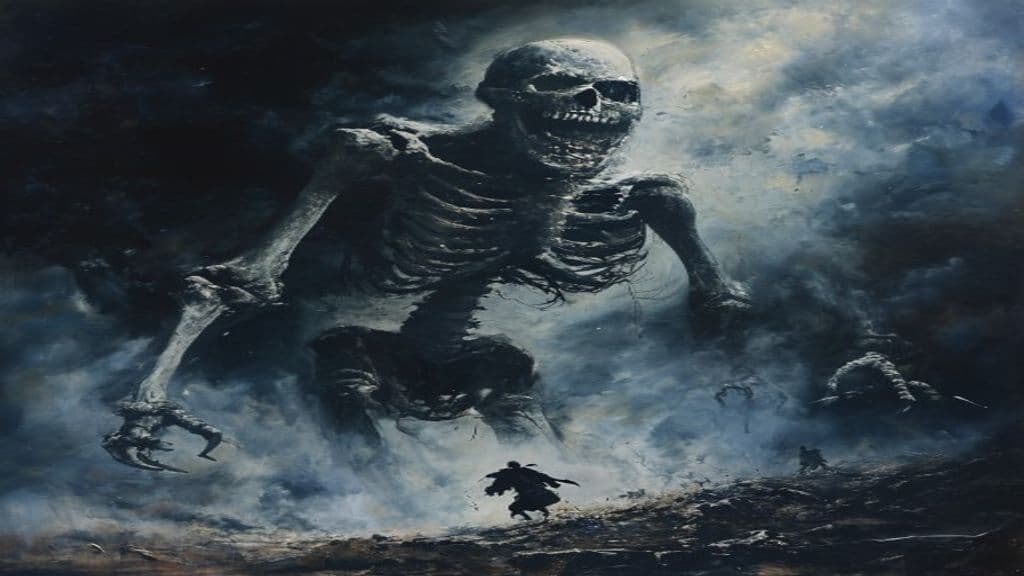
Gashadokuro
A fifteen-times-human-height skeletal yokai formed from the bones of those who starved to death or died on battlefields, their unburied remains fused together into a hungry colossus.
Adad
Adad (also Hadad, Haddad; Sumerian Iškur) is the storm- and rain-deity attested in ancient Mesopotamian and Canaanite religious contexts. Sources identify him as a principal weather god whose domain is storms and rainfall and whose name appears across multiple Near Eastern languages and sites, including Ebla (as Hadda, c. 2500 BCE).
Ama-arḫuš
Ama-arḫuš is attested in Mesopotamian sources as a divine figure associated with compassion and healing. She is presented both as an independent goddess and as an epithet applied to other goddesses (notably as a title designating them compassionate, for example in association with Gula).
Anunītu (Annunitum / Anunitu)
Anunītu (Annunitum / Anunitu) is a Mesopotamian goddess associated with warfare who began as an epithet of Ishtar of Akkad emphasizing a warlike aspect and by the late third millennium BCE came to be treated as a distinct tutelary deity, attested as patron of cities such as Akkad and Sippar-Amnanum and worshiped elsewhere in Mesopotamia.
Belet-ekalli (Ninegal)
Belet-ekalli, also rendered Ninegal, is a Mesopotamian palace tutelary deity whose name means 'lady of the palace.' She appears in canonical god lists and in interstate treaty enumerations, indicating a recognized role in palace cult and state-level ritual contexts.
Bunene
Bunene is an attendant deity (sukkal) of the Mesopotamian sun-god Šamaš (Utu), described as the charioteer who conveyed the sun from the eastern horizon to the western doorway of heaven and as a cultic intercessor included in offerings and temple inventories, especially at Sippar.
Haya
Haya is attested as a theonym in ancient Mesopotamian religion. Some modern scholars have characterized Haya as a grain or agricultural deity on etymological grounds, a reading that other scholars treat as tentative or unreliable given the limited evidence.
Ili-mīšar
Ili-mīšar (Mīšaru, Misharu) is a Mesopotamian deity who functions as the personification of justice and is sometimes portrayed as a divine judge. He is attested from the Ur III period onward and was worshiped in multiple Mesopotamian cities with at least one attested local tutelary role.
Irnina
Irnina (dir-ni-na / dir-ni-ni) is a Mesopotamian divine personification of victory attested both as an independent goddess and as an epithet applied to other deities (notably Ishtar). She appears in god lists, royal campaign literature, and syncretistic hymnody and is placed in some sources near underworld deities.
Ištaran
Ištaran is the tutelary deity and divine judge of the Mesopotamian city of Der. He is attested from the Early Dynastic period through the Middle Babylonian period, associated with serpents (especially the snake god Nirah), and was politically important in legitimizing local rulers; his cult statue was at times seized by Assyrians to secure the city's loyalty.
Kusibanda
Kusibanda (also spelled Kusigbanda; older disputed reading Guškinbanda) is a Mesopotamian deity who functions as the tutelary god of goldsmiths and silversmiths. He is associated with the preparation of statues and is attested in temple contexts (notably the temple of Ninimma in Nippur) and in documents from Seleucid-period Uruk.
Laguda
Laguda is an ancient Mesopotamian local deity associated with maritime/coastal waters of the Persian Gulf and a named cult-place (Nēmed-Laguda). He appears in god lists, ritual/incantation corpora, literary compositions, and inophoric personal names from the Kassite and first-millennium periods, where he functions as a named maritime figure within Mesopotamian theological geography.
Laṣ
Laṣ is a Mesopotamian goddess attested as the spouse and intercessory consort of the god Nergal, worshiped in cult centers such as Kutha (E‑Meslam) and Tarbiṣu. She appears in god lists, offering and administrative documents, and is invoked among underworld deities and as a guarantor in treaties.
Community Record
- [1]Latarak — Wikipedia. Wikipedia, 'Latarak' article (summarized attestations, ritual corpora references, iconography, etymology notes)wiki
- [2]Lulal — Wikipedia. Wikipedia, 'Lulal' (contextual association and comparative attestations)wiki
- [3]Wikidata: Latarak. Wikidata entry for Latarak (classification metadata)other
- [4]Cuneiform Commentaries Project — Weidner’s God List B (CCP 6.7.B). Cuneiform Commentaries Project: Weidner’s God List B (attestation/equation contexts)academic
- [5]Cuneiform Commentaries Project — Weidner’s God List A (CCP 6.7.A). Cuneiform Commentaries Project: Weidner’s God List A (attestation/equation contexts)academic
- [6]Solariapublications — A Brief Guide to the Babylonian Constellations. Online reconstruction discussing speculative astral identifications (treated as uncertain in summaries)other
- [7]Solariapublications — Full Reconstruction of the Babylonian Star-Map (Map 2). Online reconstruction with speculative identifications (noted as disputed/uncertain in the provided material)other
- [8]Earlywritings forum thread: The Celestial Pole in the Apocalypse (page 5). Forum discussion mentioning speculative astral identifications (treated as speculative in summaries)other
- [9]Duke abstract (ritual assemblage reference). Abstract referencing ritual assemblages that include Lulal/Latarak among apotropaic figures (used as partial contextual evidence)other
- [10]Generation No. 3 / ANU03 (online reproductions). Online reproduction linking to Mesopotamian god lists and mythic materials (used with caution; secondary)other
- [11]ANU03 mirror. Secondary online reproduction of god-list material (used cautiously)other