Not specified in the source material.
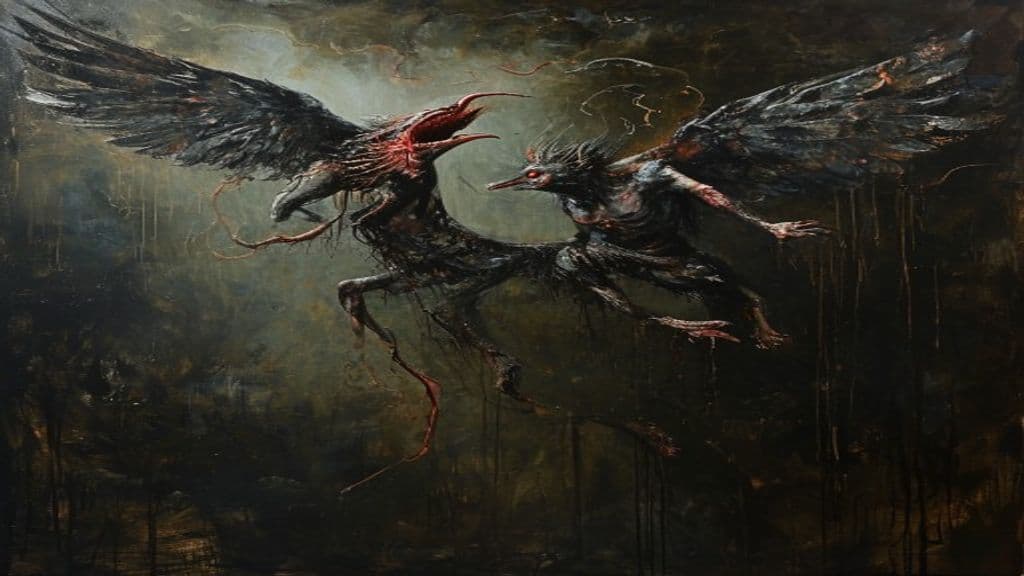
The Leyak has a flying head with entrails still attached, setting it apart from other supernatural entities.
The Leyak targets pregnant women and newborn children, primarily to suck their blood or abduct infants. Its specific goal is often described as sucking 'her baby's blood'.
Barong
In Balinese mythology, the Barong is a panther-like creature and leader of good spirits. (Note: - Power tier: Greater (based on the description as a powerful regional entity, leader of hosts of good spirits) - Abilities: Specify that the Barong opposes Rangda's evil energies, implying a defensiv)
Lete
Lete is not attested in the provided sources as a supernatural being. The attested uses of the form 'Lete' are lexical and onomastic: a Basque toponym and surname, an ancient city (Lete in Mygdonia), a modern village in Nepal, an entry-word in the constructed language Toki Pona meaning 'cold' (with an associated glyph), an esoteric programming language (esolang) called Lete, an ICAO airport code (LETE for Morante Airfield), and a proper name applied to an exoplanet. No sources in the consulted corpus describe Lete as a spirit, demon, deity, or monster.
Lethus
Lethus is not attested as a single traditional supernatural being in the supplied sources; the lexical form appears in multiple unrelated contexts: as a Greek mythic personal name (father of Pylaeus), as a taxonomic label in entomology, as modern personal/user names, and as a single modern fan-made fictional monster (the "Lethus Dragon" on a D&D wiki). No coherent folkloric ontology, rituals, or traditional powers are documented for an entity called Lethus.
Leto
Leto (Ancient Greek: Λητώ / Λατώ; Latin: Latona) is an ancient Greek goddess best known as the mother of the Olympian twins Apollo and Artemis. She functions in myth and cult as a kourotrophic (mother‑or nurse‑goddess) figure with important sanctuaries at Delos and the Letoon in Lycia, and appears in narratives that emphasize both mildness and the capacity to call down retribution when insulted.
Leucosia
Leucosia is a name applied in the source corpus to multiple distinct referents: a possible name for one of the Sirens of Greek mythology (a sea-associated, singing female figure), a modern taxonomic genus of small 'pebble' crabs (family Leucosiidae), and several modern/pop-cultural uses. The supplied sources do not preserve a standalone ancient narrative or ritual corpus specifically attached to a Siren named Leucosia.
Levan (unattested forest spirit — proposed)
No supplied sources attestate a supernatural being named Levan in Georgian tradition. The name Levan appears in the provided materials only as a Georgian masculine given name and in various toponyms and archival name references; there is no folkloric description, origin story, or ritual material relating to a forest spirit by this name in the supplied sources.
Leviathan
A giant sea serpent in Jewish mythology, embodying chaos and serving as a metaphor for a powerful enemy. (Note: - Power tier should be Ancient (Leviathan's abilities are often described as deity-level, such as threatening the damned after their lives are over and being annihilated) - Appearance is not mentioned)
Leđan (Slavic tradition)
An ancient and magical city from Croatian mythology and folklore. (Note: 1. Power tier: downgrade to Greater (since Leđan is described as an "ancient" city, but its magical nature and lack of explicit abilities suggest it may be less powerful than Ancient). 2. Appearance: )
Lha
Lha is a Tibetan term used in Buddhist and related Himalayan contexts to denote local or regional deities and divine presences that have been incorporated into the ritual and popular religion of Tibet and neighbouring areas. The category overlaps with indigenous spirits and classical Buddhist beings (devas, yakshas) and functions within ritual life as objects of veneration, territorial sacralization, and protective or beneficent cult practice.
Libat
Libat is the Mandaic name for the planet Venus and one of the Seven (šuba) planetary beings who form part of Ruha's entourage in the Mandaean World of Darkness. Treated both as the astronomical Venus and as an agentive supernatural being, Libat is associated with love and reproduction yet is often framed negatively as a demonic power (daiuia) and sometimes identified with Ruha or her epithets such as Amamit and ʿstira/Estira.
Libya (daughter of Epaphus)
A mythic eponymous ancestress in Greek and Roman genealogical tradition: a daughter of Epaphus whose name personifies the land/ethnonym Libya. In some variant sources she is said to be beloved of Poseidon and, in those accounts, mother of progenitors such as Agenor and Belus. Surviving testimonia treat her primarily as an etiological genealogical figure rather than an active cultic or supernatural agent.
Lichas (Spartan)
A mortal human figure in Greek tradition, associated with ancient Sparta. He demonstrated leadership and diplomatic skills during the Peloponnesian War. (Note: 1. Power tier should be Primordial, as Lichas is described as a mortal human figure in Greek tradition with significant impact on historical events. 2. Abilities description can be expanded to include)
Community Record
- [1]Wikipedia. Source 1wiki