
The supplied sources do not give a single unified mythic origin for lha as a category. Rather, Buddhist religious worlds in Tibet incorporated Indian cosmological categories (devas, asuras, yakshas) and later assimilated regional spirits and local gods — the lha — into Buddhist and local ritual orders. Individual lha may have their own origin stories within local or Bon traditions (for example Shenlha Ökar is an important deity in the Yungdrung Bon tradition), but the general category arose through syncretic incorporation of place-based divinities into Buddhist and indigenous religious practice.
The provided materials do not supply a consistent generic iconography for lha as a class. Appearance varies by individual deity and local tradition; some named lha or analogous deities (e.g., Shenlha Ökar in Bon sources) have distinctive iconography in their own traditions, but no single visual description for all lha is given in the cited excerpts.
Sources frame lha primarily by their social and ritual roles rather than enumerating a fixed set of supernatural powers. As local/regional divine beings integrated into Buddhist practice, lha are venerated in ritual and popular contexts and function as protectors or recipients of offerings, participants in the sacralization of landscape, and elements of local religious economies. They may be ritually empowered or propitiated much like other Tibetan protector deities, though specific powers differ by named deity and locality.
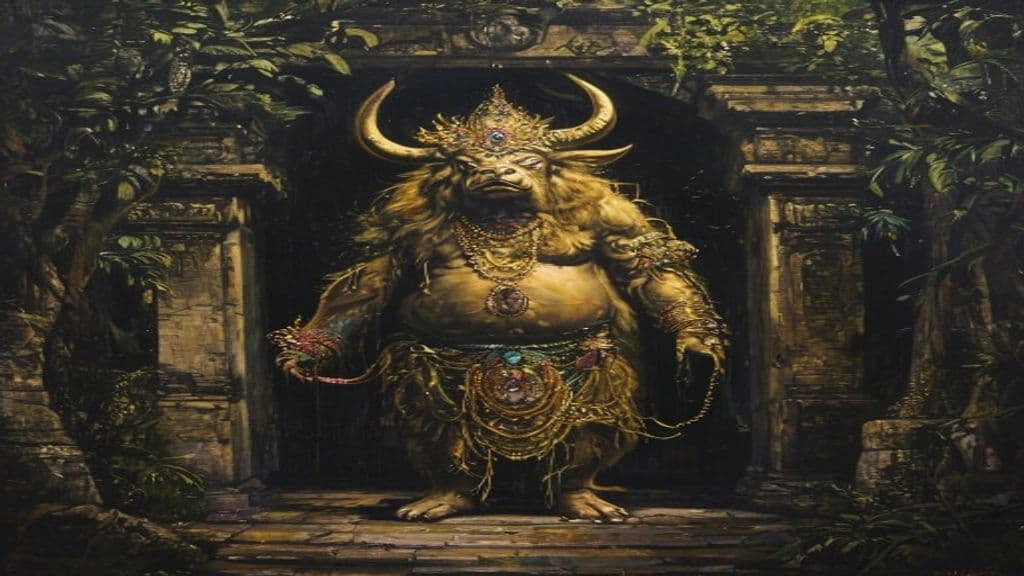
Acala
Acala (Sanskrit: अचल, 'The Immovable') is a wrathful protective deity (dharmapala) in Vajrayāna and East Asian esoteric Buddhism, classed among the Wisdom Kings (Vidyārāja). He functions as a ritual focus for visualization and mantra practice intended to remove obstacles and bind or destroy hostile forces.
Amitābha
Amitābha is a central celestial Buddha of Mahayana Buddhism who presides over the western Pure Land called Sukhāvatī. Devotional practices invoking his 'measureless' light and life (nianfo/nembutsu) are presented in Pure Land traditions as a path by which beings may be reborn in his buddhafield and quickly attain Buddhahood.
Bhrikuti
Bhrikuti is a historic-legendary 7th-century Nepali princess of the Licchavi line who became queen-consort to the Tibetan king Songtsen Gampo and, in Tibetan religious imagination, is represented iconographically and devotionally as an emanation or incarnation of Green Tara. Sources credit her with bringing sacred Buddhist images, skilled Newar craftsmen, and patronage that aided the establishment of Buddhism in Tibet; she is not presented in the sources as a harmful folk spirit.
Bodhisattva
A bodhisattva is a being or practitioner in Buddhist thought who has generated bodhicitta — the wish and compassionate intention to attain awakening (bodhi) for the benefit of all sentient beings. In Early/Theravāda contexts the term often denotes the Buddha in his pre‑awakening lives, while Mahāyāna expands it into an ideal and category of spiritually advanced, active helpers and devotees.
Bönpo Lu (local mountain spirits)
A research label for local mountain-associated spirits situated in Himalayan/Tibetan ritual worlds; the term as presented is not documented in detail in the supplied sources. The available materials place such landscape spirits within a broader Bön and Tibetan Buddhist milieu where mountains and local non-human agents are engaged through offerings and ritual specialists.
Dharmapāla
In Buddhist traditions, a dharmapāla is a protective deity or guardian whose role is to defend the Dharma (the Buddha's teaching) and to avert obstacles to spiritual practice. Appearing across Mahāyāna and Vajrayāna contexts (notably Tibetan, Chinese, and Japanese), dharmapālas range from local worldly guardians to wrathful enlightened emanations invoked in tantric ritual.
Dīpankara Buddha
A Buddha of the past in Buddhist sacred history who, according to traditional narratives, recognized and predicted the future Buddhahood of the bodhisattva Sumedha (a previous life of Gautama/Śākyamuni). He is venerated in ritual contexts, represented in Asian Buddhist art, and commemorated in contemporary temple and festival practices.
Preta (Hungry Ghost)
A post-mortem supernatural being associated with extreme, unremitting hunger and thirst. In Hindu usage the Sanskrit term can mean a deceased person, while Buddhist traditions develop the category into a distinct realm of hungry spirits whose condition illustrates karmic consequences for demeritorious action.
Rainbow Body (Tibetan tradition)
In the Tibetan Buddhist tradition, the Rainbow Body is a level of realization where the physical body transmutes into light, indicating profound spiritual attainment. (Note: 1. Remove Primordial power tier as it's not supported by the source material, which doesn't indicate a cosmic or deity-level power. 2. Add more specific information about the Rainbow Body phenomenon a)
Samantabhadri
Samantabhadri is a female Buddha and dakini in the Vajrayana (Tibetan) Buddhist tradition, described as the primordial Mother Buddha and the dharmakaya dakini aspect of the Trikaya. She functions doctrinally as the feminine, non-dual ground of awakening and is identified as the consort and counterpart of Samantabhadra.
Tārā
Tārā is a major female sacred figure in Mahāyāna and Vajrayāna Buddhism — variably described as a bodhisattva, a Buddha, a yidam (meditation deity), and a motherly saviouress who rescues beings from worldly and spiritual danger. She functions as both an object of devotion and a meditational realization, with prominent forms such as Green and White Tārā and a liturgical corpus centered on mantras and sadhana practice.
Wind Horse
In Mongolian shamanistic tradition, the Wind Horse is a symbolic representation of the human soul associated with flight and liberation. (Note: 1. Power tier should be Greater (its association with flight, liberation, and being in the center of cardinal directions suggests deity-level abilities). 2. Appearance is not explicitly described, but)
Community Record
- [1]Buddhist_deities - Wikipedia (section covering incorporation of local gods). "Buddhism includes a wide array of divine beings that are venerated in various ritual and popular contexts. Initially they included mainly Indian figures such as devas, asuras and yakshas, but later came to include other Asian spirits and local gods."wiki
- [2]Shenlha Okar - Wikipedia. "Shenlha Ökar ... is the most important deity in the Yungdrung Bon tradition of Tibet. He is counted among the 'Four Transcendent Lords'..."wiki
- [3]Charting the Shugden Interdiction in the Western Himalaya (Martin A. Mills). Mills recounts that 'His Holiness the Fourteenth Dalai Lama... performed a tantric empowerment ceremony to the Tibetan protector deity Tamdrin' as an example of protector deity ritual context.other
- [4]Tabo Monastery - Wikipedia. Tabo Monastery (founded 996 CE) is part of the Tibetan Buddhist institutional landscape in which local deities would be integrated or encountered.wiki
- [5]Vajrasattva and monastic practice (illustrative context). "This Vajrasattva practice is performed in its most concise manner every morning at the temple..." used to illustrate the monastic ritual environment.other