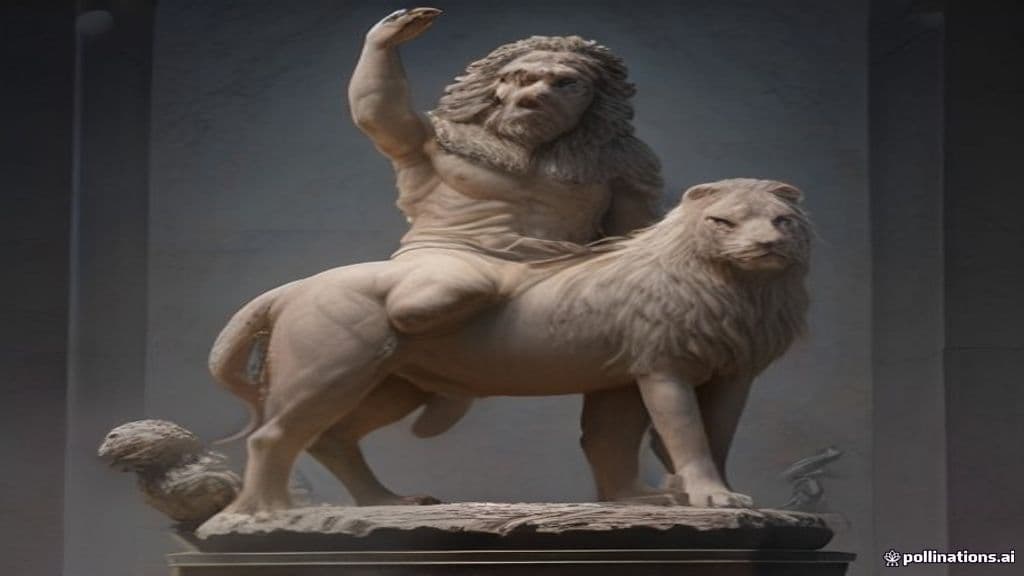
The Lion of Cithaeron appears in Greek narrative traditions as a large predatory lion that issued from the region of Mount Cithaeron to harass nearby communities. In the Heracles-centered tradition (as summarized from Apollodorus and related scholia/Tzetzes), the lion attacked the cattle of Amphitryon and Thespius; Thespius encouraged the young Heracles to kill it over the course of an extended hunt (reported in summaries as lasting fifty days), after which Heracles donned the lion's skin and scalp as a token of the exploit. In a competing local Megarian tradition reported by Pausanias (as summarized in modern references), the lion had slain many people, including Euippus (Evippus), son of King Megareus, and the king promised that whoever killed the beast would marry his daughter and inherit the throne; Alcathous is the hero who slays the lion in that account and, upon accession, is said to have built temples to Artemis Agrotera and Apollo Agraeus. The Suda and later summaries give regional epithets (Thespian, Ravine lion) that tie the beast to a particular den or gorge near Cithaeron.
Primary sources and the supplied summaries consistently identify the entity simply as a lion — a large terrestrial predatory feline — without extended supernatural physical description. No classical passage in the provided material supplies distinctive markings, extra-mortal anatomy, or anthropomorphic features; later modern summaries echo the basic label 'lion' or 'man-eating beast.' The Suda's epithet Charadraîos leōn (Χαραδραῖος λέων) — "Ravine lion" — highlights its association with a specific geographic den (χαράδρα, charadra = ravine/gorge) rather than a distinctive corporeal anomaly.
The attested behaviors are mundane but narrative-significant: the lion ranged from Mount Cithaeron into adjacent lowlands to hunt and kill livestock and people, thereby destabilizing local economic and civic order. Sources record prolonged predatory activity (the Heracles account summarized from Apollodorus indicates a hunt that took fifty days) and lethal attacks (Pausanias' Megarian summary reports numerous victims, including a royal son). The lion functions as a localized, persistent adversary whose removal by a hero confers social rewards (marriage and kingship in the Megarian tradition) or heroic identity (Heracles wearing the skin). The provided material does not ascribe supernatural resistances, magical powers, speech, or other non-natural faculties to the beast; its menace is expressed through carnivorous predation and the social crisis that produces.
Weaknesses
- othervulnerability to mortal hunters (slain by Heracles or Alcathous)
Wards
None recorded.
Lineage of Mahabali
A significant ancestral line within Hindu mythology tracing the descent of the Daitya clan from sage Kashyapa through Raja Bali. (Note: 1. Power tier should be Primordial, as the lineage is tracing back to a sage and a cosmic ancestral line. 2. Add a physical description: None is provided in the sources but typically, Daitya clan memb)
Lingji (灵吉)
Lingji (灵吉; Língjí) is a fictional Bodhisattva figure invented by Wu Cheng'en in the 16th‑century novel Journey to the West. In the novel he resides on Little Sumeru Mountain and is called upon to subdue wind‑based demons; he provides two named magical items, the Flying Dragon Staff (飞龙杖) and the Wind‑Calming Pill (定风丹), which are used to capture or protect against powerful winds.
Linh Hồn của núi
Linh Hồn của núi (literally, "spirit/soul of the mountain") is a descriptive label for a mountain spirit in Vietnamese language; the supplied sources contain no specific folkloric descriptions, rituals, or origin stories for an entity explicitly named "Linh Hồn của núi." The phrase participates in a broader Vietnamese cultural field where spirits and memory are topics of artistic and historical reflection, but concrete traditions for this exact name are not present in the provided materials.
Linh hồn (sông) — research notes
Notes on the concept of 'linh hồn' as found in three Hồng Hoang (xianxia) excerpts; sources discuss disembodied, transmigrating souls and cosmic mechanisms but do not provide material specifically about Vietnamese river spirits ('linh hồn sông' or 'thủy quỷ').
Linton Worm
A serpent-like monstrous "worm" from Scottish Borders folklore associated with a hollow on Linton Hill; traditionally described as a large wyrm that ravaged people, livestock and crops and was overcome in a heroic confrontation. The legend is presented in sources as medieval in origin and comparable to other British worm/dragon tales such as the Lambton Worm.
Linus of Thrace
Linus of Thrace (Λῖνος) is a mythic Greek culture-bringer associated with the origin and exemplification of the linos (a dirge/threnody) and with early lyric song, music-teaching, and the transmission of letters and instruments. He is variously described as son of a Muse and a god and is the focal figure of annual commemorative lament and local tomb-claims in multiple Greek locales.
Lion of Judah
A symbolic and emblematic figure originating in biblical and related traditions that names the tribe/line of Judah, royal legitimacy (notably Ethiopian Solomonic claims), and a messianic title in Christian scripture; later adopted as an emblem of Haile Selassie I and of Rastafari identity. It functions as a cultural-religious emblem rather than a literal supernatural creature in the provided sources.
Lir
Lir (also Ler) is an Old Irish sea-personification and mythic ancestor figure whose name literally means 'sea'. In medieval Irish material he appears as a named figure — notably father of Manannán mac Lir and as a king in the tale The Children of Lir — and functions more as an elemental progenitor linked to the maritime domain than as a consistently individuated deity in surviving excerpts.
Liriope
Liriope is primarily attested in the supplied sources as (a) a minor mythological figure — a nymph named in Ovid’s Metamorphoses as the mother of Narcissus by the river-god Cephissus — and (b) as a modern scientific name reused for genera in botany and zoology (and for an asteroid). The provided material does not document Liriope as an active, continuing supernatural agent with associated rituals or powers.
Lisin
Lisin is a Mesopotamian deity attested across hymn, lament, incantation, lexical, and astronomical texts. Initially addressed as a mother-goddess in early hymnic material, Lisin later appears in incantation corpora and is reinterpreted in esoteric texts with associations to fire; in the first millennium BCE the name is used for the star Antares.
Little Crown Prince Zhang
Little Crown Prince Zhang (小张太子, Xiǎozhāng Tàizǐ) is a literary character from the 16th-century novel Journey to the West who, in regional popular religion of the lower Yangtze, was later syncretized with a local flood-protecting tutelary figure worshipped as the 'Sizhou Zhang Great Sage' (泗州张大圣). He appears in narratives as a martial Buddhist disciple and in ritual contexts as a protector invoked in rites addressing water calamities.
Little giant Roger the firefighter
No coherent folkloric or mythic entity called 'Little giant Roger the firefighter' is documented in the supplied sources. The materials contain scattered, unrelated references (a Wikidata fragment 'Little giant from Barcelona', news about firefighters, and various fiction and biography items) but nothing that establishes a supernatural being by this name.
Community Record
- [1]Lion of Cithaeron - Wikipedia. Wikipedia article 'Lion of Cithaeron' summarizing Apollodorus, Pausanias, Suda and modern referenceswiki
- [2]Cithaeronian Lion - Wikidata Q1743879. Wikidata entry for the Cithaeronian Lionwiki
- [3]The Son of Amphitryon (Archive.org Legendary Passages LP0003). Archive.org recording summarizing Apollodorus' account of Heracles and the Lion of Cithaeronliterary
- [4]The Thirteenth Labor (Archive.org Legendary Passages LP0053). Archive.org recording including Tzetzes' and related summaries referencing Heracles' labors and episodesliterary
- [5]Marvunapp: Lion of Cithaeron (compilation). Modern reference page compiling classical variants about the Lion of Cithaeronother
- [6]Greek Legends and Myths: The Lion of Cithaeron. Modern retelling summarizing Pausanias, Apollodorus, and local traditionsother
- [7]GreekMyths-GreekMythology: Hercules and the Lion of Cithaeron. Modern summary of the Heracles version and regional variantsother
- [8]Alcathous in Greek Mythology - Greek Legends and Myths. Modern summary describing Alcathous' slaying of the lion and subsequent building of temples (based on Pausanias)other
- [9]Cithaeron - Wikipedia. Geographic and toponymic context for the mountain associated with the lionwiki