
There is no preserved cosmogonic birth-myth for Lisin; god‑list and hymnic genealogy place Lisin as a child of the earth/mother goddess Ninhursag and the god Šulpae, and as sibling of Ashgi. In later god-list tradition Lisin is paired with the spouse Ninsikila and together are assigned eight children in the god list An = Anum. A single extant lament focused on Lisin narrates her mourning for a son and blames her mother Ninhursag for that death; beyond these familial assignments there is no comprehensive origin narrative preserved in the cited sources.
No consistent anthropomorphic or iconographic description of Lisin survives in the cited material. Early hymnic contexts address Lisin with the epithet ama ('mother'). In later astronomical tradition the name Lisin was applied to the star Antares, and some scholars infer an association with scorpion imagery from the star's Mesopotamian label, but this is an interpretive link from the star-name rather than a preserved theomorphic depiction.
Rather than a clear catalogue of powers, sources attest roles and associations: early hymns address Lisin as ama (a tutelary/maternal epithet in Mesopotamian religious language); Lisin functions as a mourner in lament literature; the deity appears in incantation corpora (Udug Hul), where one text has Lisin associated with the cooking of ritual ingredients; and late esoteric/lexical texts invent Akkadian etymologies that portray Lisin in terms of burning/fire and associate the name with ritual materials (e.g., 'white fumes', minerals such as hūlu and kibrītu, horn of the gazelle, and certain medicinal plants). In astronomical-omenic practice the star Lisin could receive petitionary prayer when visible.
Weaknesses
- otherNo known textual attestations of specific weaknesses or targeted wards against Lisin
Wards
- conditionPetitionary practice to the star Lisin when visible (MUL.APIN prescribes communal waking to partake for good luck)
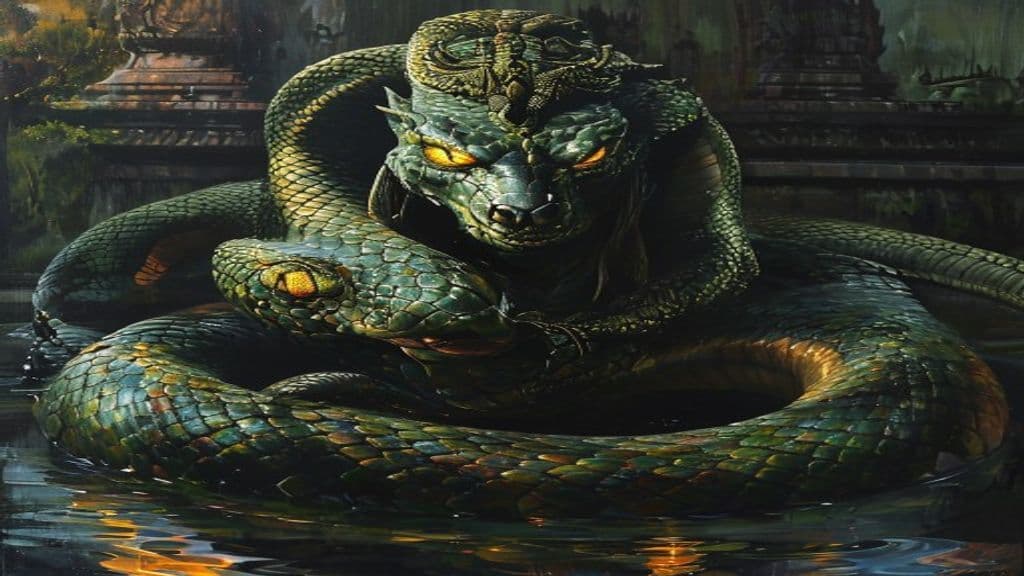
Naga
Divine serpent beings of Hindu, Buddhist, and Jain cosmology — powerful guardians of water, earth, and underground treasures. Revered as deities in South and Southeast Asia.

Ninhursag
Ninhursag is a principal Sumerian mother/earth/mountain goddess—literally 'lady of the sacred mountain'—associated with fertility, birth, creation, and the living earth; she appears across multiple Sumerian myths and served cultic and tutelary roles in Early Mesopotamian religion.
Abu
Abu is a poorly understood Mesopotamian god attested in modern reference summaries. Secondary literature tentatively links him with vegetation and snakes and records that he was often paired with a deity written gu2-la2, but primary details about his cult, iconography, and myths are lacking in the cited sources.
Alammuš
Alammuš is a Mesopotamian deity who functioned as the sukkal (attendant or court-official deity) of the moon god Nanna (Akkadian Sin). He is attested in offering lists, god-lists, oath formulas, legal and seal texts, and in Mesopotamian astronomical lists where he is paired with Ningublaga as the 'Little Twins.'
Alla
Alla (Alla‑gula) is a Mesopotamian underworld‑associated deity attested in Ur III and Old Babylonian texts. He functions in sources as the sukkal (attendant) of Ningishzida and is grouped with lamentation literature’s ‘dying gods’; many details of his character remain fragmentary and debated.
Amasagnudi
Amasagnudi is a late-attested Mesopotamian divine attendant (nin-sukkal) associated with the sky-god Anu. She appears primarily in lexical and god-list texts and was integrated into the Seleucid-period reorganization of Uruk's pantheon, where she is paired with the male attendant Papsukkal.
Antu
Antu (Antum) is a Mesopotamian goddess traditionally regarded as the feminine counterpart and spouse of the sky god Anu. Attestations range from Early Bronze Age references to a marked elevation of her cultic profile in Achaemenid and Seleucid-period Uruk, and in some late theological texts she is equated with earth or primordial and underworld figures.
Asalluhi
Asalluhi (also Asarluhi, Asarluhe, Asaralimnuna, Asaralim, Asalim, Asarnuna) is a Mesopotamian deity primarily associated with incantations and exorcism. He is described in some sources as a son of the god Enki and is likely identical with an earlier figure called Asar attested from the third millennium BCE.
Ea (Enki)
Enki (Akkadian Ea) is a major Mesopotamian deity associated with wisdom, crafts, fresh subterranean waters (the Abzû/Apsu), magic, and incantations. He functions as a benefactor of humankind and rulers, a source of ritual and healing authority, and the divine ruler of the subterranean freshwater domain called the Abzû.
Edimmu
In Mesopotamian religious tradition the edimmu are a type of utukku — restless, wind-like spirits of the improperly buried who can be vengeful, possessive, and life-draining; later popular media reinterprets them as vampire- or undead-styled monsters in games and fiction.
Erragal
Erragal (also Errakal, Errakalkal, Errakar, Erkal) is a Mesopotamian deity attested from the Isin‑Larsa through Neo‑Babylonian periods. He is polyvalent in function: identified with a star in the MUL.APIN tradition and invoked apotropaically in incantation series, associated in some texts with storm/destructive power and, in some contexts, linked to the underworld; scholarly opinion differs on whether he is distinct from, derived from, or an epithet of Erra.
Gibil (Girra)
Gibil (Akkadian Girra) is a Mesopotamian deity personifying fire in its constructive (furnaces, metallurgy, ritual purification) and destructive (lightning-set conflagrations, burning fields) aspects. He is attested in city cults (Shuruppak, Eridu, Nippur) and invoked in ritual and incantation literature (Maqlû, Šurpu, namburbi) for purification and counter-magic purposes.
Igigi
A class of younger heavenly beings in ancient Mesopotamian myth, the Igigi are attested chiefly as a subordinate, laboring cohort of gods contrasted with the higher-ranking Anunnaki; in the Atrahasis narrative they perform manual tasks for senior deities and at one point rebel from forced toil. The name is attested in Sumerian orthography (i-gi4-gi4, later í-gì-gì) and its ultimate lexical origin is unknown, though scribal spellings invite numerical wordplay.
Ilaba
Ilaba is a Mesopotamian deity attested from the Sargonic (Akkadian) period as the city god of Akkad and a tutelary war-god for Akkadian rulers. He is associated with a mace as his emblem, invoked in royal inscriptions, treaties, curse-formulae and continued to appear in post‑Akkadian cultic contexts.
Community Record
- [1]Lisin (Wikipedia). Wikipedia contributors, 'Lisin,' Wikipedia, The Free Encyclopediawiki
- [2]Wikidata: Lisin. Wikidata entry Q62389703 for Lisinother
- [3]Markham J. Geller on Udug Hul and ritual contexts (summary in source excerpts). Summary of academic discussions of Lisin's appearance in Udug Hul and ritual materials (as cited in the provided source excerpts)academic
- [4]MUL.APIN (astronomical compendium) reference (as summarized). Summary of MUL.APIN instruction regarding the star Lisin (as given in the provided source excerpts)academic