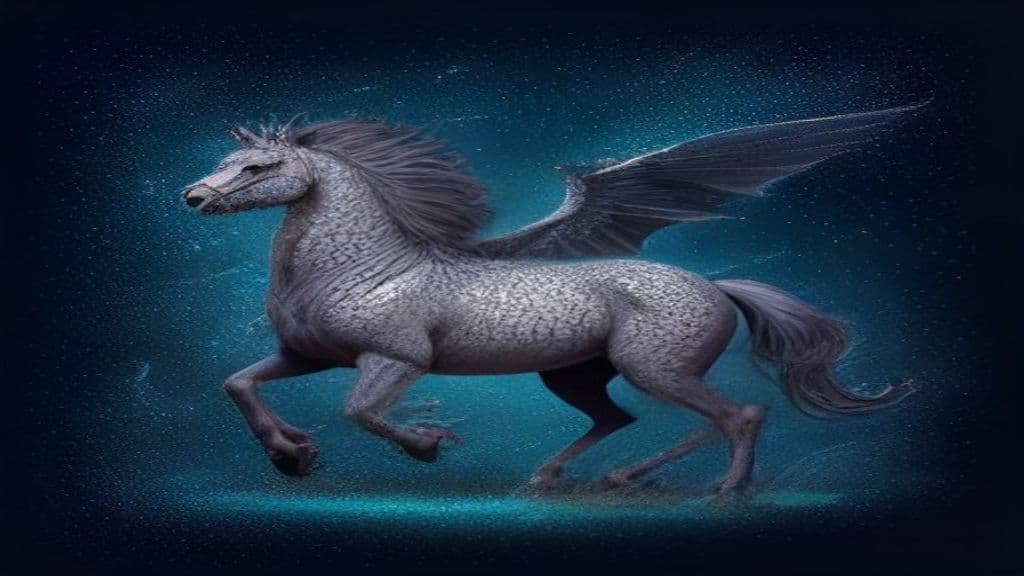
Classical commentaries and annals narrate that the longma emerged from river waters (notably the Yellow River and Lo River) bearing a patterned scheme or 'map' (the Hetu) on its back. Texts cited in the tradition include a Yijing commentary describing 'the water of the Ho sent forth a dragon horse; on its back there was curly hair, like a map of starry dots', Kong Anguo's Shujing commentary that links the longma to Heaven-and-Earth's vital spirit and notes it appears when a holy man sits on the throne, and the Bamboo Annals' account that a dragon-horse 'appeared, bearing in his mouth a scaly cuirass... ascended the altar, laid down the scheme, and went away.' Variants in sources assign the recipient of the Hetu to different culture-heroes (e.g., Fu Xi, Shun), but the common theme is the river-borne longma bearing cosmological designs to sage-rulers.
Classical descriptions present the longma as a composite: the body of a horse covered with dragon scales and—in some accounts—wings at its sides. A Yijing commentary describes 'on its back there was curly hair, like a map of starry dots,' indicating the patterned marking (the Hetu) associated with the creature. Kong Anguo's Shujing commentary explicitly gives the horse body plus dragon scales and notes that a 'true dragon horse has wings at its sides.' Sources vary in additional embellishments, but the consistent image is horse form + dragon integument, sometimes winged.
In the source tradition the longma's primary role is portent-bearing and mediation of divine patterns: it appears from rivers bearing the Hetu (Yellow River chart) or other schemes and thus functions as a natural-supernatural messenger validating or signaling sage-rulers. Classical commentaries attribute to it liminal powers connected with water—emerging from the river, and in Kong Anguo's Shujing commentary it 'walks upon the water without sinking'—and some accounts describe wings and flight. Later narrative usages sometimes extend the dragon-horse motif (for example, winged dragon-horses drawing imperial carriages in later legend), but the core attested behaviors in the supplied sources are river-appearance, bearing sacred patterns/maps, and acting as an omen of auspicious rulership.

Dragon (Long)
Long (龍, "dragon") is a pervasive cultural and artistic motif that appears in Taoist sacred-geographical contexts, Chinese literature, and modern exhibitions; the provided sources treat it as part of the broader mythic imagery present around Taoist sites and ritual scenes rather than as a single, consistently described doctrinal entity.
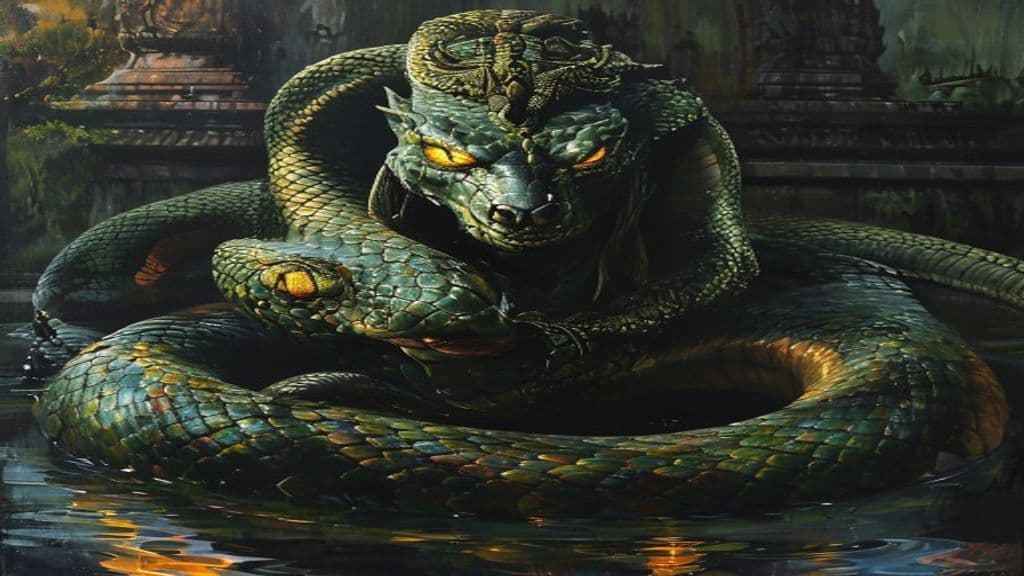
Naga
Divine serpent beings of Hindu, Buddhist, and Jain cosmology — powerful guardians of water, earth, and underground treasures. Revered as deities in South and Southeast Asia.
Ao Guang (Dragon King of the East Sea)
Ao Guang is the Dragon King (Dragon God) who presides over the East Sea (Dōng Hǎi) in Chinese mythology, literature, and folk-religion. He is presented in sources as a regional aquatic deity associated with water and weather and appears as a named supernatural figure in classical vernacular novels such as Journey to the West and Fengshen Yanyi.
Ao Kuang
Ao Kuang (also attested as Ao Guang) is the Dragon King of the East Sea in Chinese mythology and folk religion, one of a quartet of sea-dragon sovereigns associated in folklore with the cardinal seas. He appears in classical literature and later popular media as a ruler of maritime waters whose favor or displeasure is connected to tides, rain, floods and storms.
Asian dragon (long / loong)
The Chinese or Asian dragon (Chinese: long or loong) is a legendary creature in Chinese mythology, folklore, and culture, widely represented as an auspicious, potent being most commonly associated with control over water and weather. It appears across myth, art, and modern public performance rather than as a single folkloric apparition with standardized ritual responses.
Chinese dragon (long / loong)
A central legendary zoomorphic being in Chinese myth and culture (Chinese: long / loong), the dragon embodies auspicious cosmic and ancestral power, especially mastery over water and weather, and functions as an imperial and communal emblem across material culture, ritual performance, and state iconography.
Dilong (地龍)
Dilong (地龍; dìlóng, "earth dragon") is a category-name in Chinese dragon taxonomy denoting dragons associated with the earth/ground. The term is polyvalent in sources: it designates an earth-associated dragon-type in cosmological and omen literature, and by analogy names earthly animals (notably the earthworm) used in materia medica.
Eight Pillars (八柱, bāzhù)
The Eight Pillars (Chinese: 八柱, bāzhù) are a cosmological feature in Chinese mythology consisting of eight mountain-pillars located in the eight cardinal directions that function as supports/axes of the world, conduits between Earth and Heaven, and loci for paradises and supernatural inhabitants.
Feng Meng
Feng Meng (also spelled Beng Meng) is a figure from Chinese mythology described as the apprentice of the divine archer Houyi (Yi) who, driven by envy of his master's skill, murdered Houyi with a club made from a peach tree.
Four Holy Beasts
A set of four sacred animals in Chinese and broader East Asian cultural and astronomical tradition, mapped to the four cardinal directions and used as auspicious, protective, and cosmological symbols in literature, architecture, and material culture.
Fuxi
Fuxi (伏羲 / Fu Hsi) is a primordial culture-hero in Chinese myth credited in traditional accounts with establishing social institutions (marriage, family), teaching technologies (hunting, fishing, cooking, music), and originating systems of knowledge such as divination and the eight trigrams (ba gua). Frequently paired with Nüwa, he occupies a foundational role in prehistoric cosmology and ritual memory rather than a narrowly historical figure.
Gonggong
Gonggong is a legendary prehistoric Chinese figure, portrayed in literary and mythic sources as a powerful water-associated being whose destructive act damaged the cosmic supports of the heavens and caused great floods; his story functions as an etiological myth explaining river directions and certain celestial observations.
Huli jing (Fox spirit)
Huli jing (狐狸精), commonly rendered in English as "fox spirit," are shapeshifting supernatural beings from Chinese folklore and mythology. Classified among the broader class of yāoguài, they are morally ambivalent figures that may be benevolent, malevolent, or trickster-like depending on the tale and context.
Kuafu (夸父)
Kuafu is a mythic giant in Chinese tradition known for attempting to chase and capture the Sun; his pursuit is used etiologically to explain landscape features (drained rivers, a peach forest, and in some versions a mountain range) and proverbially as an emblem of audacious but ultimately futile striving.
Community Record
- [1]Longma - Wikipedia. Wikipedia entry 'Longma' summarizing classical sources and modern commentary (cites Yijing commentary, Kong Anguo's Shujing commentary, Bamboo Annals, and secondary treatments).wiki
- [2]Bamboo Annals (excerpt as cited). Bamboo Annals passage (as cited in secondary sources): 'Then a dragon-horse appeared, bearing in his mouth a scaly cuirass, with red lines on a green ground, ascended the altar, laid down the scheme, and went away.' (cited in Wikipedia summary).literary
- [3]Shujing commentary (Kong Anguo) — cited. Kong Anguo's Shujing commentary (as cited in Wikipedia): describes the dragon-horse as 'the vital spirit of Heaven and Earth... its shape consists of a horse's body, yet it has dragon scales... a true dragon horse has wings at its sides and walks upon the water without sinking.'literary
- [4]Yijing commentary (cited). Yijing commentary (as cited in Wikipedia): 'The water of the Ho sent forth a dragon horse; on its back there was curly hair, like a map of starry dots.'literary
- [5]SymbolSage: Longma: The Majestic Dragon-Horse of Chinese Mythology. Modern secondary summary discussing longma's symbolism, appearance, and cultural role (used for corroboration of descriptive material).other