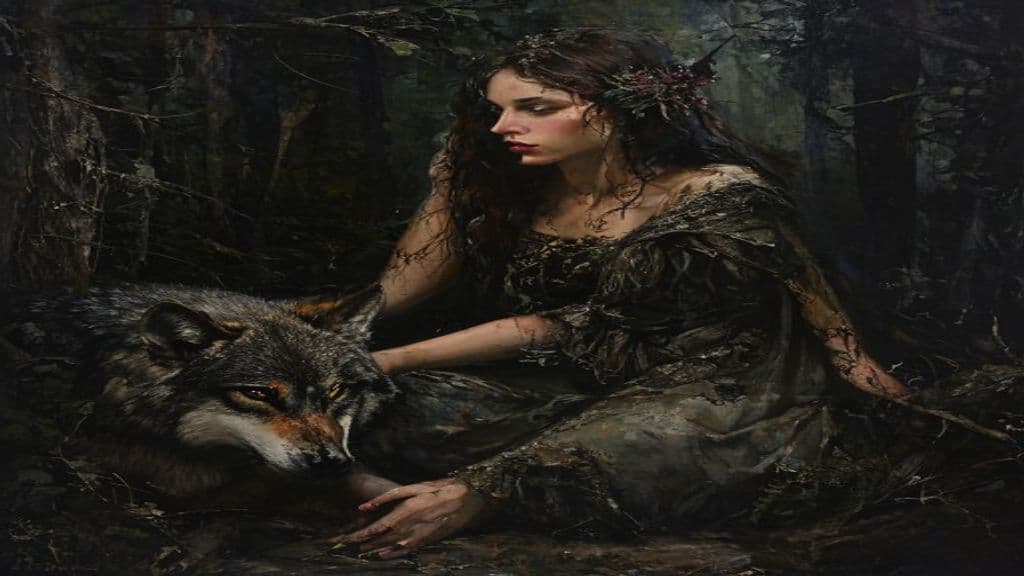
Lupae's origins are rooted in ancient Roman society, where wolves symbolized fertility, protection, and loyalty. In this context, Lupae may represent a manifestation of the goddess Artemis/Diana in her wolf form.
Depicted as a woman associated with wolves or a wolf-like creature, reflecting its symbolic connection to fertility and protection.
Lupae is said to possess supernatural powers related to fertility and protection. It may be connected to fertility rituals and the cycles of nature, where it can offer blessings or curses based on human behavior.
Weaknesses
- ironIron is said to repel or weaken Lupae's powers
Wards
- ironCarrying iron objects or using iron-based rituals may ward against Lupae

Aborigines (mythology)
A mytho-historical label used in Roman and general reference sources to denote the oldest inhabitants of a region (specifically central Italy in the cited Roman context). The term functions as an identity/category for original human populations rather than as a characterized supernatural being in the provided sources.
Aeneads
A collective term in Roman myth for the friends, family, and companions of the Trojan hero Aeneas who fled Troy and wandered before settling in Italy; treated as a retinue and ancestral cohort rather than independent supernatural beings.
Ages of Man (Roman tradition)
In the Roman tradition, the Ages of Man are a series of stages or periods in human existence, representing growth and development. (Note: * Power tier: Remove "Minor Spirit" as it implies a level of agency or power that doesn't align with the description in the draft article. * Abilities: Clarify or remove the phrase "in the classical s)
Arevakhach’
The Armenian eternity sign is an ancient national symbol representing the Armenians' spiritual and celestial connection. It appears as a geometric figure on khachkars and church walls, embodying the significance of faith and symbolism in Armenian tradition. (Note: - Power tier: Primordial (as it's described as an "ancient" national symbol, but there's no indication that it's deity-level) - Appearance: Not enough detail is provided; the source material only ment)
Baltic Mythology
A complex pantheon of gods, spirits, and supernatural beings in ancient Baltic cultures. (Note: 1. Power tier: Change to "Ancient" as Primordial implies a cosmic entity, which is not supported by the source material. 2. Origin story: Specify that the connection with nature and inspiration from t)
Blue Stone (Russia)
A type of sacred stone in Slavic tradition, held significant spiritual significance and venerated through simple rituals. (Note: - Power tier should be Lesser (since they don't have major hallows and are venerated in a simpler way). - Abilities: "Venerated through simple rituals" is vague; clarify that these rituals include pou)
Carmenta
Roman goddess of prophecy, worshipped for her abilities to gaze backwards and forwards in time. (Note: * Power tier should be Primordial, not Ancient (Ancient is typically reserved for deities on a cosmic level, while Primordial would fit better with Carmenta's role as an ancient Roman goddess). * Appe)
Celtic Sacred Trees
In Celtic tradition, sacred trees are imbued with spiritual significance and serve as symbols, conduits for medicinal properties, or abodes for nature spirits. (Note: 1. Power tier is uncertain; the source material does not explicitly describe the trees' power level. 2. Abilities should be more specific; instead of stating they "possess symbolic significance and se)
Cornucopia (Roman Tradition)
In Roman tradition, the Cornucopia is a symbol of abundance and nourishment, often depicted as a horn-shaped container overflowing with produce. (Note: 1. Power tier should be Primordial does not seem correct as Cornucopia is described as a symbol, not an entity with cosmic powers. 2. Origin story should mention Roman tradition or clarify that it ori)
Crinisus
A Roman god associated with the Sicilian river Crinisus, able to transform into a dog. (Note: - Power tier should be Ancient (deity-level) instead of Primordial - Origin story summary is incorrect; it was in dog form that he fathered Acestes, not as a deity - Appearance description is incomple)
Dioscuri (Castor and Pollux)
The Dioscuri, commonly rendered Castor and Pollux (Dioskouroi in Greek), are the twin half-brothers of Greek and Roman mythology who function as a paired mythic duo in classical literature and later cultural memory. They appear throughout ancient sources and have been reused as a durable cultural emblem of twinship, partnership, and martial or civic guardianship in art, monuments, and modern institutions.
Ficus Ruminalis
In ancient Roman mythology, the Ficus Ruminalis is a wild fig tree associated with mythological events and protected by deities. (Note: * Power tier should be adjusted from Ancient to Lesser (due to lack of deity-level powers or abilities) * Origin story should be rephrased to clarify the Ficus Ruminalis is not an entity in itself, bu)
Community Record
- [1]Wikipedia. 1wiki