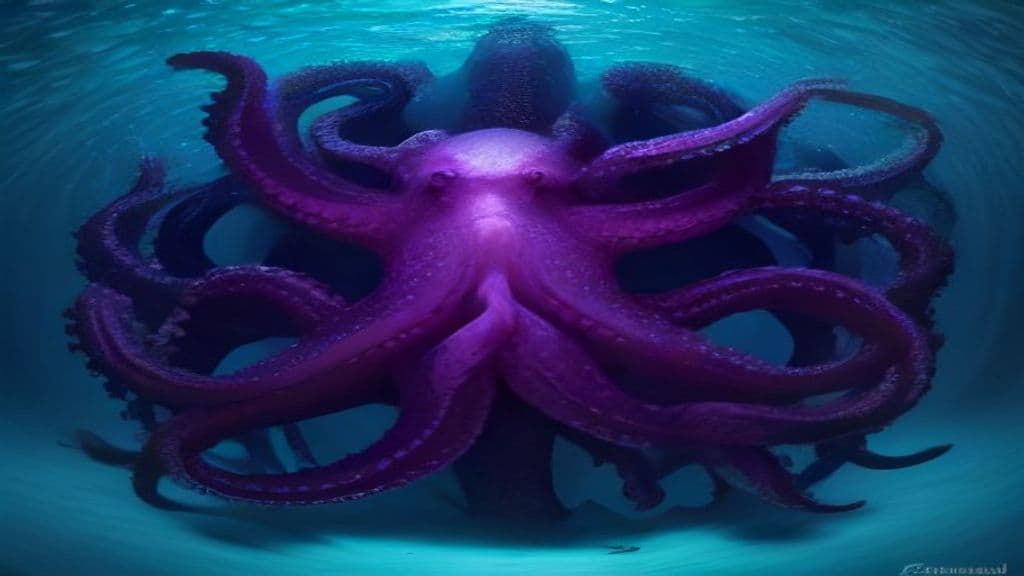
The name 'lusca' is reported as a clipped form of Mollusca, the biological phylum that includes octopus, squid, and cuttlefish, and in local accounts the term refers to a large mollusk-like sea monster said to inhabit blue holes and banana holes around Andros. Sources present the lusca within local warning traditions and accounts of hazardous sinkholes rather than as part of a documented religious or ritual origin narrative.
Descriptions vary in the sources: commonly rendered as a 'giant octopus' or 'giant cuttlefish,' sometimes as a hybrid such as 'half-shark, half-octopus' or 'half-octopus, half-dragon,' with emphasis on powerful, sucker-tipped tentacles. Reported size claims range widely in the folkloric record — from historical reports of large but plausible cephalopods (e.g., a 19th-century letter describing a 'colossal octopus' with several-foot arms and a multi-foot body) to later lore claiming armspans of many tens of feet.
Sources portray the lusca as a predatory aquatic creature that pulls swimmers, fishermen, and boats into blue holes and submerged caverns; guides use the creature in warnings to explain disappearances and to dissuade risky entry into sinkholes. While accounts attribute catastrophic strength (dragging victims and sinking small craft), this is presented in the sources as folkloric description rather than empirically established capability.
Weaknesses
- conditionNo traditional weaknesses recorded; practical avoidance advised
- otherGuides' warnings/avoidance of blue holes (documented preventative practice)
Wards
- conditionAvoidance — local guides warned visitors and fishermen not to enter blue holes
Luke Cage
Luke Cage is a fictional African-American comic-book superhero created for Marvel Comics in 1972. Portrayed as a formerly incarcerated man who gained superhuman strength and highly durable skin through an experimental procedure, he operates as a street-level hero—originally a 'Hero for Hire'—whose stories engage themes of race, class, and the criminal justice system.
Lulal
Lulal is a Sumerian-origin divine figure attested as a minor god and as an anthropomorphized protective being in Mesopotamian ritual practice. He functions mythically as an attendant or bodyguard of Inanna and pragmatically as an apotropaic presence deployed on amulets, bells, reliefs and clay statues to guard thresholds, baths, and courtyards.
Lumma
Lumma is a minor Mesopotamian deity attested in temple lists and incantations, functioning as a warrior-farmer and a guardian of the Ekur (Enlil’s temple) often invoked to seize or restrain harmful supernatural beings.
Luote
A magical Finnish incantation in Kalevala meter, serving as a tool for magic users to cast powerful spells. (Note: 1. Power tier: Primordial is too high, given that it's used for "powerful spells" rather than cosmic or deity-level effects. 2. Summary: Luote is an incantation, not a tool; it's the magic users who u)
Lupae
In Roman tradition, Lupae refers to a female wolf or prostitute symbolizing fertility and protection. (Note: - Power tier: Change to Ancient (deity-level) as Lupae's abilities and symbolism suggest a higher level of power than Primordial. - Abilities: Clarify that Lupae is associated with fertility and prote)
Lupercal
A Primordial entity associated with the mythological origins of Rome, connected to fertility and nurturing through its relationship with the she-wolf (Lupa). The Lupercal entity is linked to a cave at the southwest foot of the Palatine Hill in Rome. (Note: 1. The power tier should be reevaluated; being associated with fertility and nurturing through a mythological context does not necessarily imply Primordial-level powers. 2. Sensory cues are unknown ba)
Luxovius
Luxovius (Latinized Luxovios) is a local Gallo‑Roman god associated with the waters of Luxeuil (the sanctuary at Luxeuil‑les‑Bains). He is attested in votive inscriptions as a place‑bound healing/spring deity and is paired in the cult with a female consort, Bricta (Brixta). Etymology links his name to a Proto‑Indo‑European *leuk‑ 'light/whiteness', suggesting combined associations of light and curative waters in his character.
Lwa (Loa)
Lwa, also spelled loa, are spirit beings venerated within the African diasporic religion of Haitian Vodou and incorporated into some revivalist forms of Louisiana Voodoo. Many lwa identities derive in part from deities of West African traditions, especially Fon and Yoruba.
Lycaon (king of Arcadia)
Lycaon is a legendary early king of Arcadia in Greek myth, portrayed as an archetypal impious ruler whose filicidal crime and attempt to deceive Zeus function as a moral and etiological tale linking Arcadian genealogy to mythic origins.
Lycaon of Arcadia
Lycaon is a mythic king of Arcadia who, in the commonly attested classical version, murders and cooks his son to test Zeus's omniscience and is by divine retribution transformed into a wolf; the tale functions as an etiological and moral narrative about impiety and metamorphosis in Greek myth.
Lycastus
Lycastus (Greek Λύκαστος) is a personal name attested in Greek mythic and geographic tradition for several human figures and an eponymous place: a Cretan king in the Minos genealogies, an Arcadian twin/hero (son of Ares and Phylonome) exposed and suckled by a she‑wolf, a lover in a sacrificial tale, and an autochthonic eponym for a town in Crete.
Lycomedes
Lycomedes is attested in the provided sources as a human figure from Greek myth — the king of the Dolopians on the island of Scyros during the Trojan War — and as a modern reuse of the name in biological taxonomy and as an online contact/handle. The supplied material contains no evidence treating Lycomedes as a supernatural spirit.
Community Record
- [1]Lusca (Wikipedia article). Wikipedia, 'Lusca' (accessed via provided research notes)wiki
- [2]1872 letter reporting a 'colossal octopus' (as summarized in secondary sources). Summary of an 1872 report cited within the Lusca article (as summarized in the supplied materials)folk
- [3]Lusca Fantastic Film Fest (example of modern cultural reuse). Wikipedia entry noting modern cultural uses of the lusca name (provided in research notes)other