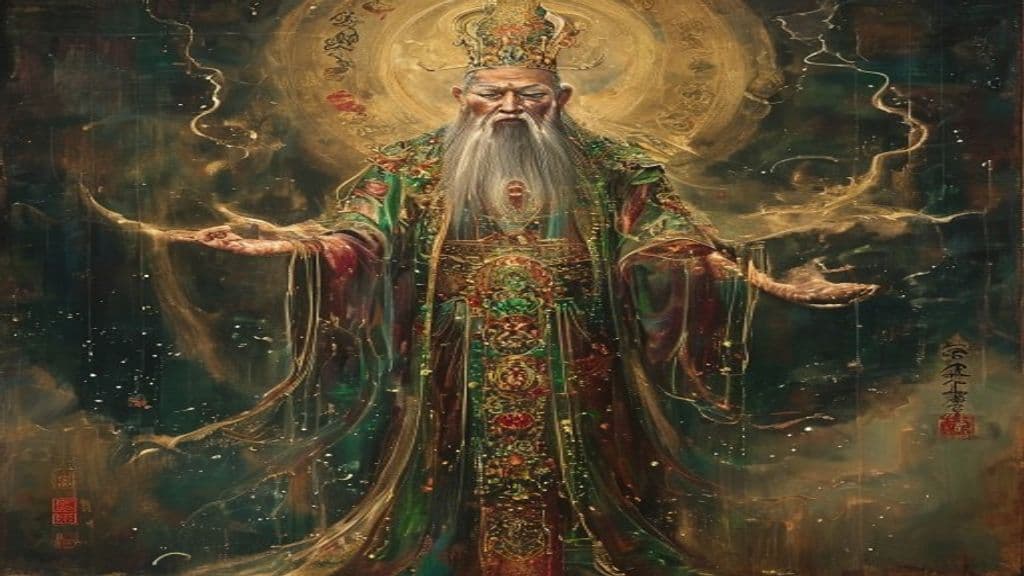
In Vietnamese cosmology, Ông Trời is one of the most important gods. He was later merged with the Jade Emperor.
Bà Chúa Xứ (Lady of the Realm)
Bà Chúa Xứ, also called Chúa Xứ Thánh Mẫu, is a localized tutelary and prosperity goddess in Vietnamese folk religion centered at Vĩnh Tế village at the foot of Sam Mountain, An Giang province. She is worshipped as a protector of business, health, and the Vietnamese border and attracts pilgrimages and a major three-day festival beginning on the 23rd day of the fourth lunar month.
Chang'e
Chang'e (嫦娥), originally attested as Heng'e and linked to the older name Chang Xi, is the female lunar immortal of Chinese myth who resides in the Moon Palace (廣寒宮). Best known from the elixir-of-immortality tale in which she ascends to the Moon and is accompanied there by the Jade Rabbit, she functions across religious and literary contexts as a lunar goddess/immortal and a poetic symbol of solitude and longing.
Chinese gods and immortals (shenxian)
A heterogeneous corpus of deities (shen) and immortals (xian) in Chinese religious and mythic thought, understood as manifestations or localizations of the cosmic principle (Tian/Tao/qì). They include celestial gods, local tutelaries, deified culture-heroes, and Taoist immortals formed and sustained by temples, ancestral ritual, and popular cult.
Cá Ông (Whale spirit / Whale God)
Cá Ông is the Vietnamese folk-religious spirit associated with large whales, venerated as a guardian of fishing communities. Coastal communities perform funerary burials for beached whales and hold festivals in the whales' honor, reflecting a protective, reciprocal relationship between fishermen and these whale-spirits.
Eight Immortals (八仙; Bā Xiān)
The Eight Immortals are a group of legendary xian (immortals) in Chinese mythology and popular Taoist-related religion, portrayed as once-human figures who attained transcendence. They function as exemplars of Taoist immortality, patrons of varied social roles, and popular auspicious figures in art, ritual cults, qigong, and martial arts.
Four Symbols (Sì Xiàng)
A set of four mythological creatures in Chinese cosmology—Azure Dragon, Vermilion Bird, White Tiger, and Black Tortoise‑Snake—serving as celestial asterisms and directional guardians integrated into ritual, astrological, and state symbolism.
Huang Shigong
Semi-mythological Taoist hermit and legendary scribe who imparted knowledge and wisdom through written texts. (Note: - Power tier: Primordial (since he's semi-mythological and a figure from ancient Chinese culture, but not explicitly stated as deity-level) - Appearance: "No physical description is provided in the so)
Hồn Ma (wandering spirit)
Hồn ma (also rendered ma, hồn, vong, or bóng ma) refers to wandering human souls in Vietnamese belief whose failure to be ritually integrated into the ancestor line leaves them roaming the living world. They are socially significant, implicated in everyday ritual practice, missing‑person searches, and the work of spirit mediums and ritual specialists.
Kitchen God (Zao Jun / Zao Shen)
The Kitchen God is a Chinese domestic deity associated with the household stove/hearth who monitors family conduct and annually reports that conduct to the Jade Emperor, influencing the household's fortunes. He is typically represented by a paper effigy or plaque kept above the stove and is the focal figure of year-end household rites around the Little New Year.
Ma (Vietnamese ghost)
Ma are wandering souls or spirits of the dead in Vietnamese cultural belief who, depending on ritual treatment, may become protective ancestors or remain restless ghosts that affect the living's luck and daily life. They are embedded in practices of ancestor worship, domestic offerings, and the work of spirit mediums.
Ma Da (ma đói) — Vietnamese "hungry ghost"
The supplied source corpus does not contain ethnographic or textual descriptions of Ma Da (ma đói) in Vietnamese tradition. Only two relevant fragments appear: the Vietnamese name for the Nīlakaṇṭha Dhāraṇī (Chú đại bi / Đại bi tâm đà la ni) and a note that auspicious/inauspicious days are recognized in Vietnam. No direct sourced information about ma đói’s attributes, rituals, or role is present in the provided materials.
Mazu
Mazu (媽祖) is a deified female protector of seafarers originating in Fujianese popular religion as the historical/legendary Lin Moniang. Venerated across Chinese folk religion, Taoist and Buddhist registers, and in coastal and diasporic Chinese communities (notably Taiwan), she functions as a tutelary sea goddess whose cult includes temples, imperial honorific titles, and large popular pilgrimages.
Community Record
- [1]