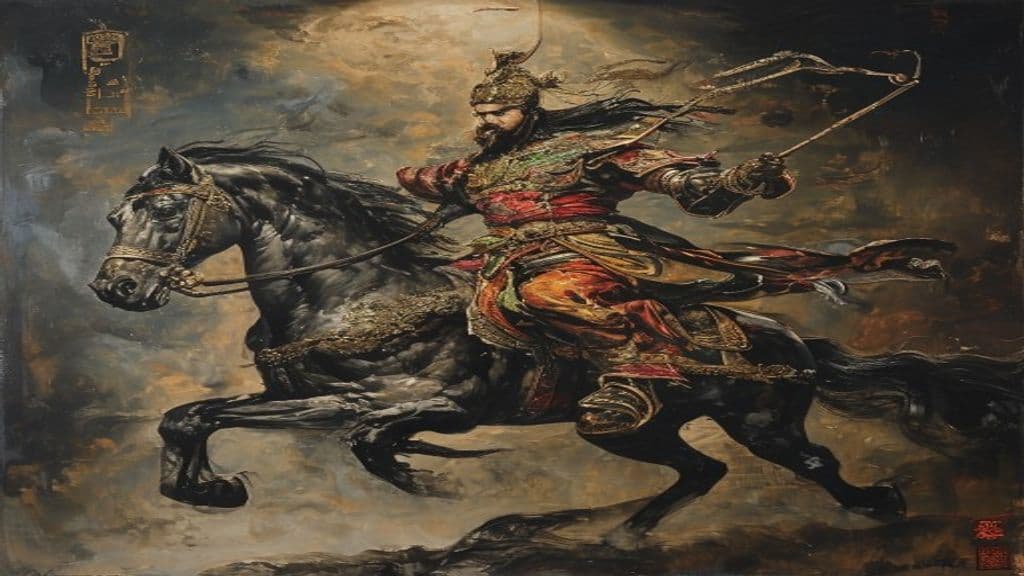
Traditional accounts (as summarized in modern retellings cited in the provided material) describe Gióng as a miraculous child who did not speak as an infant; when his people were threatened he grew rapidly into a giant warrior, accepted an iron horse and weapons, defeated invading enemies, and then ascended—being venerated thereafter. Modern sources characterize this cycle (birth as a boy who becomes a giant warrior, fights invaders on an iron horse, and is subsequently sainted) as the core legend that makes him a national culture-hero and one of Vietnam's Four Immortals.
Source summaries portray Thánh Gióng as a 'warrior giant' or heroic martial figure. Traditional elements attributed to his iconography in popular summaries include a rapidly grown giant youth in warrior garb, armed with iron weaponry and mounted on an iron horse that bears him in battle and later departs with him to heaven. The provided sources do not supply detailed, consistent iconographic descriptions or measurements.
Summarized legends credit Gióng with miraculous rapid growth from child to giant and extraordinary martial prowess sufficient to rout invading forces; he rides an iron horse and uses iron weaponry. As one of the Four Immortals and a sainted figure in popular religion, his role in cultural practice is protective and exemplary rather than malevolent—he is invoked as a symbol of courage and patriotic defense. The supplied materials do not enumerate other supernatural powers or ongoing interventions in daily life.
Bà Chúa Xứ (Lady of the Realm)
Bà Chúa Xứ, also called Chúa Xứ Thánh Mẫu, is a localized tutelary and prosperity goddess in Vietnamese folk religion centered at Vĩnh Tế village at the foot of Sam Mountain, An Giang province. She is worshipped as a protector of business, health, and the Vietnamese border and attracts pilgrimages and a major three-day festival beginning on the 23rd day of the fourth lunar month.
Cá Ông (Whale spirit / Whale God)
Cá Ông is the Vietnamese folk-religious spirit associated with large whales, venerated as a guardian of fishing communities. Coastal communities perform funerary burials for beached whales and hold festivals in the whales' honor, reflecting a protective, reciprocal relationship between fishermen and these whale-spirits.
Hồn Ma (wandering spirit)
Hồn ma (also rendered ma, hồn, vong, or bóng ma) refers to wandering human souls in Vietnamese belief whose failure to be ritually integrated into the ancestor line leaves them roaming the living world. They are socially significant, implicated in everyday ritual practice, missing‑person searches, and the work of spirit mediums and ritual specialists.
Ma (Vietnamese ghost)
Ma are wandering souls or spirits of the dead in Vietnamese cultural belief who, depending on ritual treatment, may become protective ancestors or remain restless ghosts that affect the living's luck and daily life. They are embedded in practices of ancestor worship, domestic offerings, and the work of spirit mediums.
Ma Da (ma đói) — Vietnamese "hungry ghost"
The supplied source corpus does not contain ethnographic or textual descriptions of Ma Da (ma đói) in Vietnamese tradition. Only two relevant fragments appear: the Vietnamese name for the Nīlakaṇṭha Dhāraṇī (Chú đại bi / Đại bi tâm đà la ni) and a note that auspicious/inauspicious days are recognized in Vietnam. No direct sourced information about ma đói’s attributes, rituals, or role is present in the provided materials.
Mụ bà (Mười hai Bà mụ)
A collective of twelve female tutelary figures in Vietnamese folk religion who act as midwives and household guardians of newborns, responsible for teaching infants early life skills and auspicious traits. They are ritually acknowledged in some regions at a special ceremony when a baby is one month old.
Thánh Trần
Vietnamese venerated ancestor spirit and national hero associated with bravery, loyalty, protection, and national pride. (Note: - Power tier: Minor Spirit (as it is an ancestor spirit and not a deity) - Abilities: add that these qualities are believed to be bestowed upon people through his worship, such as protection from harm)
Thứ phi Hoàng Phi Yến
Legendary figure and imperial concubine from Vietnamese tradition, known for her involvement with Lord Nguyễn Phúc Ánh and the fate of their son, Prince Cải. (Note: 1. The power tier should be Primordial -> Ancient (Her abilities seem more deity-level, influencing Lord Ánh's decisions and having an impact on those around her). 2. The summary should mention that t)
Ông Trời
In Vietnamese tradition, Ông Trời is a high-ranking deity associated with the divine realm and later merged with the Jade Emperor. (Note: 1. The power tier should be Primordial, not Ancient, since Ông Trời is described as one of the most important gods in Vietnamese cosmology. 2. Add information about Ông Trời's appearance, abilities, s)
Ông Táo (Kitchen God)
Ông Táo is the Vietnamese household/kitchen deity who serves as the family's advocate before higher gods and as an emissary between heaven and earth, especially salient in New Year (Tết) ritual contexts.
Thành Hoàng
A local Vietnamese deity protecting villages from natural disasters and calamities. (Note: - Power tier should be Lesser, as they are local spirits. - Summary is accurate but could be expanded. - Origin story is missing; include source material description of how these spirits came to be en)
Thánh Tông di thảo
A collection of 19 tales in the truyền kỳ (traditional Vietnamese folktales) genre, written by Emperor Lê Thánh Tông during his reign in 15th-century Vietnam. (Note: 1. Power tier: Lowered to Greater, as there's no indication of Primordial-level powers. 2. Origin story: Simplified to focus on Lê Thánh Tông's promotion of Confucian learning and his writing in Liter)
Community Record
- [1]Thánh Gióng: The Vietnamese Warrior Giant of National Pride | Mythlok. "Thánh Gióng, one of the most celebrated figures in Vietnamese mythology... Also known as Saint Gióng, he is recognized as one of the Four Immortals in Vietnamese spirit"folk
- [2]Religion in Vietnam (Wikipedia summary used as source context). "The majority of Vietnamese do not follow any organized religion, instead participating in one or more practices of folk religions, such as venerating ancestors, or praying to deities, especially during Tết and other festivals."wiki
- [3]Vietnam’s UNESCO-recognised intangible cultural heritage | VietnamPlus. Contextual source noting Vietnam's documentation and protection of intangible cultural heritage, situating legendary figures like Thánh Gióng within living cultural forms.other
- [4]Vietnam's 15 elements on UNESCO-recognised intangible cultural heritage list | VietnamPlus. Contextual source on intangible heritage in Vietnam; used to contextualize the cultural role of legendary figures and festive veneration.other
- [5]Thánh Gióng. Wikipedia articlewiki