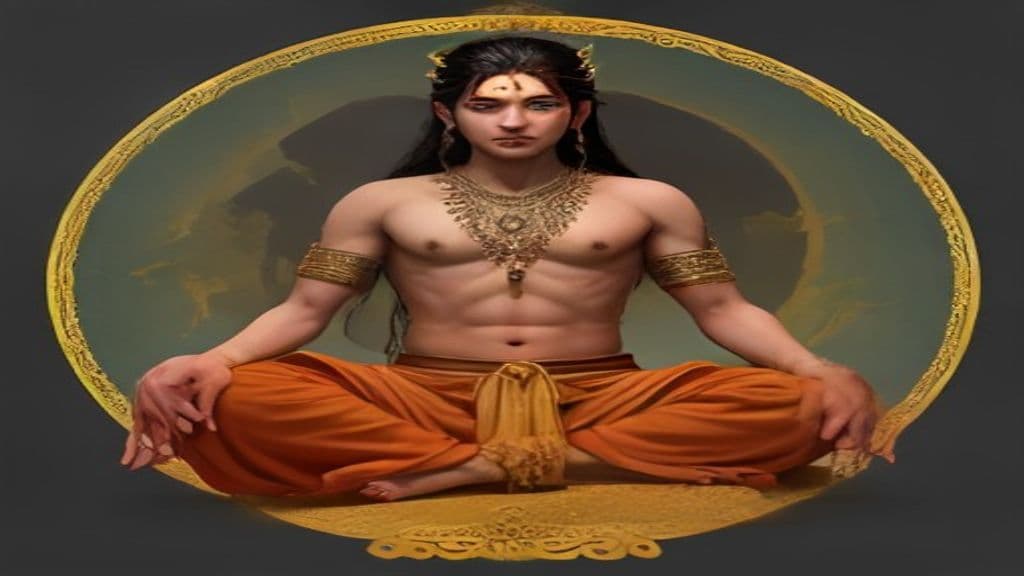
In the epic corpus Malyavan is named as a son of Sukesha and brother of Mālī and Sumālī, placing him in a familial leadership line among rākṣasas and allied groups. He is attested across Sanskrit sources and regional retellings as an elder counsellor in Rāvaṇa's court; after Rāvaṇa's death some accounts record his continued prominence as chief counsellor to Vibhīṣaṇa. The supplied sources do not provide a mythic birth narrative or further cosmogonic origin beyond these genealogical and courtly affiliations.
The provided materials do not include a detailed physical description. Malyavan is identified principally by his social role, kinship (son of Sukesha; brother of Mālī and Sumālī) and court position rather than by distinctive corporeal features in the cited excerpts.
Malyavan's principal portrayed ability is juridical and political: he is a learned counsellor versed in śāstras and statecraft who gives prudent advice (notably urging alliance with Rāma and the return of Sītā). In the Thai Ramakien he is shown conducting fair witness investigations and issuing authoritative orders. Some secondary and puranic summaries list him among rākṣasa leaders who oppose the gods in broader mythic lists, but the core epic emphasis is on his advisory, judicial, and continuity-of-institution role rather than overt supernatural feats.
Maliu
Maliu is not documented in the provided sources as a supernatural being; rather the token 'Maliu' appears in Samoan-language news meaning 'death'/'to die', as a phrase in Hawaiian song titles and lyrics ('E Maliu Mai'), and as a personal name in Polynesian contexts. No mythological origin, appearance, powers, or rituals associated with a spirit named Maliu are attested in the supplied materials.
Maliyadeva
Maliyadeva is a revered early Sri Lankan Buddhist monk and arahant preserved in Theravādin chronicle tradition. Credited in summaries of the Mahavamsa with arahantship and high psychic powers (abhiññā), he is associated in local tradition with specific meditation sites and modern commemorations in Sri Lanka.
Malkuth (מַלְכוּת)
Malkuth is the tenth sefirah on the Kabbalistic Tree of Life, the lowest sphere representing the manifest world or 'Kingdom'. It functions as the receiving endpoint of the divine emanations, the realm of material existence (the World of Assiah), and a symbolic locus for humility, embodied action, and the Shekhinah in Zoharic material.
Mallinātha
Two distinct historical/religious figures share the name Mallinātha in the supplied sources: (1) Mallinātha Sūri, a medieval South Indian Sanskrit commentator known for Sanjivani commentaries on the five mahākāvyas; and (2) Mallinātha (Mālliṇātha), the 19th tīrthaṅkara in Jain tradition, listed as a ford-maker born at Mithilā into the Ikshvaku lineage.
Mallku (mountain condor spirit)
The provided source does not describe a supernatural Mallku; it records Mallku as an epithet or name used by a modern Bolivian political figure, Felipe Quispe Huanca. There is insufficient information in the source to characterize Mallku as an entity within Inca or Andean cosmology.
Malphas
Malphas is a named infernal officer in early modern European grimoire tradition, described as a high-ranking Great President of Hell who commands forty legions and who appears to conjurers in ritual contexts, most commonly as a raven or, on request, as a hoarse-voiced man.
Mam
Mam is a pan‑Maya kinship term used as a respectful appellation for aged ancestral powers and several local elder deities. It names a set of distinct local figures—mountain spirits, earth deities, a ritual straw effigy used during the Uayeb, and particular cult figures such as the Tzutujil Mam Maximón—each tied to specific places, seasons, or social domains.
Mama Huaco
Mama Huaco is an ancestral female figure in Inca origin narratives who emerges from the cave of Paqariq Tampu/Pacaritambo among the founding siblings; sources describe her as strong and skillful and record an act in which she hurled two golden staffs northward, an action tied to territorial marking in the origin cycle.
Mama Ipacura
A name that appears in some modern mentions as a feminine figure associated with Inca origin-cycle narratives; however, the supplied source set contains no primary descriptions or attestations of Mama Ipacura as a distinct, historically documented mythic personage. Most statements about her must therefore be treated as uncertain and extrapolated from the general category of Inca "Mama-" founding women.
Mama Killa (Mama Quilla)
Mama Killa (Quechua: Mama Killa / Mama Quilla, 'Mother Moon') is the Inca lunar goddess and a high-ranking divine figure whose cycles regulated time, ritual order, and aspects of women's social life. She is depicted as a moon-personified woman, served by priestesses, and figured in myths explaining lunar spots and eclipses.
Mama Ocllo
Deified mother and fertility goddess associated with the establishment of the city of Cusco and foundational power within Inca society. (Note: - Power tier: Primordial (due to her association with creation and foundational power) - Abilities: The text only mentions reproductive and maternal care powers, but it is likely that Mama Ocllo's abi)
Mama Ocllo Coya
Mama Ocllo Coya (fl. 1493) is recorded in the supplied sources as a princess and queen consort (Coya) of the Inca Empire, wife of Sapa Inca Topa Inca Yupanqui and mother of Huayna Capac. Described in historical and legendary accounts as politically active and influential, she is credited with a stratagem in a Chimor episode and with decisive action to secure her son's succession.
Community Record
- [1]Malyavan - Wikipedia. Wikipedia: Malyavanwiki
- [2]Valmiki Ramayana - Yuddha Kanda - Sarga 36 (translations/summaries). Valmiki Rāmāyaṇa, Yuddha Kaṇḍa Sarga 36 (online translation/summaries)literary
- [3]Valmiki Ramayanam (Archive). Archive: Valmiki Ramayanamliterary
- [4]The Ocean Of Story Vol. 1 (Archive). The Ocean of Story (secondary retellings and summaries)other
- [5]Malyavan (Mythology/Encyclopedia entry). Mythology/folklore encyclopedia entry for Malyavanfolk
- [6]Hare Krsnas - Battles of Vishnu Avatars - Malyavan, Mali and Sumali. Hare Kṛṣṇa movement summary discussing Malyavan and kinother