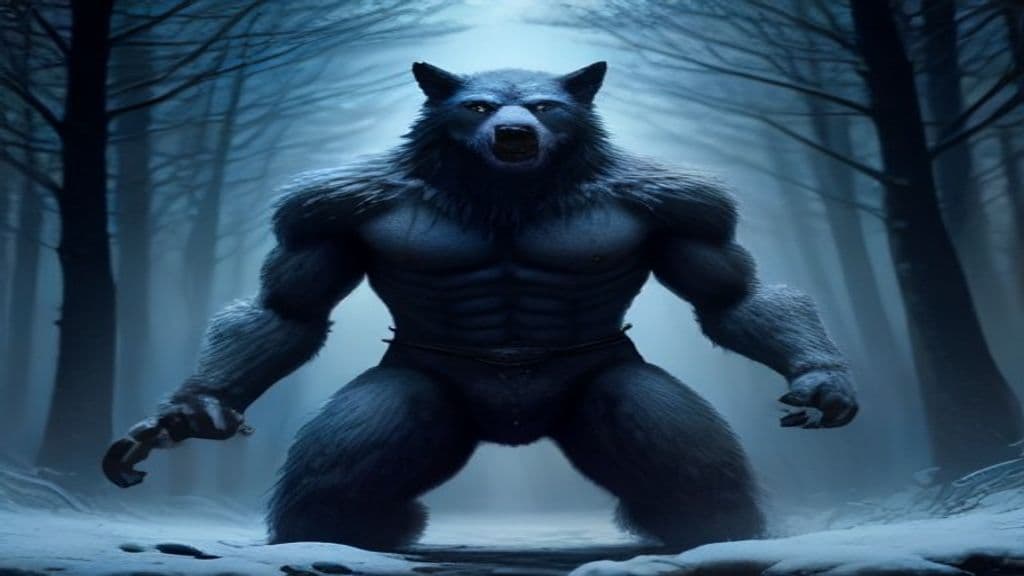
Maugrim is a literary creation of C. S. Lewis appearing in the 1950 novel The Lion, the Witch and the Wardrobe. Within Narnian cosmology he is one of the Talking Animals — animals that possess speech, agency, and moral choice — who allied himself with the White Witch during her Hundred-Year Winter. Editorial history of the text records that in early American editions Lewis altered the name to "Fenris Ulf" (an explicit allusion to the Norse wolf Fenrisúlfr), but later editions restored the original name and since 1994 the character has been consistently presented as Maugrim. He recurs in the narrative as the White Witch's chief enforcer until he is slain by Peter Pevensie, an event that functions narratively as both martial defeat and symbolic restoration of order (Peter is thereafter styled "Sir Peter Wolfsbane").
The book describes Maugrim as "a huge grey beast – its eyes flaming – far too big to be a dog." Adaptations emphasize or vary this base image: the 1988 BBC production depicts a humanoid wolf-like form in scenes of speech and combat and a more natural wolf when standing guard or mortally wounded, while the 2005 film presents him as a very large, aggressive wolf in action sequences. Canonical textual detail centers on great size, grey fur, and flaming eyes.
Maugrim's recorded abilities in the sources are martial and social rather than supernatural in the cosmic-altering sense. He functions as the Captain of the White Witch's Secret Police and commands subordinate wolves, carrying out orders to arrest and kill (for example, raiding and effecting the arrest of Mr. Tumnus, being sent with wolves to the Beavers' house, and taking positions at the Stone Table). He is a Talking Animal with fluent speech used for intimidation and issuing commands (he conveys Edmund's message to the Witch and interrogates other creatures in adaptations). He demonstrates physical strength and combat skill sufficient to threaten human children and other creatures but is vulnerable to and ultimately slain in armed combat by Peter Pevensie.
Weaknesses
- conditionvulnerable to armed combatants / mortal wound
- conditionloss of protection from the White Witch (operates as an agent rather than an immortal force)
Wards
None recorded.
Hwin
Hwin is a fictional talking mare from C. S. Lewis's The Chronicles of Narnia, prominently featured in The Horse and His Boy (1954). She is a Narnian free-talking beast characterized by humility, clear thinking, and gentle temperament, who was captured in Calormen as a foal and later escapes back to Narnia.
Jill Pole
Jill Pole is a fictional English schoolgirl created by C. S. Lewis who appears as a protagonist in The Silver Chair and The Last Battle of The Chronicles of Narnia. In the narrative she is called by Aslan into Aslan's Country and sent to Narnia to undertake a quest and later to take part in the final events of Narnia.
Mr. Beaver
Mr. Beaver is a fictional anthropomorphic beaver character who appears in the secondary world of C. S. Lewis's The Chronicles of Narnia. The provided sources identify him only as a character entry in lists/databases of Narnia characters.
Polly Plummer
Polly Plummer is a fictional human character created by C. S. Lewis who appears as a child in The Magician's Nephew (set 1900) and later as an adult in The Last Battle. She is a practical, emotionally steady companion to Digory Kirke, participates in inter-world travel via Uncle Andrew's rings and the Wood between the Worlds, and after her death in The Last Battle is transported to Aslan's country.
Matsigenka spirits and demons
In Matsigenka ethnography, a class of active lesser supernatural beings—commonly rendered in English as "spirits and demons"—are held to influence everyday life, while remote creator gods are viewed as withdrawn. Shamans historically mediated with these beings; today many functions are performed by healers amid increasing Christianization and cultural change.
Matsés (animist tradition)
The Matsés are an Indigenous people of the Peruvian and Brazilian Amazon whose worldview is animist: there is no strict separation between physical and spiritual worlds, and animals, plants and trees are inhabited by spirits that shape health, hunting success and medicinal efficacy. The supplied sources document this distributed set of nonhuman persons and shamanic practices (including sapo frog medicine) rather than a single named supernatural entity.
Mau rākau (Māori martial art)
Mau rākau is a traditional Māori martial art emphasizing physical and spiritual discipline, practiced by warriors in New Zealand. (Note: * Power tier should be Primordial, as the article states it was practiced by warriors in New Zealand, which implies a high level of cultural and spiritual significance. * The ability to wield traditio)
Maudgalyayana
Maudgalyayana is a devout spiritual practitioner and one of the Buddha's closest disciples, revered as the second foremost male disciple in Buddhist tradition. (Note: - The power tier should be Ancient, not Greater, given his attainment of enlightenment shortly after ordination. - There is no mention of a search for spiritual truth with Śāriputra in the source mate)
Mavka (Nyavka)
A female forest spirit in Ukrainian folklore, the mavka (also nyavka) represents the soul of a girl who died prematurely or unnaturally. Mavkas are ambivalent: various accounts portray them as alluring, dangerous seductresses who may lure men to death, while other local beliefs credit them with tending cattle and protecting flocks.
Mavroneri
A metaphorical entity associated with the River Styx, serving as a boundary between the mortal world and the underworld. (Note: 1. Power tier is incorrect; Primordial is typically associated with cosmic entities, but Mavroneri's abilities are related to a specific geographical location (the River Styx) rather than cosmological)
Mavuika
Mavuika is a fictional, in‑world divine figure in the video game Genshin Impact who functions as Natlan's Pyro Archon. Presented as a formerly mortal warrior who gained the Archon office, she drew on the power of the Ruler of Death to sacrifice herself to postpone a war for 500 years and is later resurrected in the game's current timeline.
Maximón (San Simón)
Maximón is a syncretic Maya folk deity and folk saint venerated in the Guatemalan Highlands (notably Santiago Atitlán and Zunil). He is an ambivalent, worldly figure—commonly represented by household or community effigies—that receives offerings (cigars, liquor, flowers, bread) and serves as a local mediator for petitions and favors. His identity and stories vary by town and combine pre-Hispanic Maya elements with Christian saint imagery, sometimes including associations with Judas Iscariot or Saint Simon.
Community Record
- [1]Maugrim - Wikipedia. Wikipedia article 'Maugrim' (accessed edition notes and character description)wiki
- [2]Maugrim | Villains Wiki. Villains Wiki entry on Maugrim (adaptation and character notes)other
- [3]Maugrim vs Wolves | Scanner (Bandcamp). Band/track using the name Maugrim (example of cultural afterlife and appropriation)other