
Polly Plummer is introduced as an 11-year-old London girl in The Magician's Nephew. She becomes involved when she and Digory Kirke receive rings crafted or distributed by Uncle Andrew, which cause them to vanish into the Wood between the Worlds. Through its pools they visit other worlds (including the ruined world of Charn) and then witness Aslan's creation of Narnia; she later remains one of the lifelong "friends of Narnia" who are summoned to aid the land and, after dying in a railway accident as described in The Last Battle, is transported to Aslan's country.
As depicted in the cited summaries, Polly is an 11-year-old girl in The Magician's Nephew (set in 1900) noted more for her practical steadiness than for detailed physical traits. In The Last Battle she appears as a 60-year-old adult in earthly chronology; after death she and Digory are described as becoming young again and being dressed as royalty (referred to as Lady Polly). The available sources supply no further consistent physical description.
Polly possesses no intrinsic supernatural powers in the sources. Her notable capacities are moral and behavioral: practicality, caution, emotional steadiness, loyalty, and friendship which balance Digory Kirke's temperament. She participates in magical events (travel via Uncle Andrew's rings and the pools of the Wood between the Worlds; witnessing Aslan's creative act) but these are narrative mechanisms and not presented as personal magical abilities. She is later among the human "friends of Narnia" who are received into Aslan's country after death.
Weaknesses
- conditionMortal vulnerability (dies in a railway accident as related in The Last Battle)
Wards
- otherNone (no wards or protections against Polly are attested in the cited sources)

Digory Kirke
Digory Kirke is a human fictional character created by C. S. Lewis in The Chronicles of Narnia. He appears as a child in The Magician's Nephew, as the elderly 'Professor' in The Lion, the Witch and the Wardrobe, and is included in Lewis's narrative chronology that places his death in a 1949 railway accident and his subsequent presence in the renewed Narnia/Aslan's Country within the fiction.
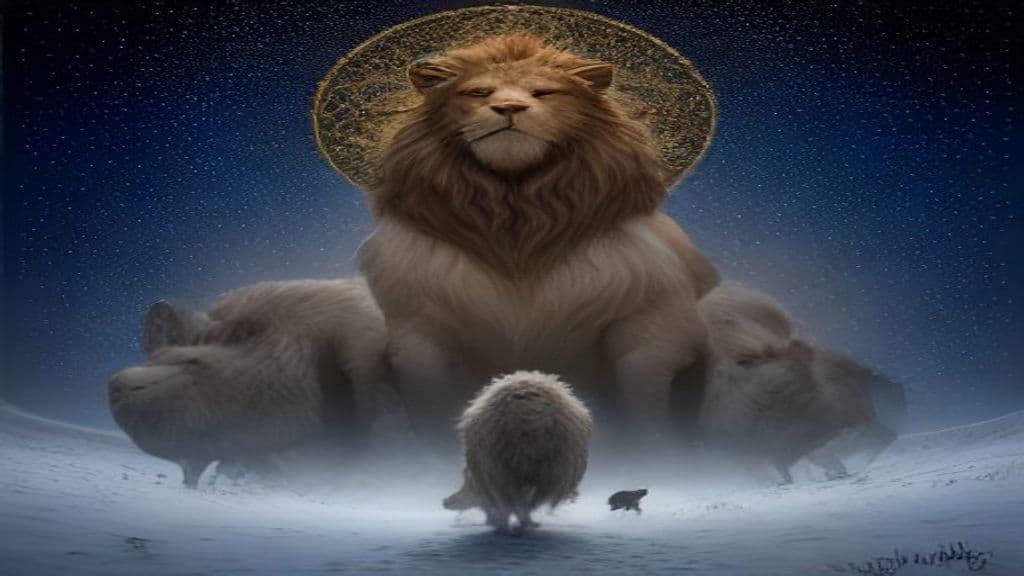
Aslan
Aslan is the singular, talking lion figure at the center of C. S. Lewis's The Chronicles of Narnia, functioning as creator, king, judge, savior, and moral authority within that fictional cosmology. The name also appears in unrelated contexts (personal names, a lion-like alien in Traveller RPG) but those are distinct referents.
Hwin
Hwin is a fictional talking mare from C. S. Lewis's The Chronicles of Narnia, prominently featured in The Horse and His Boy (1954). She is a Narnian free-talking beast characterized by humility, clear thinking, and gentle temperament, who was captured in Calormen as a foal and later escapes back to Narnia.
Jill Pole
Jill Pole is a fictional English schoolgirl created by C. S. Lewis who appears as a protagonist in The Silver Chair and The Last Battle of The Chronicles of Narnia. In the narrative she is called by Aslan into Aslan's Country and sent to Narnia to undertake a quest and later to take part in the final events of Narnia.
Maugrim
Maugrim is a fictional Talking Animal — a large, sentient Narnian wolf — who serves as the Captain of the White Witch's Secret Police in C. S. Lewis's The Lion, the Witch and the Wardrobe. He functions as an armed enforcer of the Witch's tyranny, is described as very large and fearsome, and is ultimately killed in single combat by Peter Pevensie.
Mr. Beaver
Mr. Beaver is a fictional anthropomorphic beaver character who appears in the secondary world of C. S. Lewis's The Chronicles of Narnia. The provided sources identify him only as a character entry in lists/databases of Narnia characters.
Poemenius
Poemenius (Ancient Greek: Ποιμένιος, Poimenios) is a personal name of Greek origin borne by multiple historical and literary figures in Late Antiquity and later periods. In the supplied sources it functions as a proper name for distinct human persons — most prominently a mid-4th-century Roman officer who seized Trier, several Christian clerics/bishops attested in patristic correspondence, and an attested name-entry as a leader of satyrs in a mythological name-list — rather than a single supernatural being.
Pohjola
Location in Finnish mythology and a central figure in the Kalevala epic. (Note: 1. Summary should mention that Pohjola is a central figure in the Kalevala epic, but also clarify that it is a location, not just a character. 2. Power tier: Lesser (not Greater), as Pohjola does not )
Polevik
A Slavic field spirit associated with cultivated fields and agricultural labour. Traditional accounts depict Polevik as a field-dwelling being encountered by peasants and travellers (especially at noon or sunset) that can mislead, punish, or occasionally be negotiated with by offerings.
Polkan
Polkan (Полкан, Палкан) is a legendary East Slavic folktale hybrid—variously half-human/half-horse or half-human/half-dog—known from the Bova Korolevich (Buovo) narrative cycle as an exceptionally powerful warrior who first opposes and then becomes the sworn companion and protector of the hero.
Polong
A Malay familiar spirit produced from human blood and kept in a bottle by a human owner; it is deployed to afflict victims by possessing them, typically preceded by a smaller insect-like helper (pelesit). Victims are cured when the spirit is called off by its owner or through a shamanic exorcism that forces the polong to name its human 'parent.'
Poltergeist
A poltergeist is a German-derived ghostlore label for an unseen agent associated chiefly with noisy, kinetic, and disruptive physical phenomena in domestic settings. Modern summaries and case literature emphasize episodic outbreaks of object movement, loud noises, and occasional assaults or electrical/foul-smell disturbances, with competing explanations ranging from spirit activity to hoax, psychogenic projection, or natural physical causes.
Poludnitsa (Lady Midday / Noonwraith)
A Slavic folkloric personification of the dangers of the midday hour, depicted as a young woman who appears in agricultural fields at noon and is held responsible for heat-related collapse, neck pains, and occasional madness.
Polyboea
Polyboea (Ancient Greek Πολύβοια) is a name applied to several related personae in Greek myth and local cult — most notably a maiden of Amyclae (sister of Hyacinthus) who died a virgin and was reputed to have been taken to Elysium or admitted into the train of Artemis. The same name appears elsewhere in mythic genealogies and, in modern taxonomy, as a genus of Asian nursery-web spiders.
Community Record
- [1]Polly Plummer - Wikipedia. Wikipedia contributors. "Polly Plummer." Wikipedia, The Free Encyclopedia.wiki
- [2]Polly Plummer - Wikidata. Wikidata entry Q2206150 for Polly Plummer.wiki
- [3]Digory Kirke - Wikipedia. Wikipedia contributors. "Digory Kirke." Wikipedia, The Free Encyclopedia. (used for contextual association)wiki