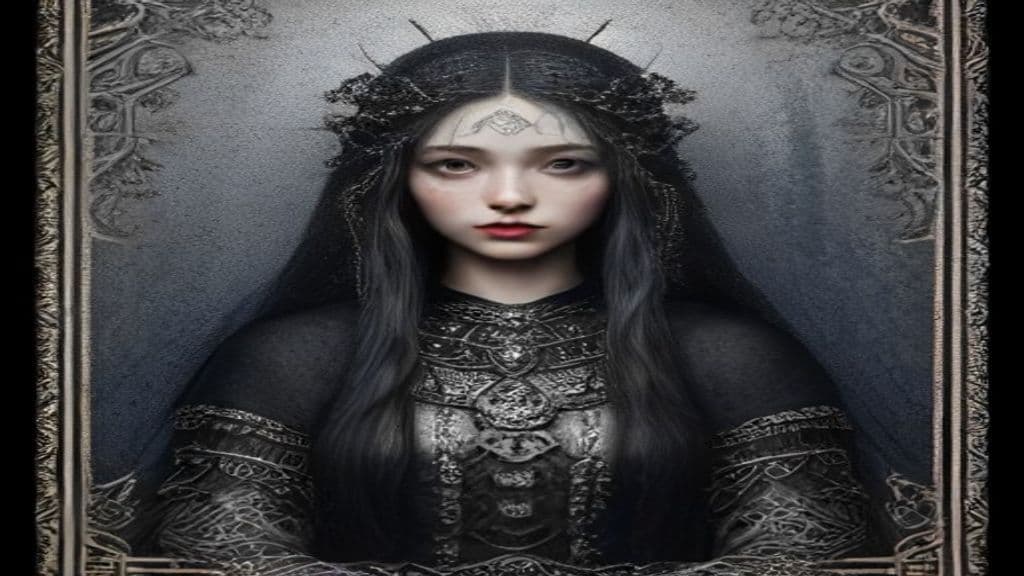
Menglöð appears in the Svipdagsmál poem-cycle (commonly printed with the Poetic Edda) as the object of Svipdagr's quest. In the stanza-corpus of Fjölsvinnsmál she is named daughter of Svafrþorinn (a name otherwise unattested), which provides a brief genealogical anchor in the poetic tradition. The narrative frame preserved in these sources portrays her not as a creator or wide-ranging deity but as an otherworldly maiden-hostess whose hall and person are the goal of a cultic/heroic wooing; her attestations derive from literary-poetic contexts rather than from recorded liturgy or ethnographic cult practice.
Direct descriptive detail is sparse in the surviving texts: the poems and indexed captions consistently call her "the maiden" and locate her in a guarded hall, but they do not supply bodily or costume descriptions. Modern commentary links her name and role to necklace/jewel imagery (rendered in scholarship as something like "necklace-glad" or "jewel-joy"), a thematic association rather than an attested physical trait. Thus physical appearance beyond her designation as a maiden and occupant of an enchanted hall is not specified in the provided sources.
No explicit personal magical feats are attributed to Menglöð in the surviving Svipdagsmál excerpts; sources present her primarily as the desired bride and resident of a protected hall. The primary supernatural elements recorded around her are defensive: the hall is guarded by the giant Fjölsviðr, two dogs, a clay wall and a wall of fire. These protections function as part of the narrative challenge the suitor must overcome, but the texts do not explicitly ascribe these defenses as active magical acts performed by Menglöð herself.
Weaknesses
None recorded.
Wards
- conditionhall defences of dogs, clay wall and wall of fire
- otherthe giant sentinel Fjölsviðr guarding the residence
Agilaz (Egil)
Agilaz (reconstructed Proto-Germanic) — commonly recorded in medieval sources as Egil or Ægil — is a legendary archer attested in Germanic heroic tradition. He appears as the brother of Völund (Wayland/Weland) in the Old Norse poem Völundarkviða and in the Thidreks saga, and his name is also inscribed on early medieval objects (Franks Casket, Pforzen buckle). The attested material presents him as a named heroic human archer within saga and inscriptional contexts rather than as a recurrent supernatural species.
Beli's bane
A kenning-style epithet from the Old Norse poetic corpus, rendered from Old Norse bani Belia (with an adjectival bjart = 'bright' in some transmissions). It functions as 'the slayer (bane) of Beli' within the prophetic catalogue of Ragnarök in Völuspá rather than as a fully independent named being with its own cult or origin story.
Skald (Norse Poet)
In Norse tradition, a skald is a poet who composes poetry in the form of skaldic verse, often honoring kings and mythological figures. (Note: - Power tier: Downgrade to Ancient (deity-level), as the abilities described do not match Primordial level. - Appearance: Clarify that formal attire was worn during performances, but provide more spec)
Menelaus
Menelaus is a mytho-historical king of Sparta in the Greek epic tradition, husband of Helen and a leader in the Trojan War cycle. He appears in Homeric epic (Iliad, Odyssey) and many later literary retellings and traditions; he is portrayed as a mortal royal figure whose fortunes are affected by divine intervention.
Menelik I
Legendary first Emperor of Ethiopia and ancestral founder of the Solomonic dynasty who, in Ethiopian tradition, links Ethiopian monarchy to the biblical House of David through descent from King Solomon and the Queen of Sheba. Central to his narrative is the transfer or removal of the Ark of the Covenant to Ethiopia and the establishment of a sacred custodial tradition around it.
Menemachus
Menemachus is not a mythological being in the supplied sources but a personal name with two distinct attestations: (1) a historical Greek physician (Greek: Μενέμαχος) of the Methodic school, active in the 2nd century CE and cited by later medical authors; and (2) a taxonomic usage recorded on Wikidata as a genus of insects. Neither source treats Menemachus as supernatural.
Menes
Historical figure and pharaoh of ancient Egypt, credited with unifying Upper and Lower Egypt. (Note: * Power tier: Should be Primordial, not Ancient (Historical figure and pharaoh, not a deity-level entity) * Abilities: The text does not support the claim that Menes' unification had a "profound impac)
Meng Po (Lady of Forgetfulness)
Meng Po (孟婆; Mèng Pó, literally 'Old Lady Meng') is a deity-like underworld official in Chinese folk religion who administers a brew—the Five Flavored Soup (迷魂汤; míhúntāng, 'waters of oblivion')—to newly dead souls on the Bridge of Oblivion so they forget prior lives before reincarnation.
Mengues / Mengue
The term 'Mengues' (also attested as 'Mengue') is documented in the provided sources only as an onomastic item — a surname, a village toponym in Cameroon, and as a name/title used in Spanish-language and contemporary artistic works. The sources contain no evidence that 'Mengues' denotes a supernatural or folkloric entity.
Menhit
Menhit (also Menhyt, Menchit) is a Nubian-origin lioness war goddess incorporated into Egyptian religion as a martial tutelary and solar-associated deity. She is commonly depicted as a lioness bearing a solar disk and the uraeus and is linked in myth to the Eye of Ra tradition and to royal protective iconography.
Menippe
Menippe (Ancient Greek: Μενίππη) is a name borne by multiple female figures in Greek mythic genealogies: attested as an Oceanid, as a Nereid, as a Thessalian Naiad of the river Peneios, and as one of the Coronidian maidens (a daughter of Orion paired with Metioche). The attestations are catalogic and local rather than a single unified biography.
Menka
A Dayan witch who has survived approximately 200 years — the first named threshold, when her glamour is at its most potent and her seductive powers allow her to pass freely among the living.
Community Record
- [1]Svipdagsmál (summary / Svipdagsmál description). Wikipedia: Svipdagsmál — overview of the poem-cycle 'The Spell of Gróa' and 'The Lay of Fjölsviðr' and their narrative elements.wiki
- [2]Menglöð — MyNDIR image caption. MyNDIR caption: 'Menglöð (non.) The maiden that Gróa's son Svipdagr is determined to woo and wed. Menglöð´s residence is guarded by the giant Fjolsviðr, two dogs, a clay wall and a wall of fire.'literary
- [3]Svipdagr finds Menglöð — MyNDIR. MyNDIR: indexed page describing Svipdagr's quest and the guarded residence of Menglöð.literary
- [4]Fjölsvinnsmál commentary & text (Unity Commentary Robinson). Commentary and translation material for Svipdagsmál and Fjölsvinnsmál describing the riddle-exchange and sentinel Fjölsviðr.literary
- [5]Svafrþorinn (entry). Wikipedia: 'In Norse mythology, Svafrþorinn is the father of Menglöð by an unnamed mother. He is attested in this form solely in a stanza of Fjölsvinnsmál.'wiki
- [6]Through the Fiery Wall: Menglod, Brynhild, and Gerdr. We Are Star Stuff essay noting motif parallels of a young man passing a wall of flames and other hazards to reach a woman (comparisons to Gerðr and Brynhildr).other
- [7]The goddess and the jewel. Modern commentary linking Menglöð thematically to necklace/jewel imagery and discussing the symbolic field connecting female divinities and precious objects.other
- [8]The Saemundar Edda (Thorpe translation, 1865). Translation and presentation of the Eddaic poems including text relevant to Svipdagsmál / Fjölsvinnsmál.literary