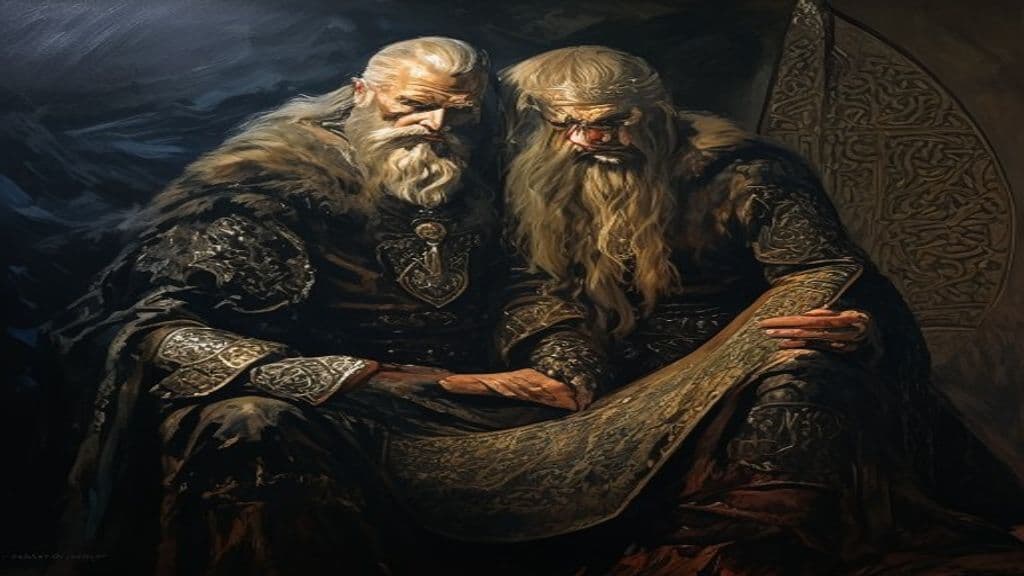
In Norse tradition, skalds were typically freemen or slaves who were trained in poetry and storytelling.
Skalds often wore formal attire during performances.
Skalds are known for their exceptional poetic skills, particularly in composing skaldic poetry that honors kings and mythological figures.
Weaknesses
- conditionpoetic failure
Wards
None recorded.
Agilaz (Egil)
Agilaz (reconstructed Proto-Germanic) — commonly recorded in medieval sources as Egil or Ægil — is a legendary archer attested in Germanic heroic tradition. He appears as the brother of Völund (Wayland/Weland) in the Old Norse poem Völundarkviða and in the Thidreks saga, and his name is also inscribed on early medieval objects (Franks Casket, Pforzen buckle). The attested material presents him as a named heroic human archer within saga and inscriptional contexts rather than as a recurrent supernatural species.
Beli's bane
A kenning-style epithet from the Old Norse poetic corpus, rendered from Old Norse bani Belia (with an adjectival bjart = 'bright' in some transmissions). It functions as 'the slayer (bane) of Beli' within the prophetic catalogue of Ragnarök in Völuspá rather than as a fully independent named being with its own cult or origin story.
Menglöð
Menglöð is an Old Norse supernatural female figure attested in the poem-cycle Svipdagsmál as the guarded maiden whom the hero Svipdagr seeks to woo and wed. She resides in an enchanted hall protected by a giant sentinel, dogs, a clay wall and a wall of fire; surviving sources present her mainly in this narrative-ritual context rather than as a fully articulated cultic deity.
Situa Festival
The Situa was a festival in the Inca Empire, held in Cusco to promote health and ritual purification. (Note: 1. Add a specific origin story or mythological reference to the "Origin Story" section. 2. Power tier: Given that it's an important festival and its rites are described by chroniclers, it's unlikely t)
Six‑Eared Macaque
A supernatural primate antagonist from the Ming‑dynasty novel Journey to the West who impersonates Sun Wukong. Described in the text as one of four special "spiritual primates," he demonstrates near‑omniscience and perfect mimicry of the Monkey King until revealed and subdued by the Buddha.
Siyah Div (Black Div)
Siyah Div (Persian: سیاه دیو), rendered in English as 'Black Div', is a named Div‑figure attested in Persian epic tradition (the Shahnameh). In the available sources he is identified in the manuscript/illustration cycle of the Shah Tahmasp Shahnameh and remembered by the epithet 'Slayer of Siamak.'
Sjtuf
Sjtuf is a Roermond processional giant — a 6‑metre-high anthropomorphic effigy (also called Christoffel) used in Dutch/Flemish giants' processions. It functions as a civic and religious pageant figure personifying Saint Christopher and is documented in archival descriptions and a Wikidata entry as a constructed parade giant rather than an autonomous supernatural being.
Sjörå
A female humanoid water spirit of Swedish folklore classed among the rå (place-keepers). Bound to a particular lake, pool, or freshwater site, the sjörå protects the waters and its fish, rewards respectful users with good catches and safety, and may seduce or drown those who are disrespectful.
Skanda
Skanda is a prominent South Asian divine figure: in Hinduism he is the war-god son of Śiva and Pārvatī (also worshipped regionally as Murugan, Kartikeya, Subramanya) and the eponym of the large Skanda Purāṇa; in East Asian Mahāyāna Buddhism he appears as a monastery guardian known as Weituo (韋馱) or Idaten (韋駄天).
Skaði
Skaði is an Old Norse mythic figure, daughter of the jötunn Þjazi who is also treated as a goddess. Associated with mountains, winter, skiing and bowhunting, she becomes the wife of the sea-god Njörðr as part of compensation for her father's death and appears among the Æsir in mythic narratives (including the binding of Loki).
Skeleton (undead)
An articulated, physically manifested collection of bones animated as an undead agent. Appears across folklore, visual art, literature, and modern popular media where it functions variously as a personification of death, a symbol in cultural practices, and a commonly used hostile creature in games and fiction.
Skin-Walker (Navajo Tradition)
A malevolent entity in Navajo culture that can transform into animals or humans, causing harm to others. (Note: - Power tier should be Greater (powerful regional) instead of Primordial (cosmic). - Remove "A key characteristic" from Abilities and just state the characteristics. - No sensory cues, weaknesses, or )
Community Record
- [1]Wikipedia: Skaldwiki