
Mephistopheles first appears as a named figure within the Faust narrative tradition rather than as an inherited ritual spirit. The name and character emerge in the post-medieval Faustbuch cycle (the Faust chapbooks that circulated from the 16th–18th centuries) and were taken up in dramatized form by Christopher Marlowe (Doctor Faustus) and later substantially reworked and popularized by Johann Wolfgang von Goethe in his two-part Faust. Sources emphasize that the name is a Renaissance-era literary coinage drawing on Greek and Latin linguistic play; etymological readings propose a Greek negation μή (mē) and φίλος (philos, "friend") as bookends of the compound while the middle element is uncertain. Scholarship and encyclopedia summaries underline that Mephistopheles was not previously part of older ritual demonologies and that his cultural existence is chiefly as a constructed interlocutor for moral, intellectual and theological themes in the Faust cycle.
Appearances of Mephistopheles vary by text and performance. In early chapbook versions he may be presented in disguise (for example, an 18th-century chapbook read by Goethe describes Mephostophiles as appearing "in the form of a greyfriar" when summoned by Faust in a wood outside Wittenberg). Marlowe's portrayal in Doctor Faustus gives the figure a fallen-angelic register and an introspective voice, while Goethe's Mephistopheles is theatrically elaborate and mutable in tone; staging traditions treat the role as challenging and adaptable. Beyond these literary and dramatic representations, source material stresses that there is no single fixed folk physical taxonomy for Mephistopheles because the figure is primarily a literary construct and often appears disguised or shifting in form.
Across the Faust corpus Mephistopheles functions as Hell's messenger and an agent-provocateur: he negotiates bargains for human souls, tempts and corrupts, and acts as a trickster, liar and deceiver. Literary descriptions attribute to him shapeshifting and illusion-making powers—he can assume the forms of animals, persons, knights and other guises to deceive or manipulate. In major dramatizations (Marlowe, Goethe) the character is given psychological and ironic dimensions—capable of witty debate, introspection, and lament—so his behavioral repertoire ranges from straightforward diabolical bargaining to complex theatrical engagement with themes of freedom, beauty and moral consequence. Sources reiterate that his functional authority derives from his role as a servant of Hell rather than from an independent place in pre-existing magical praxis.
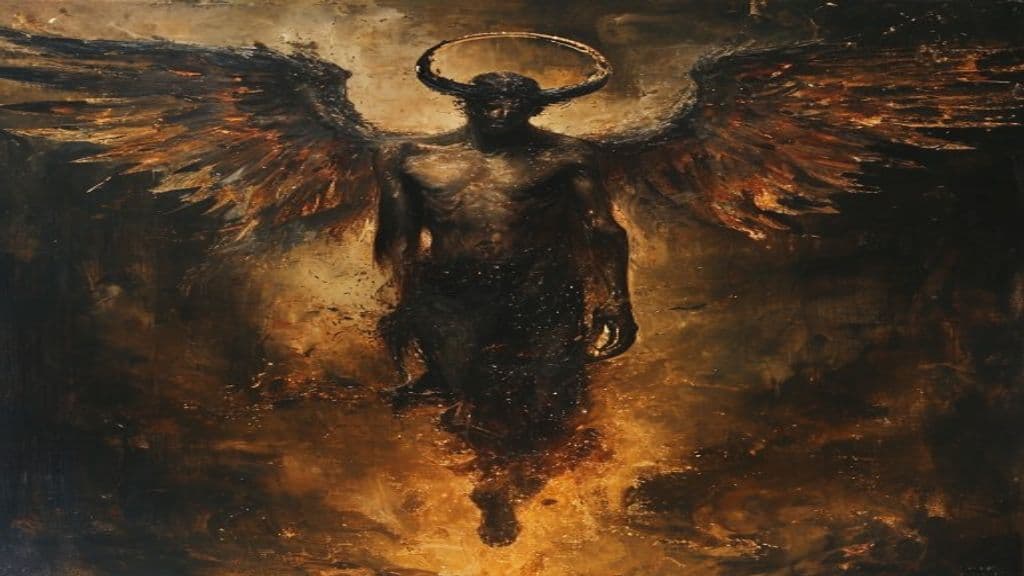
Iblis
The primordial deceiver in Islamic theology; a jinn who refused God's command to bow before Adam and was expelled from heaven. The source of all temptation and whispered suggestion.

Lucifer
A multilayered figure whose core identity in the cited sources is the planet Venus as the brilliant morning star (Latin lucifer, 'light-bringer' / Hebrew hêlêl, 'shining one'). In later Jewish and especially Christian exegesis the Isaiah image Helel ben Shachar is reinterpreted as a mythic fall motif and becomes associated with a rebellious heavenly being identified with the adversary; this development overlays the earlier astronomical and poetic personification.
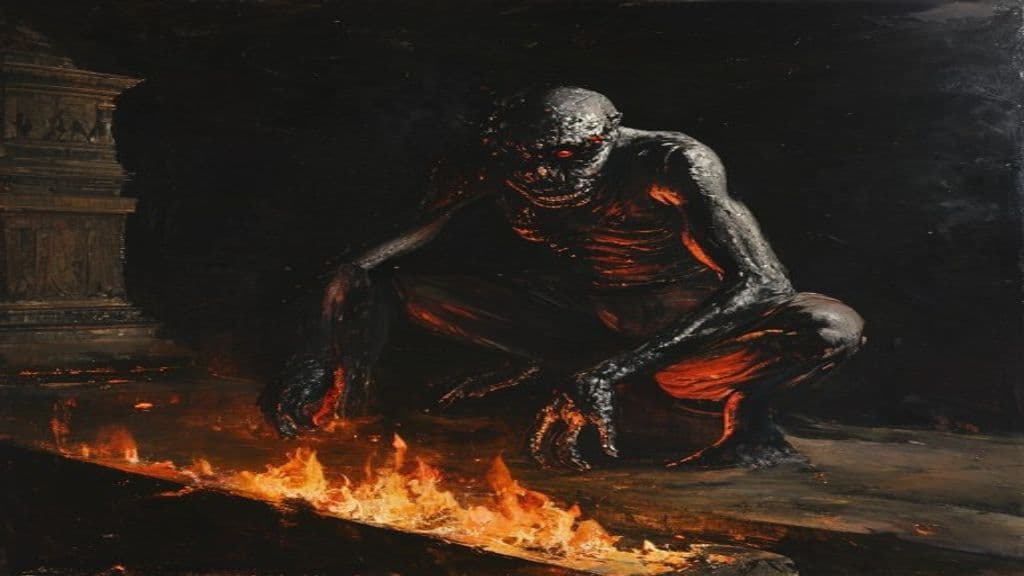
Pishach
Among the oldest classified demon-types in Hindu tradition — flesh-eating entities of the cremation ground first named in the Atharva Veda. The Pishach inhabits fresh corpses and possesses the living, causing the specific Ayurvedic condition of 'pishachabadha': madness, speaking in unknown languages, consuming impure things.
Menninkäinen
A mischievous, goblin-like spirit in Finnish mythology that guards treasures and enjoys riddles and games of dominance. (Note: 1. Power tier: Lower to Primordial or Ancient, given the description of guarding treasures and enjoying games of dominance. 2. Origin story: Remove "originally described as spirits that lived in isola)
Menoeceus
Menoeceus is an Ancient Greek personal name borne by two principal figures in classical literature: a Theban noble connected with the Seven against Thebes cycle whose voluntary death is recounted as obedience to an oracle, and the addressee of Epicurus's didactic "Letter to Menoeceus." The name functions in mythic-civic and philosophical registers rather than as a supernatural being.
Menoetius
Menoetius (Greek: Μενοίτιος / Μενοίτης) is a name applied to multiple figures in ancient Greek narrative traditions: a second‑generation Titan associated with hubristic violent force and punished in the Titanomachy; a chthonic herdsman (Menoetes) who guards Hades’ cattle and wrestles Heracles during the twelfth labor; and a mortal of Opus counted among the Argonauts and father of Patroclus. The shared name carries an etymological sense of 'doomed might.'
Menreiki
Menreiki (面霊気) is a mask-associated yōkai recorded in the Edo-period compendium Gazu Hyakki Tsurezure Bukuro (1781). Classical sources describe it as a monster composed of Gigaku masks; modern popular culture has expanded the motif into characters and narratives that emphasize masks as repositories of emotion or as instruments of coercion.
Menshen (門神)
Menshen, or "door gods," are paired guardian deities in Chinese popular religion and related practices placed at thresholds to repel harmful influences and encourage beneficial ones. They appear as images, tablets, or statues affixed to doors and gates and are commonly replaced each Chinese New Year as part of household renewal.
Mentor
Mentor is a secular social role: a person who provides guidance, teaching, influence or patronage to a less experienced person (a mentee). In the provided sources it is treated as an interpersonal and professional relationship rather than a mythic or supernatural being.
Mercury (mythology)
In the provided sources, "Mercury" appears primarily as a polyvalent modern label; the only mythological sense explicitly listed is as a Roman deity on a disambiguation page. The supplied materials do not contain descriptive, ritual, or ethnographic information about Mercury as a mythic being.
Mergen
Mergen is a Turkic sky deity associated with wisdom, intelligence, abundance, and skilled marksmanship. He is presented in Turkic cosmology as a son of Kayra, brother of Ulgan, and as dwelling on the seventh level of the sky; iconographically he is linked to a white horse, the color white, and the image of a young helmeted archer.
Meriones
Meriones is a mortal Cretan hero of the Trojan War cycle in Greek epic tradition, known as a skilled warrior, charioteer and companion of Idomeneus. He appears in Homeric rosters and narratives (notably the Iliad) and was traditionally associated with a hero-tomb and local cult at Knossos (Cnosus).
Mermaid
An aquatic folkloric being with the head and upper body of a female human and the tail of a fish, appearing across many cultures as both omen of maritime danger and occasional benefactor or romantic partner to humans.
Merman
A male sea‑humanoid figure, typically described as human above the waist and fish‑like below, attested across Greek, Norse/Icelandic, Mesopotamian‑influenced, and early modern sources as mythic sea‑beings, transformed humans, or catalogued maritime curiosities.
Mermerus
Mermerus is a mortal figure in Greek mythic genealogies, most commonly named as one of the two sons of Jason and Medea (paired with Pheres) whose fate figures in the Medea domestic tragedy. The name also appears independently in other epic contexts (notably as a minor Trojan warrior killed in battle) and in fragmentary/local genealogical notes linking a Mermerus into royal lines.
Community Record
- [1]Mephistopheles - Wikipedia. Wikipedia contributors, 'Mephistopheles,' Wikipedia, The Free Encyclopedia.wiki
- [2]Wikidata: Mephistopheles. Wikidata entry Q272805 for Mephistopheles.wiki
- [3]Faust: A Tragedy (Goethe), Project Gutenberg. Goethe, Johann Wolfgang von, Faust: A Tragedy (Part I), translation and public-domain editions referenced via Project Gutenberg.literary
- [4]A Modern Mephistopheles, and A Whisper in the Dark (Louisa May Alcott), Project Gutenberg. Alcott, Louisa May, 'A Modern Mephistopheles, and A Whisper in the Dark,' Project Gutenberg.literary
- [5]Archive references and cultural items (selected). Various cultural items referencing Mephistopheles available via Archive.org; used as part of the assembled dataset.other