
According to the canonical and commentarial materials cited, he was born with the personal name Kolita and became the monk Maudgalyāyana (Mahāmaudgalyāyana), one of the Buddha's closest disciples and paired structurally with Śāriputra as the two foremost male disciples. The Khuddaka-texts Vimanavatthu and Petavatthu present him as the monk who, after entering deep meditative absorption (jhāna), used his meditative/supernormal powers to go to the heavens, meet devas, and inspect the conditions of petas; he then reported what he had observed to the Buddha and the monastic community. These narrated journeys form the origin of the verses and stories in those collections and situate Moggallāna as the authorized eyewitness whose journeys legitimize the texts' moral teaching.
Canonical sources identify Moggallāna as an ordained bhikkhu and present him in monastic contexts rather than as a distinctively supernatural-looking being. The supplied materials do not give physical or extraordinary corporeal descriptions; instead, narratives habitually show him entering jhāna, departing and returning to the monastic assembly, and speaking to the Buddha and other monks about what he witnessed. Thus his appearance in the literature is that of a senior monk and narrator-figure who functions within monastic settings.
The Vimanavatthu and Petavatthu attribute to Moggallāna the capacity to enter deep meditative absorption (jhāna) and, by supernatural meditative power (abhiññā-like faculties as described in the texts), to travel to or perceive heavenly realms and to encounter devas and petas. He acts as an eyewitness reporter: after his journeys he recounts what he saw to the Buddha, who uses those accounts as moral exempla linking present conduct (kamma) to posthumous states (vipāka). The sources frame these abilities as meditative knowledge used pedagogically rather than as ongoing residence in other realms.
Weaknesses
- conditionNo canonical weaknesses specified in the supplied sources
Wards
- otherNone specified — the supplied materials do not present warding practices directed at Moggallāna
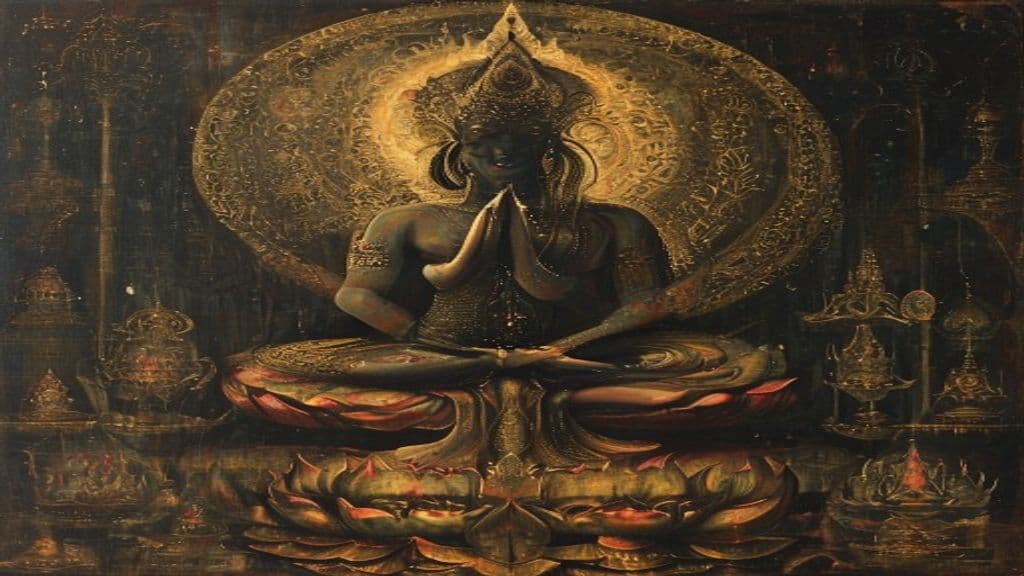
Deva (Buddhism)
In Buddhist cosmology a deva is a class of celestial being or heavenly rebirth occupying higher planes than humans; devas are longer‑lived, more powerful, and generally happier than humans but remain impermanent and subject to karma. The category spans formless meditative beings through subtle form devas to sensual gods, and maps onto the three dhātus (Ārūpyadhātu, Rūpadhātu, Kāmadhātu).
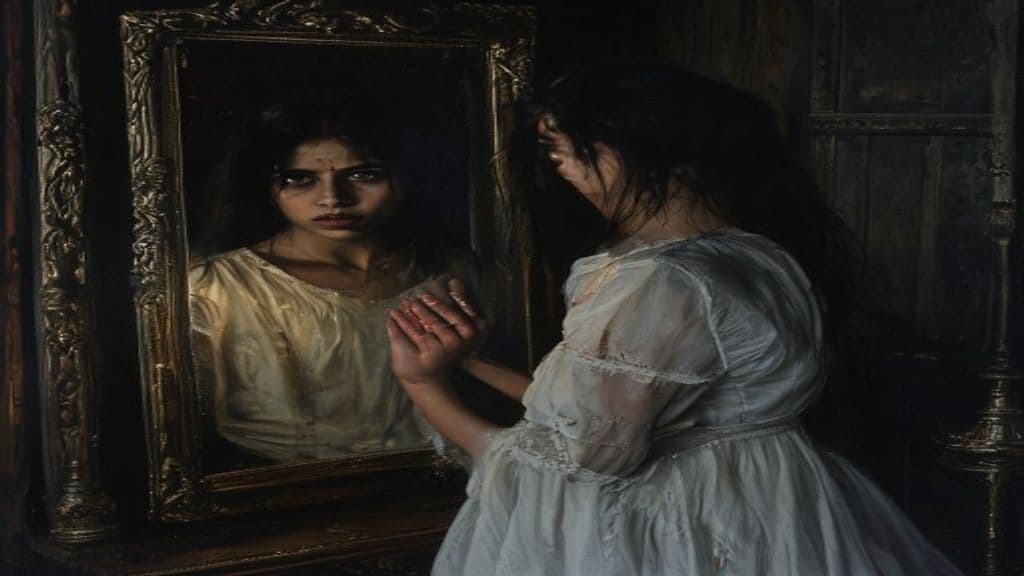
Petni
The female equivalent of the Bengali bhoot — the ghost of a young woman who died unmarried or before fulfilling her expected life. The Petni is more volatile and less predictable than the Shakchunni (married woman's ghost), driven by the particular bitterness of a life foreclosed rather than interrupted.
Mnevis
Mnevis is the ancient Egyptian sacred bull cult of Heliopolis (On), regarded as the living manifestation or ba of the solar god Ra and later assimilated with Atum‑Ra. A single living bull served as an oracular and cultic presence, entitled to ritual attendants and embalmed and buried with honours in a dedicated necropolis; the cult persisted into the late Pharaonic and classical periods and was one of the few cults tolerated during Akhenaten's reign.
Moddey Dhoo
A place‑bound phantom black dog from Manx tradition, chiefly associated with Peel Castle (St Patrick’s Isle). Recorded in an 18th‑century account by George Waldron and later collected and expanded by folklorists, the Moddey Dhoo appears at dusk in the castle guardroom and returns to a secret passage at dawn; later local reports extend the motif across the Isle of Man with variant descriptions.
Modheshwari
Modheshwari (Gujarati: મોઢેશ્વરી) is a localized tutelary form of the Great Goddess worshipped as the clan deity (kuldevi) of the Modh communities of Gujarat. Described in source materials as a martial incarnation of the Goddess (linked variably to Parvati/Adi Parashakti and to the devi Matangi), she is credited in tradition with slaying a local demon and promising protection to her devotees.
Modthryth
Modthryth is a literary royal figure attested in the Old English poem Beowulf, presented as a princess who initially behaves violently toward men beneath her rank but is later depicted as a reformed and celebrated queen. The figure functions in the poem as a foil to other aristocratic women and as a commentary on ideals of queenship (freoðuwebbe) in Anglo-Saxon literary culture. The manuscript reading of her name and the precise sense of the compound are subjects of scholarly dispute.
Moehau
A creature of New Zealand folklore associated with Mount Moehau on the Coromandel Peninsula. In source materials the moehau is presented variably as a local wild/uncanny being linked by some to the Māori maero(maeroero), and by others treated as a modern folkloric label applied to alleged sightings, jokes, or misidentified objects and animals.
Moekākara
Legendary canoe in Māori tradition, used for migration to settle New Zealand. (Note: - Power tier should be "Primordial" since it's a legendary canoe used for migration to settle an entire country. - Summary: Add that Moekākara was captained by Tāhuhunui-o-te-rangi, an ancestor of Ngā)
Mogollon Monster
A regionally anchored American folkloric cryptid reported along Arizona's Mogollon Rim, described as a large, bipedal, hairy humanoid whose accounts function as wilderness cautionary tales and local popular‑culture legend.
Mohini
South Indian spirit of a beautiful woman who died of a broken heart or by betrayal — she appears on roadsides at night, enchants men into following her, and leads them to ruin or death.
Moirai
In ancient Greek religion and mythology, the Moirai (μοῖραι) are a triad of personified destinies who spin, allot, and cut the thread of life. They function as apportioners of fate, ensuring that both mortals and gods live out the portions assigned by the universe's ordering principles.
Mokele-Mbembe
A water-dwelling entity in Central African tradition, described as reptilian or a member of an extinct sauropod lineage. (Note: 1. Power tier: should be Primordial (cosmic level) since it's often described as a legendary creature rather than a deity-level being. 2. Origin story: The source material does provide etymology, stat)
Molus of Crete
Molus is a figure in Cretan mythic genealogy, presented in surviving sources as a son in the house of Minos and chiefly significant as the father of Meriones, the Cretan warrior at Troy. He is also attested in one account as the subject of a ritual image shown at a Cretan festival: an image of a headless man called Molus, linked to a tradition that he attempted to violate a nymph and was later found decapitated.
Momoy
Momoy is the Chumash lexical term for the sacred/medicinal plant Datura wrightii and, in Chumash contexts, the spirit-power associated with that plant. It is an entheogenic medicine used in ritual and healing contexts to induce visions, support spiritual wellbeing, and to help 'keep the soul in the body' during frightening encounters; it is also recognized as poisonous and dangerous if mishandled.
Community Record
- [1]Moggallāna (Maudgalyāyana) — Wikipedia. Wikipedia: Moggallāna / Maudgalyāyanawiki
- [2]Chuyện Ngạ Quỷ - Petavatthu (Archive). Petavatthu introduction and Vietnamese translation (archive item)literary
- [3]Kinh Tương Ưng Bộ - Samyuttanikāya (Archive). Archive copy of Samyuttanikāya materials referenced for canonical contextliterary
- [4]Haunted Sigiriya: The Lion Rock (Archive) — folkloric material (does not link Moggallāna to apparitions). Folkloric account of ghostly monks at Sigiriya; note supplied materials do not identify Moggallāna among these apparitionsfolk
- [5]Wikidata: Mahāmaudgalyāyana. Wikidata entry for Mahāmaudgalyāyanaother