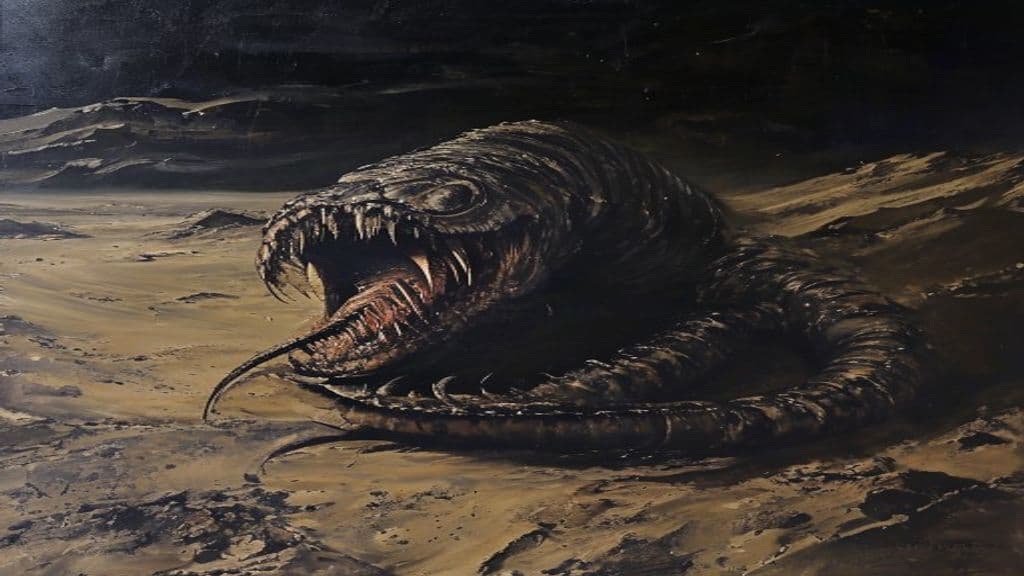
The Mongolian death worm is said to be a creature that lives in the Gobi Desert, but its origin story and existence have not been proven.
Unfortunately, there is no information provided on the physical appearance of the Mongolian death worm.
There is no information available on the abilities or behaviors of the Mongolian death worm.
Moirai
In ancient Greek religion and mythology, the Moirai (μοῖραι) are a triad of personified destinies who spin, allot, and cut the thread of life. They function as apportioners of fate, ensuring that both mortals and gods live out the portions assigned by the universe's ordering principles.
Mokele-Mbembe
A water-dwelling entity in Central African tradition, described as reptilian or a member of an extinct sauropod lineage. (Note: 1. Power tier: should be Primordial (cosmic level) since it's often described as a legendary creature rather than a deity-level being. 2. Origin story: The source material does provide etymology, stat)
Molus of Crete
Molus is a figure in Cretan mythic genealogy, presented in surviving sources as a son in the house of Minos and chiefly significant as the father of Meriones, the Cretan warrior at Troy. He is also attested in one account as the subject of a ritual image shown at a Cretan festival: an image of a headless man called Molus, linked to a tradition that he attempted to violate a nymph and was later found decapitated.
Momoy
Momoy is the Chumash lexical term for the sacred/medicinal plant Datura wrightii and, in Chumash contexts, the spirit-power associated with that plant. It is an entheogenic medicine used in ritual and healing contexts to induce visions, support spiritual wellbeing, and to help 'keep the soul in the body' during frightening encounters; it is also recognized as poisonous and dangerous if mishandled.
Momu
Momu is a figure in Chinese legendary tradition described as a legendary empress and goddess, remembered as a wife of the Yellow Emperor and traditionally credited with inventing the mirror and with a healing episode that led to her involvement in divine administration. Later popular traditions also group her among a set called the "Five Ugliest Women of Ancient China."
Monaciello (Munaciello)
A traditional Neapolitan household and city sprite, the Monaciello ('little monk') is a short, stocky, robed figure of local oral lore who inhabits Naples' underground waterworks and who visits homes, sometimes rewarding hospitality and sometimes playing spiteful tricks.
Monkey-man of Delhi
A modern Indian urban‑legend and mass‑panic phenomenon centered on reports of a monkey‑like attacker roaming New Delhi in mid‑2001. Media coverage and eyewitness reports described a frightening, inconsistent figure blamed for nighttime attacks, injuries, and panic; subsequent investigations suggested a mix of hoaxing, copycats and mass hysteria.
Monopod
A class of mythological humanoid peoples described in classical, medieval, Chinese, and Norse sources as having a single central leg with a very large foot. Treated in literature and maps as a wondrous race inhabiting the margins of the known world rather than as a lone monster.
Monotheism in pre-Islamic Arabia
Followers of Abrahamic faiths, such as Christianity and Judaism, who believed in a single all-powerful God in pre-Islamic Arabia. (Note: * Power tier: Lesser (not Greater) - monotheistic beliefs were not limited to powerful regional deities but had a relatively local presence in pre-Islamic Arabia. * Origin story: The exact timing is u)
Monster (tradition)
A broad cultural category for imagined creatures that transgress natural and social norms. In literature, mythology, religion, and popular culture, monsters mark otherness, danger, or omenatic significance rather than denoting a single, uniform being.
Monster Slayer (Nayenezgani)
Within the limited sources supplied, 'Monster Slayer' is used as an English label on a Wikipedia disambiguation page to refer to Nayenezgani, identified there only as "a character from the Navajo creation myth." The provided materials contain no narrative, descriptive, or ritual information about this figure beyond that single listing.
Moon Rabbit (Maya Tradition)
A mythical figure associated with lunar mythology, said to pound elixir or medicine for mortals and occasionally foodstuffs. (Note: 1. Power tier: Downgrade to Ancient, as while it's associated with lunar mythology, its abilities are not cosmic in scope. 2. Abilities: Add that the contents of the mortar differ among cultural tradi)
Community Record
- [1]Mongolian Death Worm. Wikipedia article on the Mongolian death wormwiki