
The available accounts do not provide a full cosmological origin for the Muldjewangk. Within Ngarrindjeri storytelling the being is situated in the waterways of the lower Murray and Lake Alexandrina and appears in local narratives (for example pestering Ngurunderi and his wives by wrecking their fishing nets). Oral tradition and later retellings present the Muldjewangk as a named water-creature encountered in the river environment rather than offering a detailed creation or origin myth in the sources provided.
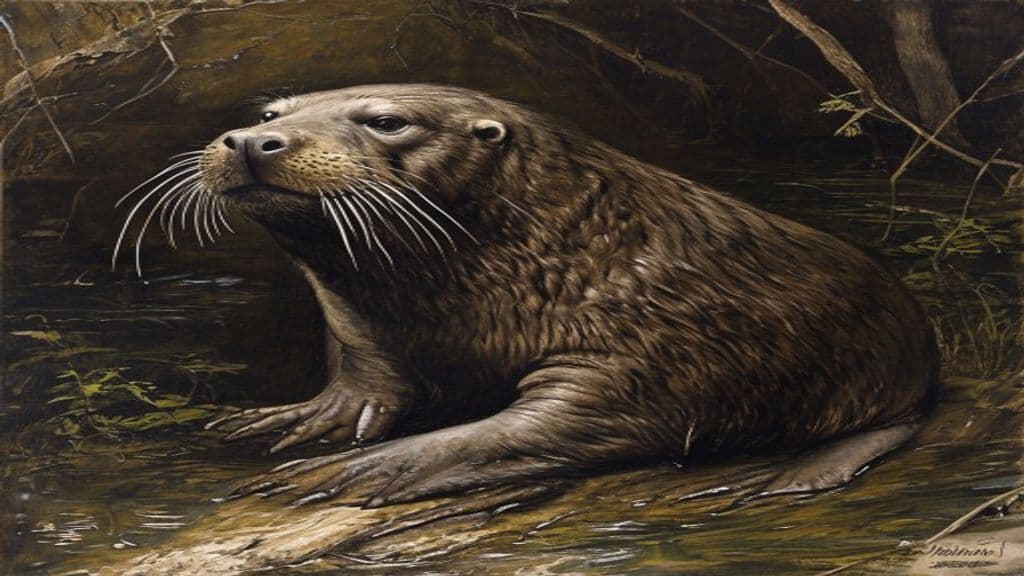
Descriptions vary between accounts. Some sources portray Muldjewangks as "evil merfolk," suggesting merfolk-like forms in some tellings, while other accounts describe a "gargantuan monster." Specific story details include reports of "two great hands grasping the hull of the boat" in a steamboat legend and sightings of "large footprints." The sources do not supply a single consistent morphology; appearance is fluid across retellings.
Reported actions in the sources are limited and concrete: wrecking fishing nets (notably pestering Ngurunderi and his wives), attacking or grasping at a steamboat hull in one legend, and hiding beneath large clumps of floating seaweed which are said to conceal them. In the steamboat account, shooting at the hands led to a subsequent supernatural affliction on the shooter (weeping red blisters and eventual death), indicating narratives of retributive consequence for harming or attempting to kill the being. The Muldjewangk functions in stories as a practical deterrent and as an agent that can interfere with human activity on the river.
Weaknesses
None recorded.
Wards
- conditionavoidance of riverbank at night
- conditionavoidance of large clumps of floating seaweed
Moʻo (example: Kihawahine)
Moʻo are identified in the supplied sources as Hawaiian lizard deities; the supplied material gives Kihawahine as an exemplar, described as a shapeshifting lizard goddess whose deification originated when the bones of a chiefly daughter were deified and whose home was the wetland pond Mokuhinia on Mokuʻula.
Mr. Beaver
Mr. Beaver is a fictional anthropomorphic beaver character who appears in the secondary world of C. S. Lewis's The Chronicles of Narnia. The provided sources identify him only as a character entry in lists/databases of Narnia characters.
Mr. Tumnus
A faun of Narnia who befriends Lucy Pevensie, hesitates to obey the White Witch's orders, is arrested and petrified under her rule, and is later restored by Aslan and serves as a royal adviser to the Pevensies.
Mtskhetos
Epic hero and legendary founder of the city of Mtskheta in Georgian mythology, son of Kartlos. (Note: - Power tier: Minor Spirit (since there's no indication of deific or powerful regional abilities) - Abilities and behaviors: lack of specific information on his abilities and behaviors means they shou)
Muhnochwa
The 'face-scratcher' of Uttar Pradesh — in 2002 a mass panic gripped hundreds of villages as people reported waking with facial scratches from an invisible entity, triggering mob violence and one of modern India's most documented supernatural hysteria events.
Mujina (貉)
A Japanese folkloric shapeshifting creature associated with badger-like and tanuki-like animals; classed among yōkai, mujina perform transformations, illusions, and pranks, and in some tales repay kindness or enact retribution when harmed.
Mullissu
Assyrian goddess and consort of Asshur, associated with fertility, marriage, and family. (Note: 1. Power tier: Based on her association with a major deity (Asshur) and potential identity with Ninlil, a goddess on par with Enlil, Mullissu's power tier should be Primordial or Ancient, not Greater.)
Mummy (undead) (Egyptian tradition)
In Egyptian folklore, a mummy is an undead creature believed to be the reanimated corpse of a deceased person. (Note: * Power tier: Should be Primordial, given the association with cosmic entities and magical powers tied to ancient Egyptian rituals. * Abilities: Clarify that supernatural abilities refer to those on a)
Mumudu (Mamu)
Mumudu (more commonly Mamu) is a Mesopotamian deity associated with dreams, attested both as described in god lists as one of the seven Šassūrātu/assuratu and in other texts as a daughter of the sun god Shamash/Utu who could be called the 'Utu of dreams'. Surviving excerpts provide no iconography or ritual prescriptions tied specifically to her.
Muneeswarar
Muneeswarar is a Tamil folk Hindu rural guardian deity venerated especially in Tamil Nadu and Tamil diaspora communities as protector of plantations, estates, and as an attendant or emanation connected to Shiva and to major folk goddesses such as Mariamman. His cult exists in both orthodox Vedic/Agamic temple modes and in non-Vedic folk modes, and much of his history and attributes are preserved in oral tradition and temple practice rather than in Vedic or Purāṇic texts.
Munisuvrata
Munisuvrata (Munisuvratanātha) is the twentieth tīrthaṅkara of the present Jain avasarpini (descending half cycle), a human exemplar who, according to Jain tradition, attained kevala jñāna and later liberation. He is venerated in temple cults, liturgical poetry, and monumental images across the Indian subcontinent.
Munjeon (Munjeon Bonpuri)
A Jeju Island household deity-concept focused on the house doorway, preserved in a shamanic narrative genre (Bonpuri) that explains the doorway's place within the Gasin, the ensemble of household deities.
Community Record
- [1]Muldjewangk. Wikipedia: Muldjewangkwiki
- [2]Muldjewangk (Wikidata). Wikidata: Q1952111wiki
- [3]Ngarrindjeri. Wikipedia: Ngarrindjeriwiki
- [4]Case #191: Lesser-Known Lake Monsters; Australia to North Korea (archive). Archive compilation referencing lake-monster accountsother