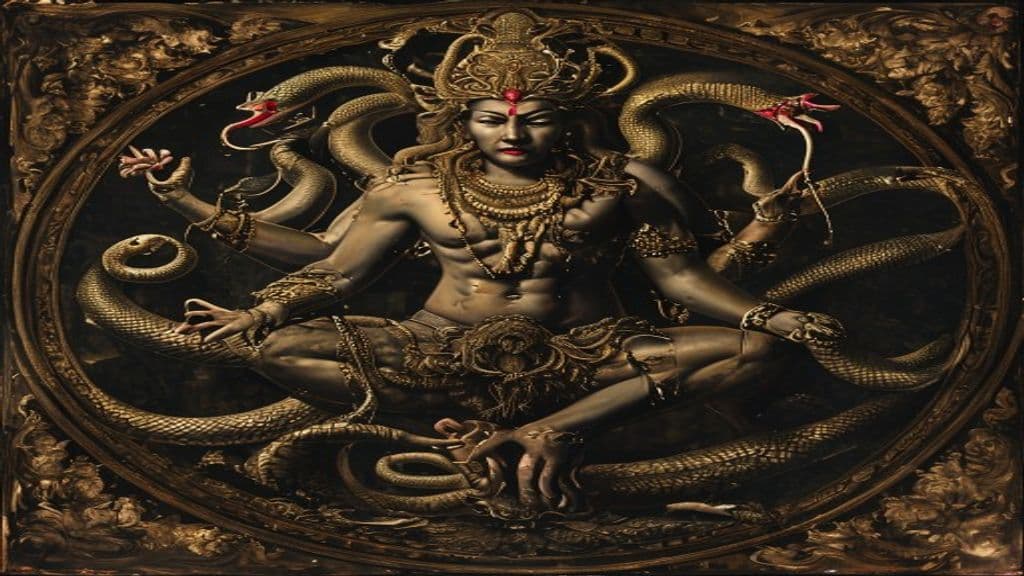
In the mythic cosmologies reflected in Hindu and Buddhist sources, nāgas are depicted as an enduring, semi-divine race that inhabit an enchanted subterranean realm called Patala or Naga-loka. They exist as organized communities with kings and lineages (e.g., Nagarajas, princesses such as Ulupi) and participate in major mythic events; individual nāga-personalities (for example, Vasuki) appear in epic narratives such as the Samudra Manthana where Vasuki serves in the churning of the ocean. Textual sources present them as an ontological category overlapping with animals (serpents), deities, and subterranean elemental peoples.
Three principal iconographic/textual forms are attested: (1) fully human figures depicted with multiple cobra hoods or snakes around the head/neck; (2) fully serpentine forms, frequently identified with the Indian cobra (Naja naja); and (3) anthropomorphic half-human/half-snake figures with human torso and serpent lower body. Certain nāgas assume grand or cosmic scale in texts (for example, Śeṣa described as having a thousand hoods ornamented with jewels). Female forms are named nagini/nāgin, and local female nāga-deities (e.g., nagammas) are associated with particular landscape features in folk practice.
Nāgas are portrayed as guardians and dwellers of subterranean realms rich in gems and treasure (Naga-loka / Patala) and as custodians or guardians of bodies of water (rivers, lakes, seas, wells). They possess venom and the capacity to threaten or harm humans, but they also act cooperatively with gods and humans in many narratives (for example, Vasuki's role in the churning of the ocean). Some nāgas have cosmic functions — Śeṣa supports and shelters the god Viṣṇu in the cosmological iconography — indicating high supernatural potency. They are socially organized (kings, lineages) and engage in rivalries with other mythic beings (notably Garuḍa).
Weaknesses
- conditionenmity with Garuḍa
- conditionvulnerability when relations with humans are offended (leading to harm from their venom or displeasure)
- othersubject to social/ritual regulation (their power is managed by worship and cult observance rather than purely magical domination)
Wards
- ritualworship and veneration of nāgas / nagammas
- symbolserpent iconography in temple contexts
Adi (asura)
Adi is attested in modern reference works as the name of an Asura who 'appears in the Matsya Purāṇa.' Beyond this single-line citation in secondary sources, no descriptive material about the figure is provided in the supplied research notes.
Adi Shakti
Adi Shakti (also Adi Parashakti, Mahadevi, Adya Shakti) is the primordial feminine power in Hindu/Shakta theology, regarded as the ultimate reality (Para Brahman) and the source from which all goddesses and gods manifest. She is both an impersonal cosmic principle (Mulaprakriti) and a focus of devotional invocation in temples, mantras, and pilgrimage sites such as Shakti Peethas.
Adi Vinayaka
Adi Vinayaka (Ādi Vināyaka; also called Nara Mukha Vinayaka) is a named iconographic and devotional form of the Hindu god Ganesha portraying the deity with a human head, described in sources as the form before the episode of decapitation by Shiva. It is rarely worshipped and appears in a small number of South Indian shrines and in devotional/musical repertoires.
Aditi
Aditi is a major Vedic goddess in Hindu tradition who personifies the boundless, infinite cosmic principle and functions as the maternal matrix from which many celestial deities (the Ādityas and other groups) are born. In the Vedic hymns she is invoked as a protective liberator who guards petitioners, provides wealth and safety, and frees devotees from hindrances such as sin and sickness.
Agni
Agni is the Vedic personification of fire in Hindu tradition: a sacred, mediating principle that manifests as terrestrial fire, atmospheric lightning, and celestial sun, and that receives and conveys sacrificial offerings. Prominent in the Rigvedic corpus, Agni functions as sanctifier, witness of rites of passage, and a transformational inner principle in later Upanishadic literature.
Ahalya
Ahalya is a mytho-legendary woman of South Asian (primarily Hindu) narrative tradition, described as created by the god Brahma, married to the sage Gautama, seduced (or tricked) by Indra, cursed by her husband, and ultimately redeemed by Rama. Her tale is a locus for themes of creation, desire, curse/penance, and redemption and she is counted among the ritual-mnemonic panchakanya.
Aindri (Indrani / Shachi / Paulomi)
Aindri (commonly rendered in sources as Indrani, also called Shachi or Paulomi) is a Hindu goddess presented as the queen-consort of Indra. She is depicted in the available material as a courtly queen associated with beauty, pride and kindness who also appears in at least one account as an active martial participant in the devas' battles with asuras.
Akshayavata
In Hindu mythology, Akshayavata is a sacred banyan tree and/or lake that symbolizes eternal life. It is mentioned in both Hindu and Jain traditions and associated with the Puranas. (Note: - The power tier should be "Greater" or at least "Ancient", as it is associated with the Puranas, which are considered ancient texts. - No specific physical description is provided, but that doesn't m)
Alakshmi
Alakshmi is an inauspicious female supernatural figure in Hindu tradition, presented as the negation or shadow-counterpart of the prosperity-goddess Lakshmi. She personifies poverty, grief, jealousy and social discord and is managed in domestic ritual and festival practice.
Alamelu
Alamelu (also Alamelu Manga / Alarmel Mangai) is a South Indian devotional name for the goddess Padmavati, identified in sources as an avatar of Lakshmi and the consort of Venkateswara; the name is also used widely as a female personal name and in titles of cultural works in Tamil and Telugu contexts.
Amrita (Buddhist tradition)
In the context of Indian religions, particularly within Hinduism and Buddhism, Amrita is a divine elixir that grants immortality and eternal life. (Note: - Power tier should be Ancient (deity-level), not Primordial. - Origin story appears accurate but lacks specificity on when Amrita was first mentioned in the Rigveda; add more detail. - Abilities are )
Ananta (Infinite)
Ananta (Sanskrit: अनन्त, 'without end') is primarily an epithet of Vishnu and a symbolic principle of infinity that is personified as the cosmic serpent Shesha. In Puranic imagery Ananta/Shesha forms the multi‑headed couch and canopy for Vishnu as he rests on the cosmic waters between cycles of creation (pralaya), and thus underwrites cyclical cosmogenesis.
Community Record
- [1]Nāga (Wikipedia). Wikipedia: 'Nāga' entry — overview of nāga as semi-divine serpentine beings, associations with Naga-loka/Patala, iconography, named personalities (Śeṣa, Vasuki), and roles in Hindu/Buddhist traditions.wiki
- [2]Brahma Purana (excerpt describing Śeṣa). Quoted puranic description: 'He has a thousand hoods and he is clearly bedecked in Svastika ornaments devoid of impurities. He illuminates all quarters by thousand jewels on his hoods.' (as cited in research notes)literary
- [3]Kamba Ramayana excerpt (Samudra Manthana context). Reference in research notes to nāga Vasuki's role in the churning of the ocean (Samudra Manthana) and association with epic narratives.literary