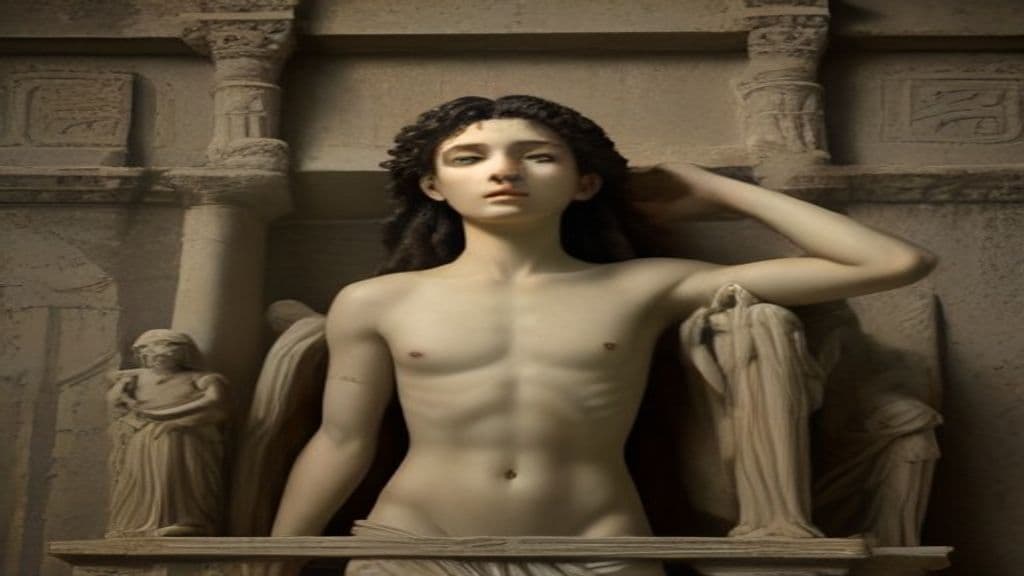
In classical Greek myth Niobe, wife of Amphion of Thebes, boasted that her greater number of children made her superior to Leto, mother of Apollo and Artemis. In retaliation for this insult the divine siblings Apollo and Artemis slew Niobe's children. Different versions of the tradition vary in the number of Niobids named or counted (ancient variants give figures such as twelve, fourteen, or twenty in different accounts), but the core origin is consistent: the Niobids are the mortal offspring whose deaths exemplify punishment for human hubris.
Ancient literary sources present the Niobids simply as the children and youths of Niobe; surviving artistic evidence depicts them generically as youthful figures rather than providing individualized, consistent physical descriptions. The subject is a frequent motif in fifth-century BCE Attic red-figure vase-painting (most famously the calyx krater that gave the Niobid Painter his conventional name) and in sculptural groups of the late fifth century BC known from Roman neo‑manneristic marble copies. In those visual traditions the Niobids appear as classical youthful forms—wounded, falling, or reclining—serving the theme of tragic slaughter rather than distinct portraiture.
The Niobids have no supernatural powers in the supplied sources; they are mortal victims whose principal 'role' is to be slain by Apollo and Artemis. As narrative figures they function as a moral exemplum: their deaths illustrate the social-religious lesson that mortals must not commit hubris by comparing themselves favorably with the gods or their favorites. They possess no agency or defenses against divine wrath in the accounts referenced.
Weaknesses
- conditionmortality and vulnerability to divine action
- otherno supernatural defenses recorded in sources
Wards
- othernone recorded — normative cultural prophylactic: avoid hubris toward gods (honor gods properly)

Leto
Leto (Ancient Greek: Λητώ / Λατώ; Latin: Latona) is an ancient Greek goddess best known as the mother of the Olympian twins Apollo and Artemis. She functions in myth and cult as a kourotrophic (mother‑or nurse‑goddess) figure with important sanctuaries at Delos and the Letoon in Lycia, and appears in narratives that emphasize both mildness and the capacity to call down retribution when insulted.
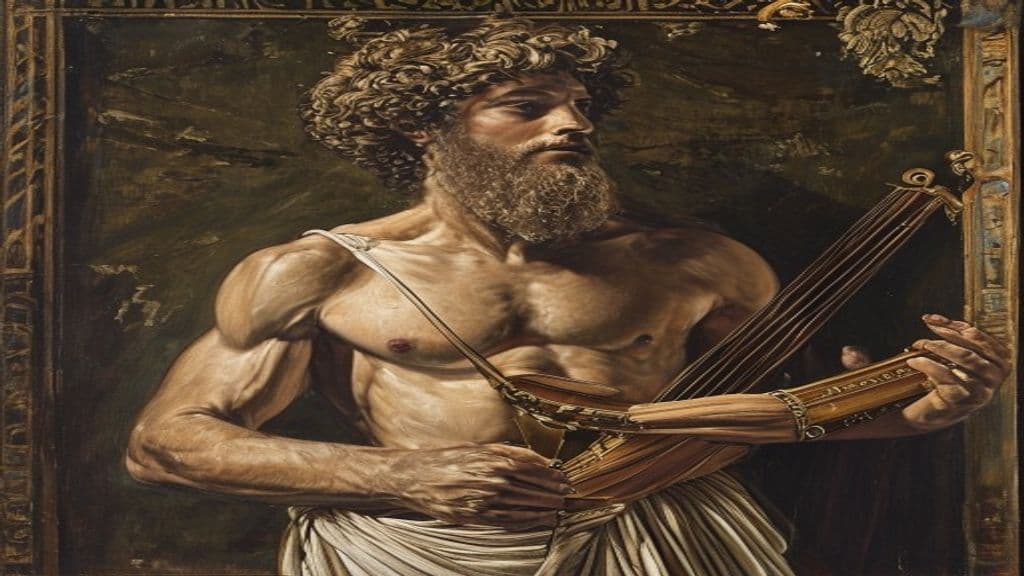
Apollo
Olympian deity of ancient Greek religion associated with prophecy, healing, music, archery, purification, and civic order. Principal patron of the Delphic oracle, protector of youth and flocks, and ambivalently both healer and bringer of plague.

Artemis
Artemis is an ancient Greek goddess of hunting, the wilderness and wild animals, transitions (especially childbirth and puberty), vegetation, and chastity. Twin sister of Apollo and daughter of Zeus and Leto, she functions as a protector of young children and maidens while also capable of inflicting disease or punishment for transgressions against her sacred laws.
Abas
Abas (Ancient Greek: Ἄβας, gen.: Ἄβαντος) is not a single mythic being but a recurring personal name borne by multiple mortals and minor mythic figures in Greek epic and genealogical traditions — kings, founders, seers, warriors, attendants, a centaur, and a youth transformed by a goddess. The name is glossed in the sources as 'guileless' or 'good-hearted' and appears across Argive, Theban, Trojan, Euboean, and other local cycles.
Acheilus
Acheilus (also spelled Akheilos/Achilleus in some sources) is a minor figure of Greek myth described as a mortal son of Zeus who was transformed into a shark and thereafter called a 'shark-formed sea daimon.' Surviving summaries frame his story as a hubris metamorphosis: boasting about his beauty led a goddess to change him into a marine monster.
Achelois
Achelois (Ancient Greek: Ἀχελωίς, 'she who drives away pain') is an attributive name or epithet used in ancient Greek mythic contexts rather than a single, consistently characterized being. The term appears applied to several different figures — a surname of the Sirens, a general name for certain water-nymphs (Acheloides), and as the name of a daughter of Pierus — and functions within Greek naming practice as a descriptive label rather than a fixed ontological office.
Achilles (son of Zeus)
A minor figure in Greek myth named Akhilleus (Ancient Greek: Ἀχιλλεύς), presented in some traditions as a son of Zeus and the Lamia who was famed for irresistible beauty, won a beauty contest judged by Pan, and was transformed into ugliness by Aphrodite. This Akhilleus is distinct from the Homeric hero of the Trojan War.
Achiroe
Achiroe (variants Anchirrhoë, Anchinoë/Ankhinoe) is a minor Greek mythological figure: a Naiad associated with the river Nile, daughter of the river-god Nilus, who becomes the wife of the Egyptian king Belus and mother of mythic progenitors such as Aegyptus and Danaus (with some accounts also naming Cepheus and Phineus). She functions primarily as a genealogical link between river-divinity and royal lineages rather than as an active agent in surviving myths.
Acontes
Acontes (Ancient Greek: Ἀκόντην) is an Arcadian prince in Greek mythology, counted among the fifty sons of the impious King Lycaon. He appears in the Lycaon narrative as a participant in a sacrilegious meal prepared for Zeus (disguised as a peasant) and is destroyed by the god's lightning as punishment.
Actaea
Actaea is a named sea‑nymph in Greek mythic lists, identified in the provided sources as the personification or eponym of the seashore. She appears primarily in onomastic and catalogue contexts (lists of nymphs/Nereids) and has no surviving independent narrative or cultic rites attested in the cited material.
Acte (Akte)
Acte (Ancient Greek Akte, sometimes rendered Acme) is a divine personification in Greek myth: one of the Horae who embodies a particular hour of the day — specifically the hour of eating and pleasure, a designated afternoon work-hour — and functions chiefly as a temporal marker rather than an active mythic agent.
Adonia
The Adonia festival is a ritual mourning celebration for Adonis, the consort of Aphrodite in ancient Greek mythology. (Note: 1. The draft claims that the article is about a "ritual mourning celebration", but the source only mentions the festival as a mourning celebration. 2. Power tier should be Primordial or Ancient since )
Aega
Aega is attested in modern reference works as a mythological name from the Greek tradition; the string 'Aega' is used for more than one minor figure or entry in Greek mythic catalogs. Surviving provided sources give no coherent myth, iconography, or rituals tied to a single, identifiable deity or spirit named Aega.
Aegaeus
Aegaeus (Ancient Greek: Αἰγαῖος) appears in Greek myth as (1) a local river-god associated with the island called Scheria (traditionally associated with Corfu) and father of the nymphs Aigaiides and of Melite (who in some sources bore Heracles a son, Hyllus), and (2) as a toponymic surname/epithet of the sea-god Poseidon derived from the town of Aegae in Euboea.
Aegesta
Aegesta is an ancient place-name and eponym recorded in Greek and Roman sources as an alternate form of Segesta, an Elymian city in northwestern Sicily, and as a mythic personal name (Aegestus/Aegesta) tied to Trojan foundation legends rather than a supernatural being.
Community Record
- [1]Niobids — Wikipedia. Wikipedia, 'Niobids' summary (accessed via provided research notes)wiki
- [2]Niobid — Wikidata entry. Wikidata item for 'Niobid' (museum/scholarly object descriptions noted in research notes)other
- [3]Niobid Painter — Wikipedia. Wikipedia, 'Niobid Painter' (naming and calyx krater description)wiki
- [4]Early Classical: Sculpture and Vases (teaching resource). Course/teaching resource noting classical vase and sculpture contexts for Niobid subjectother
- [5]Gardens of Sallust (Wikimedia/related reference). Reference cited in research notes regarding Roman copies and garden sculpture contextswiki
- [6]Archive images of calyx-krater and hydria linked to Niobid Painter corpus. Archive image of a calyx-krater related to the corpus including Niobid scenes (provided in research notes)other
- [7]Wounded Niobid (modern poetic reception). Modern poetic appropriation referenced in research notes (reception/use of Niobid trope)literary
- [8]MythLab Episode 25: Niobe. Modern summary and discussion of the Niobe tradition cited in research notesother