
No single creation myth for Nuska is preserved in the provided sources. He is attested from the Early Dynastic period onward, centered in Nippur and integrally tied to Enlil as his sukkal. Over time Nuska appears in hymns, myths, theophoric names, and ritual corpora and is adopted into the cults of other cities (Babylon, Assur, Harran) and appears in peripheral contexts (Elamite and Aramaic attestations). The sources suggest Nuska’s identity formed around a divine office (vizier/minister) rather than an independent cosmogonic origin.
Iconography and textual attestations associate Nuska with certain cultic attributes rather than a detailed anthropomorphic portrait. His emblematic items include a staff or scepter (the badge of the vizier's office), lamps or a 'bundle of flames' (Old Babylonian evidence), and in secondary summaries a rooster is listed among his symbols. Hymnic language praises him in lofty, metaphorical terms (e.g., 'You who bundle together the divine powers... Adviser of the Land'), but no comprehensive physical description is preserved in the cited materials.
Texts describe Nuska primarily in administrative and protective functions: as Enlil's doorkeeper, counselor, court overseer, mediator for petitioners, keeper of Enlil's secrets, and a divinely authorized speaker ('pre-eminent in just speech'). He is also associated with fire and light and functions as a nocturnal protective deity invoked against nightmares and hostile supernatural beings (explicitly Lamashtu and gallu). Nuska appears in hymns, oath-formulas, theophoric names, amulets, and the anti-witchcraft Maqlû corpus, indicating roles in mediation, adjudication, and apotropaic ritual. While powerful in delegated authority from Enlil, sources frame his power chiefly in terms of office and protective agency rather than cosmic creation.
Weaknesses
- otherNo specific weaknesses recorded in the provided sources
Wards
- symbolStaff/scepter (badge of office) — emblematic attribute associated with Nuska and his office
- symbolLamp or bundle of flames — fire/light imagery used in association with Nuska and found on Old Babylonian artifacts
- otherAmuletic invocation — Nuska appears on amulets (e.g., against Lamashtu) and is invoked in apotropaic contexts

Enlil
Enlil is a principal deity of ancient Mesopotamia, originally preeminent in the Sumerian pantheon as a supreme lord who orders the world by separating heaven (An) from earth (Ki). His principal cult center was the E-kur temple at Nippur, and his cult practices focused on daily offerings and priestly care of his cult statue; mythic traditions portray him as both benefactor and punisher in the administration of cosmic and social order.

Ninshubur
Ninshubur is a Mesopotamian divine attendant (sukkal) chiefly associated as the companion, messenger, and intercessor of the goddess Inanna. Functioning as a cultic office within the pantheon, Ninshubur mediates between petitioners and higher gods and appears in major myth cycles (e.g., Inanna's Descent) and in city cults across ancient Mesopotamia.

Gibil (Girra)
Gibil (Akkadian Girra) is a Mesopotamian deity personifying fire in its constructive (furnaces, metallurgy, ritual purification) and destructive (lightning-set conflagrations, burning fields) aspects. He is attested in city cults (Shuruppak, Eridu, Nippur) and invoked in ritual and incantation literature (Maqlû, Šurpu, namburbi) for purification and counter-magic purposes.
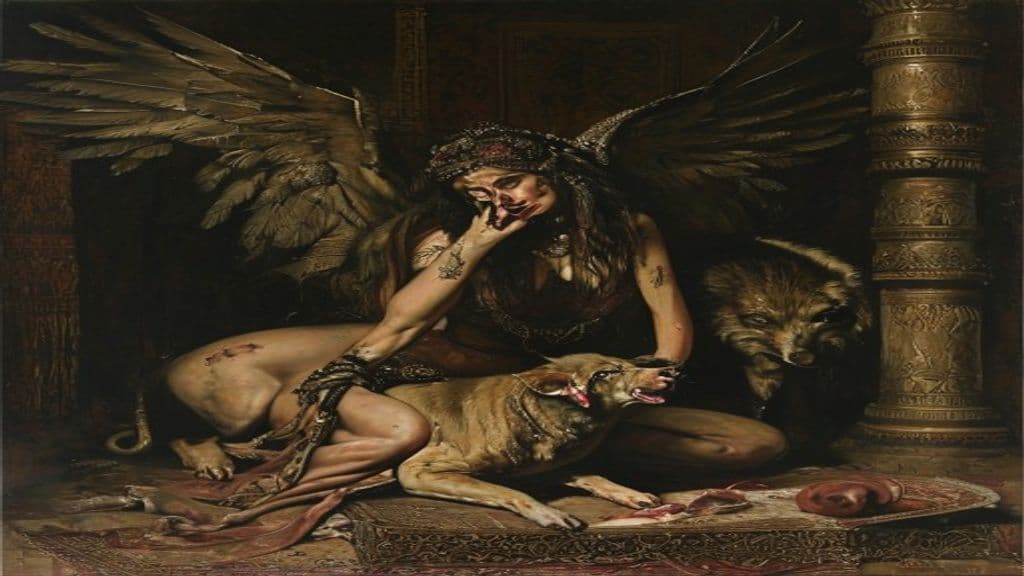
Lamashtu
The most feared demoness of ancient Mesopotamia — a divine daughter of Anu who preyed on pregnant women, caused miscarriages, and killed infants by nursing them with venom.

Gallû (gallu)
In the supplied sources, gallû (gallu) are identified as underworld spirit‑beings of Sumerian and ancient Mesopotamian religion, commonly labeled in English as demons or devils of the Mesopotamian Underworld. The name has been reused in modern fantasy role‑playing material, which adapts the term with additional fictional traits.
Community Record
- [1]Nuska (Wikipedia). Wikipedia, 'Nuska' article (entries on role as Enlil's sukkal, associations with fire/light, Maqlû, amuletic use, cult centers, and symbols).wiki
- [2]A shirgida to Nuska (Nuska A) — ETCSL translation. ETCSL translation 'A shirgida to Nuska (Nuska A)' (hymnic attestations praising Nuska's authority and attributes).academic
- [3]A shir-gida to Nuska (Nuska B) — ETCSL translation. ETCSL translation 'A shir-gida to Nuska (Nuska B)' (additional hymnic material and epithets).academic
- [4]Sadarnunna (Wikipedia). Wikipedia entry for Sadarnunna (attests Sadarnunna as Nuska's spouse and cultic pairing in Nippur).wiki