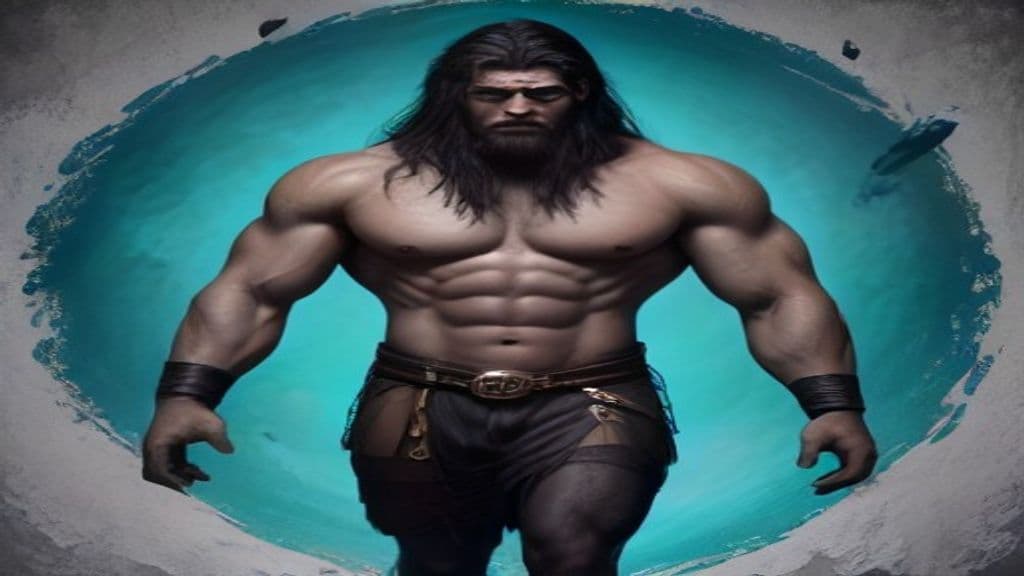
The cited sources do not provide a native origin narrative for the Ojáncanu. Modern descriptions place the being within Cantabrian mythology — the myths and legends of the pre‑Roman Cantabri of northern Iberia — but offer no indigenous account of its creation, ancestry, or cosmogonic role. Where broader historical context is mentioned, authors note that Cantabrian mythic material has later influences (for example Celtic or Roman syncretism), but the available excerpts do not link any such processes specifically to an origin story for the Ojáncanu.
Sources consistently describe the Ojáncanu as a cyclops‑like giant. Beyond the characterization as a giant and the comparative label 'cyclops‑like' or 'Celtic cyclops,' the available materials do not supply further indigenous physical details (such as exact eye count, coloration, dress, or distinguishing marks).
Available sources describe the Ojáncanu principally in moral and character terms — as 'an embodiment of cruelty and brutality' — and as a giant figure. The summaries do not enumerate specific supernatural powers, magical abilities, or detailed behaviors beyond its monstrous and violent character; no primary accounts of actions, speech, or specific feats are provided in the cited excerpts.
Arquetu
A Cantabrian popular-belief figure depicted as an old man marked with a green cross and seven keys on his forehead who intervenes in human economic affairs by lending money to prodigals and punishing repeat wastefulness with a curse of eternal poverty.
Ogunlabi (river spirit variant)
No reliable information about an entity called "Ogunlabi" (as a river-spirit variant) is present in the supplied source materials. The available sources discuss an Arsenal fan channel (AFTV) and the city and rulership of Ogbomosho in Oyo State, Nigeria, and do not document any spirit named Ogunlabi.
Ogyges
Ogyges is a primeval mythic ruler in Greek tradition, conventionally linked to Boeotia/Thebes (with an alternative tradition making him first king of Attica) and eponymous for the prehistoric age and the so‑called Ogygian deluge. His name (Ogygian) functions adjectivally to mark the very earliest, primordial times in Greek chronology and myth.
Ohomairangi
An important ancestral figure in Māori mythology, guardian of Taputapuatea marae in Rangiatea. (Note: - Power tier should be Ancient, not Greater, given that Ohomairangi lived six generations before the migration to Aotearoa. - Origin story should mention Hawaiki, not Rangiatea (Raiatea) for his place)
Ohr
Ohr (Hebrew: אור, ʾor, 'Light') is a central technical term in Kabbalah denoting divine light or emanation. It functions as a metaphysical model for how divine influence flows into and relates to the created world, rather than a personified being.
Ohthere (Vendelcrow)
Ohthere (Old Norse Óttarr vendilkráka; modern Swedish Ottar Vendelkråka) is a semi-legendary Swedish king of the Scylfing house, placed by sources in the Germanic Heroic Age, possibly early 6th century (fl. c. 515–c. 530). Literary traditions present him as a warrior-king involved in Swedish–Geatish and Swedish–Danish conflicts; a burial mound in Vendel parish (Ottarshögen) has long been associated with his name. Some narrative details (notably a Danish death in the Limfjord and the story of a wooden "Vendelcrow" of humiliation) are attested only in Snorri's later Ynglinga saga and may represent literary elaboration.
Oicles
Oicles (Anc. Greek Οἰκλῆς / Οἰκλεύς) is a mortal figure in Greek mythic genealogies and heroic-cycle narratives, known primarily as the father of the seer Amphiaraus and as a warrior who accompanied Heracles. He functions in sources as a heroic ancestor and connective node linking seer-lines, kings, and locales (Troy/Troad, Thebes, Arcadia) rather than as a supernatural being.
Okuri-inu
The Okuri-inu (送り犬, literally "escorting dog") is a Japanese yōkai encountered on mountain paths at night that follows travellers. Regional accounts identify it as a dog or wolf (okuri-ōkami, yama-inu) or as related follower-spirits (okuri-itachi); it behaves ambivalently, sometimes protecting those who comport themselves correctly and sometimes attacking or eating those who fall or panic.
Old Man of the Sea
A titular elder of the sea applied across Greek epic and local myth to ancient sea‑deities (notably Nereus, Proteus, Phorcys, Pontus) who are prophetic and often shapeshifting; in the Sinbad folktale corpus the name (Arabic: Šayḵ al‑Baḥr) denotes a parasitic, murderous sea‑monster that latches onto travellers.
Olenus
Olenus is a personal and place-name in ancient Greek tradition: a set of mythic individuals who serve as eponymous founders, rulers, or kin within genealogies, and a coastal polis in ancient Achaea whose identity is tied to those mythic traditions. Surviving references preserve names and brief roles rather than a consistent supernatural characterization.
Olevipoeg
Olevipoeg (also attested as Alevipoeg in some listings) is a named figure within the Kalevipoeg epic and related Estonian mythic/genealogical traditions. He functions as a kinship/companion figure — a son/brother-type persona in the heroic cycle rather than a standalone supernatural deity or spirit in the supplied sources.
Olganos
Olganos (Ancient Greek: Ὄλγανος) is a local river-god attested in Macedonian context. Presented as the eponymous divine personification of a river, he is recorded as a son of Beres and brother of Mieza and Beroia and is known from local cult material including an inscribed bust found at Kopanos/Emathia, dated to circa the 2nd century CE.
Community Record
- [1]Ojáncanu. Wikipedia, "Ojáncanu"wiki
- [2]Cantabrian mythology. Wikipedia, "Cantabrian mythology"wiki
- [3]Cyclops Mythology & Symbolism: The Odyssey and Beyond. Uniguide, "Cyclops Mythology & Symbolism: The Odyssey and Beyond"other
- [4]Ojancanu, The Acrobat - Jon Sholle - The Film-Makers' Cooperative. Film-Makers' Cooperative catalogue entry for "Ojancanu, The Acrobat"other
- [5]The Overkill 2024 – Zo-ii – Playful Arts & Game Curation. Zo-ii event page referencing "Overkill 2024" (mentions Ojancanu in summary material)other
- [6]Legend of Anjana (blog reference). UnMyst3 blog, "Legend of Anjana" (contextual reference to Cantabrian beings)other