
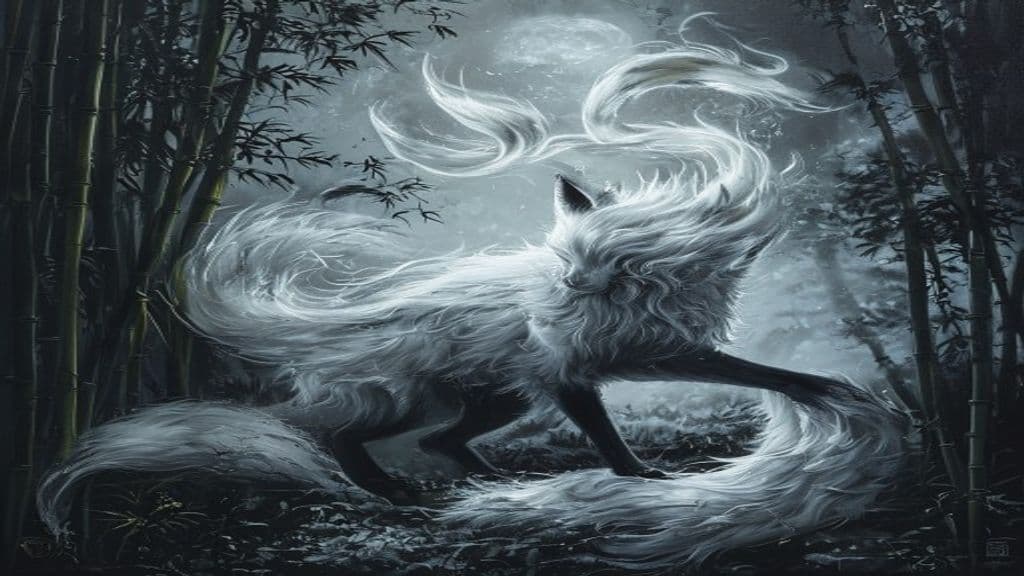
Variants in the tradition attribute the osaki's origin to fox-related mythic material. One etymology links the name 尾先 ('tail-front') to a fragment of a nine-tailed fox's tail that became an independent spirit; another (from Toen Shōsetsu) describes a tail splitting (尾裂, 'tail-split') producing the spirit. Scholars and local accounts also connect the term to misaki (spirit kin/attendant spirits). Local narratives sometimes fold broader fox myths (e.g., dispersal of pieces of the nine-tailed fox Tamamo-no-mae) into explanations for the presence of osaki in particular places.
Descriptions vary markedly by locality and teller. Generally the osaki is said to be smaller than a fox, quick of movement, and to travel in packs. Accounts include a polecat-like beast (Kyokutei Zakki); in Nanmoku (Kanra District, Gunma) it is described as a mixture of polecat and mouse or an ural-owl-like mouse, only a bit larger than a house mouse. Coloration is reported as spotted or mixed orange, brown, or gray; some describe a solid dark line from head to tail and a split tail. In Shimonita informants report human-like ears, a white-tipped nose, and occasionally a square mouth. Sources emphasize that no single, fixed appearance exists and that variation is a consistent feature of the tradition.
Folk sources describe osaki as swift, sudden-appearing pack animals that attach to households or individuals. They are credited with bringing material goods—gold, silver, rice—sporadically to families they inhabit. They may become a hereditary household attachment (families labeled osaki-mochi) or possess individuals, producing kitsunetsuki-like symptoms such as fever, agitation, mental disturbance, voracious appetite, and eccentric behavior. Social effects are prominent: osaki-mochi families commonly avoid contact with outsiders and restrict marriage to other osaki families, since marriage can transfer the condition. Local differentiation is reported — for example, yama-osaki (mountain osaki) and sato-osaki (town osaki) are distinguished in some places, with some forms said to possess people and others not.
Weaknesses
- conditionNo documented supernatural removal; tradition records irremovability
Wards
- conditionSocial avoidance and endogamy (osaki-mochi families restrict marriage and contact)
- conditionRespect toward animals locally identified as yama-osaki (mistreatment said to bring a curse)
Amanozako
Amanozako is a Japanese divine/monstrous figure described in classical summaries as a furious, contrarian kami produced from the ferocious aspect (ara-mitama) of the storm-god Susanoo; later glosses present her as an ancestor-figure for ill-tempered yōkai such as tengu and amanojaku.
Amazake-babaa
Amazake-babaa (甘酒婆, 'amazake old woman') is a Japanese yōkai figure from northern Honshū traditions associated with contagious illness. She is said to call at house doors at night asking for amazake and, if answered, brings smallpox or the common cold; local variants include a door-to-door seller (amazake-banbā/banbaa) and a Kohinata, Bunkyō account that treats her as a deified former amazake seller.
Aobōzu
Aobōzu (青坊主, "blue priest") is a Japanese yōkai whose depiction and behavior vary by locality. Appearing as a priestly humanoid with blue coloration or as a priest-faced apparition, it functions in regional legends as a frightening presence that can kidnap, threaten, or haunt people—especially children and schoolchildren—and is sometimes identified as a disguised animal or a mountain deity.
Dōsojin
Dōsojin (道祖神) are local Shinto kami venerated as tutelary guardians of liminal places such as village boundaries, crossroads, mountain passes, bridges, and roads. Represented by stones, carved couples, phallic markers, poles, or syncretic Buddhist images, they are locally maintained to ward off wandering spirits, epidemics, and to promote fertility and safe passage.
Fukurokuju
Fukurokuju is a beneficent, long-lived deity in Japanese popular religion, counted among the Seven Lucky Gods (Shichifukujin) and associated primarily with wisdom, longevity, and good fortune. His figure reflects syncretic assimilation of Chinese Taoist star-deity material (notably the Southern Polestar and the Three Star Gods tradition) into a distinct Japanese auspicious deity.
Hitotsume-kozō
A class of Japanese yōkai depicted as a bald child or young monk with a single central eye; typically a mischievous, comparatively harmless apparition that startles people and appears in Edo-period picture-books, local tales, and calendar-based folk practices.
Oyagami
Oyagami (祖神 / 親神) is a category of ancestor/parent-deity in Japanese religious thought: an ancestral spirit worshipped by a clan or a parent-like kami that cares for humans. In some sectarian contexts (notably Tenrikyo) the term is used as the personal title of the supreme deity, rendered in English as "God the Parent."
Ryūjin
Ryūjin (龍神, 'Dragon God') is a dragon-shaped water kami in Japanese myth who functions as a tutelary deity of the sea. Worshipped in strands of Shinto belief (Ryūjin shinkō), he is credited with control of tides, influence over rain and fisheries, and intervenes in human affairs from his undersea palace Ryūgū-jō.
Shōkera
A Japanese yōkai depicted in Edo-period emaki (illustrated scrolls) such as the Hyakkai Zukan and Toriyama Sekien's Gazu Hyakki Yagyō. In folk-religious contexts the shōkera is associated with the Kōshin-Machi custom and with the Three Corpses belief, functioning in tradition as a surveillant or harmful presence tied specifically to Kōshin night and to the moral cosmology of internal 'insects' that report misdeeds to heaven.
Smallpox demon (hōsōshin / hōsōgami)
In Japanese folk belief the smallpox demon (Japanese: 疱瘡神, hōsōshin / hōsōgami) is a sickness‑spirit or disease‑kami held responsible for outbreaks of smallpox. Communities treated it as an intentional supernatural agent that could be appeased, placated, driven off, or even enshrined through ritual, performance, color symbolism (especially red), and offerings.
Suijin
Suijin (水神, also Mizugami 水神 / みずがみ) is a general name in Japanese/Shinto practice for water deities and water-associated spirits. The term covers heavenly and earthly manifestations enshrined at springs, wells, rivers, ponds, irrigation works and in Suitengū shrines, and is connected with purification, safe water provision, fishing, fertility, and childbirth.
Yūrei
Yūrei (幽霊) are spirits of the dead in Japanese folklore who remain bound to the world of the living rather than having completed transition to an afterlife. They are a culturally specific category of ghost/spirits, often discussed alongside related terms such as bōrei and shiryō and appearing widely in literary, visual, and local legend contexts.
Community Record
- [1]Osaki. Wikipedia: 'Osaki' article (summarizing Kyokutei Zakki, Toen Shōsetsu, Baiō Zuihitsu and regional folklore)wiki
- [2]Wikidata: Osaki. Wikidata entry for Osaki (identifier Q385892) referenced for name variantswiki