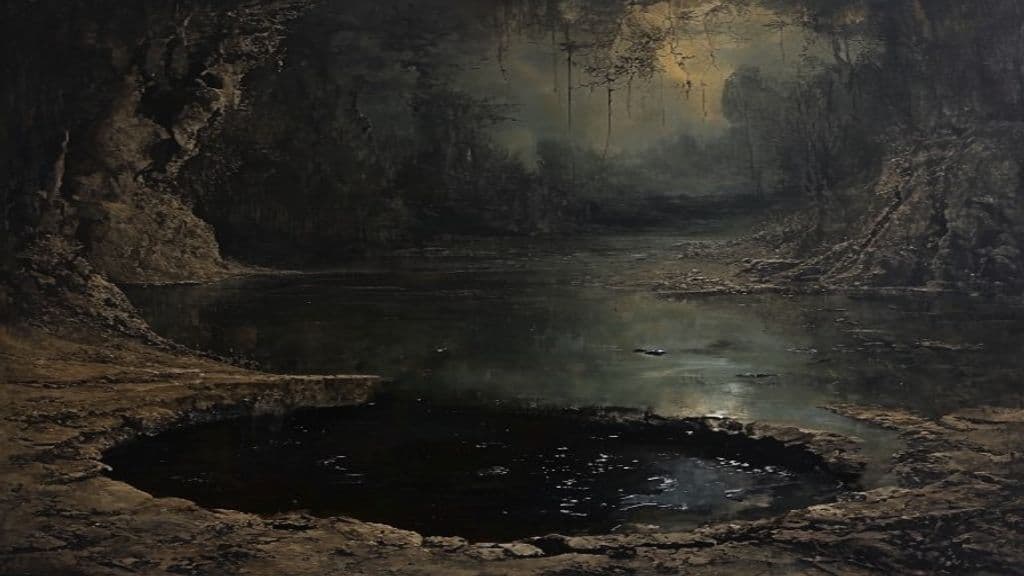
Paqarinas are believed to originate from the natural landmarks of holes in the ground and lakes, which hold spiritual significance for the Inca people.
No physical description is provided; Paqarinas may be perceptible through ritual practices or ancestral visions.
As a gateway between life and death, Paqarinas facilitate the flow of energies between worlds, serving as both origin and destination for ancestral spirits.
Weaknesses
- conditionvulnerability to disruptions of natural balance
Wards
- ritualrespect and honor for spiritual significance
- ritualancestral rituals
Chakana
A symbol used by the Inca and pre-Incan Andean societies representing a bridge or means of crossing over, with a long cultural tradition spanning 4,000 years. (Note: 1. Power tier should be Primordial as it's an ancient and widespread symbol with deep roots in pre-Incan societies. 2. Abilities section is empty and not mentioned in the source material; add a note s)
Papa (disambiguation)
Not a single folkloric entity: 'Papa' is a common word and name appearing across languages and cultures. In mythic contexts it appears as an element in names (for example Rangi and Papa in Māori mythology and Papa, an earth goddess in Cook Islands mythology) but the provided sources are a disambiguation and do not document a singular supernatural being called simply 'Papa'.
Papa Isio
Papa Isio (Dionisio Magbuelas, also recorded as Dionisio Seguela or Dionisio Papa y Barlucia) was a historical Filipino leader of a babaylan-influenced social-religious and military movement in Negros Occidental around the Philippine Revolution and the Philippine–American War. He fused indigenous spiritual authority with agrarian reform and anti-colonial nationalism, led armed resistance against Spanish and later American authorities, surrendered on August 6, 1907, and died in Old Bilibid Prison in 1911.
Papa Legba
The loa (spirit) of the crossroads in Haitian Vodou — gatekeeper between the human world and the world of the spirits. No other loa can be contacted until Papa Legba is first greeted and asked to open the gate.
Papak (Pabag)
Papak (also rendered Pabag) is attested in the provided sources primarily as a historical figure — an early 3rd-century Iranian prince/high priest associated with Istakhr in Pars — and as a modern personal name and toponym. The supplied material contains no evidence of Papak as a coherent supernatural being, spirit, or folk-creature.
Papatūānuku
Papatūānuku is the personified earth in Māori cosmology: an earth‑mother and ancestral land-figure who, together with the sky father, forms the primal couple whose union produces the atua and the natural world. She functions as the physical and spiritual ground of life and is central to genealogical, ecological, and ethical relations between people, land, and other beings.
Paps of Anu
Two mountain peaks in County Kerry, Ireland, with breast-like shapes and mythological associations to the Celtic goddess Anu. (Note: - Power tier: Not Primordial; given they are mountain peaks with a limited geographical scope, it's more accurate to categorize them as Lesser. - Summary: Should mention the mythological associations )
Paqariq Tampu
Sacred cave and birthplace of the Ayar Brothers, ancestral beings responsible for creating humans in Inca mythology. (Note: * Power tier should be Ancient instead of Primordial, as the Ayar Brothers are considered ancestral beings but not cosmic entities. * Origin story is accurate, but it could be more specific: "Accordin)
Para Brahman
Para Brahman (Sanskrit: परब्रह्म, parabrahma) is a Hindu metaphysical designation for the Supreme Brahman — the highest, ultimate Reality described as beyond all descriptions and conceptualisations. Depending on school it denotes the attribute‑less absolute (nirguṇa) or the supreme personal God (saguṇa) identified with a sectarian deity.
Parabiago Plate (Cybele and Attis)
Ancient Roman entity associated with natural cycles, time, and the forces of nature. (Note: 1. Power tier: Ancient (not Primordial), given their association with natural cycles and forces of nature. 2. Abilities: Remove "govern the interactions" - this is an inference, not explicitly stated )
Parashurama
Parashurama is the sixth avatara of the god Vishnu in Hindu tradition: an axe-bearing warrior-sage who appears to correct systemic wrongdoing (especially abusive Kshatriya power), later performs Vedic rites and retires to ascetic practice. He is counted among the Chiranjivi (immortals) and is said to reappear as the guru of the future avatara Kalki.
Paraskeva Friday
A personified figure in East Slavic folk Christianity who represents the day Friday and associated saintly cults (notably saints named Paraskeva). She functions as a localized sacred presence linked to prohibitions around women's domestic work, protective healing roles, and punitive interventions when taboos are violated.
Community Record
- [1]Paqarina (Wikipedia). Source 1wiki