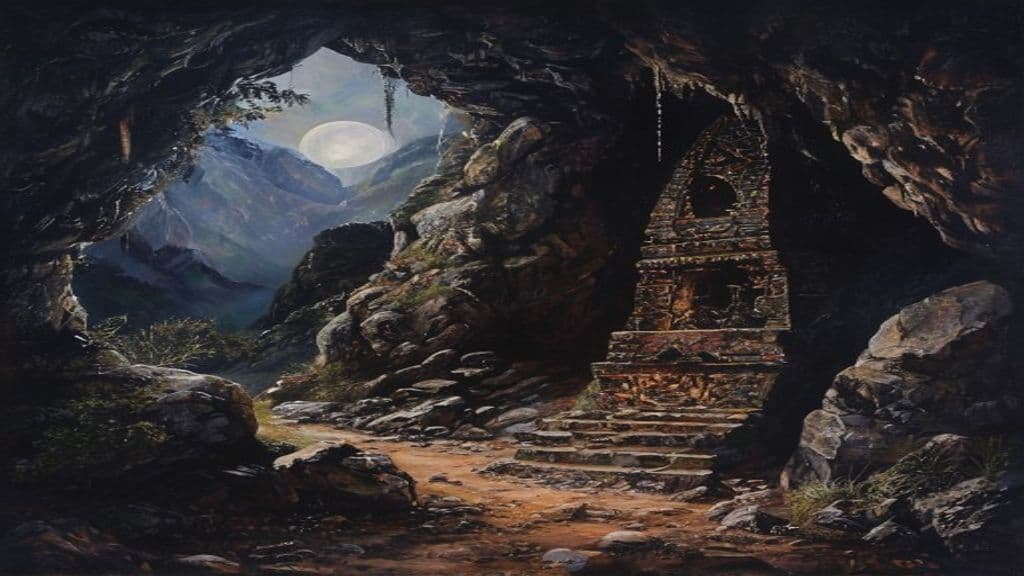
Paqariq Tampu is the birthplace of the Ayar Brothers, who are the ancestral beings responsible for creating humans. According to Incan creation myths, the Ayar Brothers were born at this sacred site and created humans through their actions.
No physical description of Paqariq Tampu is provided in the source material.
While Paqariq Tampu itself does not possess abilities, its connection to the Ayar Brothers implies a significant and fundamental role in Inca mythology. It is considered a place where the connection between the physical and spiritual worlds is strongest.
Weaknesses
None recorded.
Wards
- ritual|condition|otherconsidered a sacred location, implying potential protective properties
Huacas (Mountain Deities)
In the Quechua mythology, Huacas are mountain deities revered as protectors of regional ethnicities and central figures in myths. (Note: 1. Power tier: Primordial seems too high given that Huacas are mountain deities and not cosmic entities. 2. Appearance: Should be added that there is no physical description provided for the Huacas, b)
Inkarri
Supernatural vengeful entity that resurrects and avenges Atahualpa's death, restoring balance between Pacha Mama and humanity. (Note: 1. Power tier: Inkarri's abilities don't suggest Primordial level; it seems more like Greater or Ancient. 2. Appearance: Add a description of what Inkarri looks like after resurrecting (e.g., how its )
Pachakutic
Transformative event in Inca tradition, marking the end of one era and the beginning of another. (Note: - Power tier: Primordial (not Greater), as it represents a cosmic change in the sun or Earth's movement, which is on a universal scale. - Appearance: Remove statement about no physical description exi)
Qantu (Cantua buxifolia)
A culturally significant evergreen shrub with pink flowers in the Inca tradition. (Note: 1. Add origin story based on the Inca tradition. 2. Change Power tier to Greater: Qantu's cultural significance, association with Andean shamanism, and connection between music and flowers suggest a m)
Taki Unquy
A millenarian movement in Inca tradition that believed themselves to be reincarnations of ancient rulers and gods, seeking to restore their ancestors' rule over the Andean regions. (Note: * Power tier: Primordial is not plausible given the described abilities (resistance through armed conflict, purification rituals, and cultural revitalization efforts). A more fitting power tier would )
Yanantin
In Inca tradition, Yanantin is a philosophical concept representing the interdependent and essential parts of a harmonious whole, based on complementary opposites. (Note: 1. Power tier should be Ancient (deity-level), as it's a fundamental concept in Andean thought. 2. The appearance section is correct ("no physical description"). 3. Abilities section needs to reflect )
Papatūānuku
Papatūānuku is the personified earth in Māori cosmology: an earth‑mother and ancestral land-figure who, together with the sky father, forms the primal couple whose union produces the atua and the natural world. She functions as the physical and spiritual ground of life and is central to genealogical, ecological, and ethical relations between people, land, and other beings.
Paps of Anu
Two mountain peaks in County Kerry, Ireland, with breast-like shapes and mythological associations to the Celtic goddess Anu. (Note: - Power tier: Not Primordial; given they are mountain peaks with a limited geographical scope, it's more accurate to categorize them as Lesser. - Summary: Should mention the mythological associations )
Paqarina
In Incan mythology, Paqarinas are primordial portals between life and death that serve as gateways for ancestral energies. (Note: - Origin story: change to describe that Paqarinas are believed to originate from natural landmarks, such as holes in the ground and lakes, rather than stating they hold spiritual significance for the )
Para Brahman
Para Brahman (Sanskrit: परब्रह्म, parabrahma) is a Hindu metaphysical designation for the Supreme Brahman — the highest, ultimate Reality described as beyond all descriptions and conceptualisations. Depending on school it denotes the attribute‑less absolute (nirguṇa) or the supreme personal God (saguṇa) identified with a sectarian deity.
Parabiago Plate (Cybele and Attis)
Ancient Roman entity associated with natural cycles, time, and the forces of nature. (Note: 1. Power tier: Ancient (not Primordial), given their association with natural cycles and forces of nature. 2. Abilities: Remove "govern the interactions" - this is an inference, not explicitly stated )
Parashurama
Parashurama is the sixth avatara of the god Vishnu in Hindu tradition: an axe-bearing warrior-sage who appears to correct systemic wrongdoing (especially abusive Kshatriya power), later performs Vedic rites and retires to ascetic practice. He is counted among the Chiranjivi (immortals) and is said to reappear as the guru of the future avatara Kalki.
Community Record
- [1]Paqariq Tampuwiki