
Born to the sage Jamadagni and his wife Renuka, Parashurama is presented in the epic and Purana tradition as an avatara of Vishnu who manifests in human history to correct overwhelming evil, notably abuses by the Kshatriya warrior class. Legendary episodes include his violent vengeance for his father's murder and subsequent large-scale slaughters of Kshatriyas, performance of the ashvamedha sacrifice, gifts of land to Brahmin rishis, and later withdrawal to penance and yoga. Regional legends also credit him with reclaiming stretches of the western coast by throwing his battle-axe into the sea.
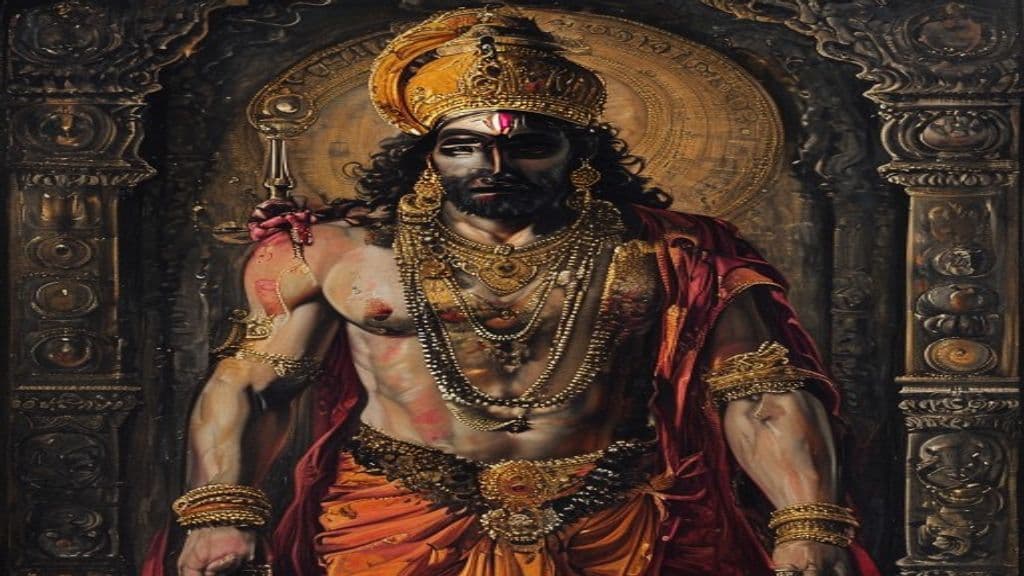
Classical sources emphasize Parashurama's armed-sage identity: a warrior ascetic prominently associated with the parashu (battle-axe) which gives him his name ('Rama with an axe'). Narrative episodes portray him as an axe-bearing combatant and a Brahmin-sage hybrid (son of Jamadagni), but the supplied excerpts do not provide a standardized description of complexion, dress, or precise iconographic details.
As an avatara of Vishnu he is granted divine authority and exceptional martial prowess: he is described as slaying large numbers of Kshatriyas when they abuse power and as routing kings and armies in those episodes. He performs major Vedic rites (notably the ashvamedha), redistributes land to Brahmin seers, acts as guru to epic warriors (Mahabharata traditions list Bhishma, Drona, and Karna among those associated with him), and is counted among the Chiranjivi who endure across ages and will instruct the future avatara Kalki. Some regional legends ascribe cosmogenic power to his axe (reclaiming land from the sea when he throws it). His narrative arc also stresses renunciation and penance after violent action.

Dashavatara
Dashavatara (Sanskrit: daśāvatāra) names a canonical set of ten principal incarnations of the Hindu god Vishnu, each a full descent (avatara) taken to restore cosmic order (dharma) at moments of great disorder. The list and order of the ten vary by Purānic and sectarian traditions; the concept functions across mythology, temple cult, and devotional practice.
Rāma
Rāma is a major divine-hero in Hindu tradition, worshipped as the seventh avatar of Viṣṇu and the central protagonist of the Ramayana. He is portrayed both as the ideal man (maryāda puruṣottama) and, in Rama-centric sects, as the Supreme Being; his life-story (birth in Ayodhyā, 14-year exile, Sītā's abduction, and the defeat of Rāvaṇa) functions as a primary exemplar of dharma.
Adi (asura)
Adi is attested in modern reference works as the name of an Asura who 'appears in the Matsya Purāṇa.' Beyond this single-line citation in secondary sources, no descriptive material about the figure is provided in the supplied research notes.
Adi Shakti
Adi Shakti (also Adi Parashakti, Mahadevi, Adya Shakti) is the primordial feminine power in Hindu/Shakta theology, regarded as the ultimate reality (Para Brahman) and the source from which all goddesses and gods manifest. She is both an impersonal cosmic principle (Mulaprakriti) and a focus of devotional invocation in temples, mantras, and pilgrimage sites such as Shakti Peethas.
Adi Vinayaka
Adi Vinayaka (Ādi Vināyaka; also called Nara Mukha Vinayaka) is a named iconographic and devotional form of the Hindu god Ganesha portraying the deity with a human head, described in sources as the form before the episode of decapitation by Shiva. It is rarely worshipped and appears in a small number of South Indian shrines and in devotional/musical repertoires.
Aditi
Aditi is a major Vedic goddess in Hindu tradition who personifies the boundless, infinite cosmic principle and functions as the maternal matrix from which many celestial deities (the Ādityas and other groups) are born. In the Vedic hymns she is invoked as a protective liberator who guards petitioners, provides wealth and safety, and frees devotees from hindrances such as sin and sickness.
Agni
Agni is the Vedic personification of fire in Hindu tradition: a sacred, mediating principle that manifests as terrestrial fire, atmospheric lightning, and celestial sun, and that receives and conveys sacrificial offerings. Prominent in the Rigvedic corpus, Agni functions as sanctifier, witness of rites of passage, and a transformational inner principle in later Upanishadic literature.
Ahalya
Ahalya is a mytho-legendary woman of South Asian (primarily Hindu) narrative tradition, described as created by the god Brahma, married to the sage Gautama, seduced (or tricked) by Indra, cursed by her husband, and ultimately redeemed by Rama. Her tale is a locus for themes of creation, desire, curse/penance, and redemption and she is counted among the ritual-mnemonic panchakanya.
Aindri (Indrani / Shachi / Paulomi)
Aindri (commonly rendered in sources as Indrani, also called Shachi or Paulomi) is a Hindu goddess presented as the queen-consort of Indra. She is depicted in the available material as a courtly queen associated with beauty, pride and kindness who also appears in at least one account as an active martial participant in the devas' battles with asuras.
Akshayavata
In Hindu mythology, Akshayavata is a sacred banyan tree and/or lake that symbolizes eternal life. It is mentioned in both Hindu and Jain traditions and associated with the Puranas. (Note: - The power tier should be "Greater" or at least "Ancient", as it is associated with the Puranas, which are considered ancient texts. - No specific physical description is provided, but that doesn't m)
Alakshmi
Alakshmi is an inauspicious female supernatural figure in Hindu tradition, presented as the negation or shadow-counterpart of the prosperity-goddess Lakshmi. She personifies poverty, grief, jealousy and social discord and is managed in domestic ritual and festival practice.
Alamelu
Alamelu (also Alamelu Manga / Alarmel Mangai) is a South Indian devotional name for the goddess Padmavati, identified in sources as an avatar of Lakshmi and the consort of Venkateswara; the name is also used widely as a female personal name and in titles of cultural works in Tamil and Telugu contexts.
Amrita (Buddhist tradition)
In the context of Indian religions, particularly within Hinduism and Buddhism, Amrita is a divine elixir that grants immortality and eternal life. (Note: - Power tier should be Ancient (deity-level), not Primordial. - Origin story appears accurate but lacks specificity on when Amrita was first mentioned in the Rigveda; add more detail. - Abilities are )
Ananta (Infinite)
Ananta (Sanskrit: अनन्त, 'without end') is primarily an epithet of Vishnu and a symbolic principle of infinity that is personified as the cosmic serpent Shesha. In Puranic imagery Ananta/Shesha forms the multi‑headed couch and canopy for Vishnu as he rests on the cosmic waters between cycles of creation (pralaya), and thus underwrites cyclical cosmogenesis.
Community Record
- [1]Parashurama (Wikipedia). Wikipedia: Parashuramawiki
- [2]Parashurama Jayanti (Wikipedia). Wikipedia: Parashurama Jayantiwiki
- [3]Wikidata: Parashurama. Wikidata entry for Parashuramaother
- [4]The Doctrine of Parashurama (Boloji article). Boloji: The Doctrine of Parashuramaother
- [5]Avadhuta Gita (archive). Archive: Avadhuta Gita (mention of Dattatreya teaching Parashurama in traditions)other
- [6]Episode 51 - Krishna comes to Town (archive). Archive episode containing related epic materialother
- [7]Caves of India: Punarjani Guha. ShowCaves: regional legend referencesother