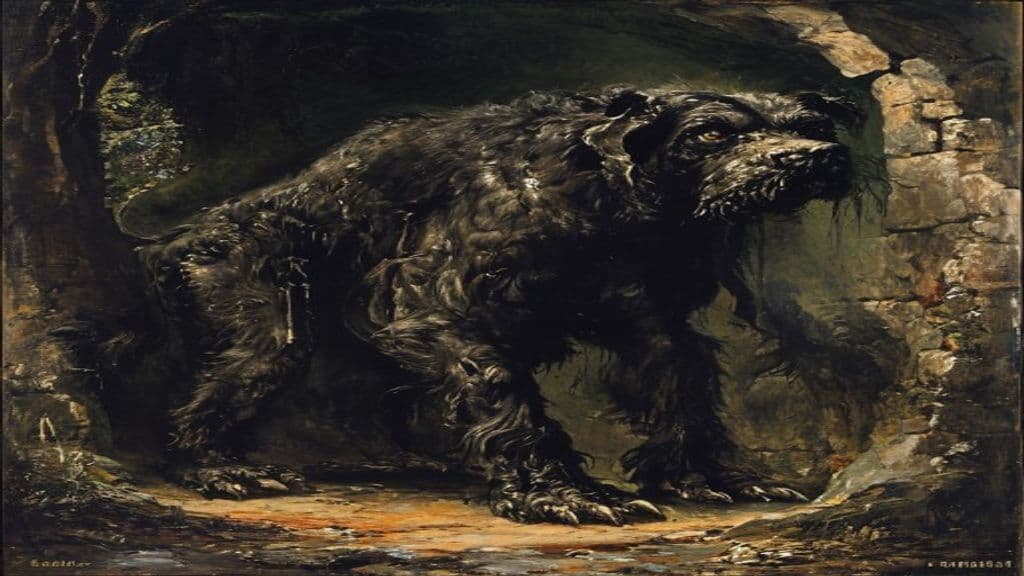
No mythic cosmogonic origin is supplied in the cited sources. The Pesanta appears in Catalan legend and popular culture as a folkloric explanation for oppressive nocturnal experiences (difficulty breathing and nightmares). Sources do not record a creation or origin narrative for the creature; it functions chiefly as a nocturnal menace in folk explanation rather than a figure with a detailed origin story.
Sources consistently describe the Pesanta as an enormous, heavy, black and hairy quadruped—commonly a dog, though some versions say cat. The Wikipedia summary specifies it is black and hairy and notes its paws are described as 'steel' and that 'its paws have holes in them.' Some derivative summaries add variants that identify the Pesanta as a witch or an animal of undefined form, and certain fandom pages report local variants placing it in abandoned churches or ruins; those latter details are variant attestations in contemporary summaries rather than part of the core encyclopedia entry.
The Pesanta's primary behavior is entering houses at night and climbing onto sleepers' chests, making breathing difficult and causing nightmares—an account framed in the sources as a folkloric explanation for experiences now associated with sleep paralysis. Sources link the Pesanta by comparison to other night‑attacking beings (for example, the Portuguese Pisadeira, Batibat, and Lietuvēns). While some fandom pages mention the creature 'hits' with steel paws, traditional encyclopedia descriptions emphasize the chest‑pressing and nightmare‑causing role; no extensive catalogue of broader supernatural powers is provided in the cited folkloric sources.

Hellhound
A class of mythic canine beings associated across many cultures with the boundary between the human world and the underworld or otherworld. Depending on tradition they function as guardians or attendants of the realm of the dead, members of spectral hunts, omens of death, or emissaries of diabolic forces.
Persian Cat (Persian Tradition)
A traditional breed of cat characterized by its long hair and round face with a petite, but not flat or smashed-in muzzle. (Note: - Power tier should be Primordial (the entity is a traditional breed of cat with no supernatural abilities mentioned), so change to Primordial. - The origin story section is missing and needs to be fi)
Persinette
Persinette is the human heroine of a 1698 French literary fairy tale by Charlotte-Rose de Caumont de La Force. In the story she is given to a fairy as recompense for stolen parsley, raised and then confined in a tower, and later reunited with a prince; elements of magic surround her fate but she herself is portrayed as mortal.
Persipnei
Persipnei (also Phersipnai, later Ferspnai) is the Etruscan queen of the underworld, consort to the underworld ruler Aita and the principal female sovereign in Etruscan netherworld iconography. She is an Etruscan analogue of the Greek Persephone and Roman Proserpina and appears chiefly in tomb frescoes.
Personifications of Death
Named, often anthropomorphic figures across cultures that embody, govern, or mediate death and the realm of the dead. Roles vary from psychopomp guide to judge or sovereign of an underworld, and forms range from skeletal reapers to regal underworld rulers and spirit families.
Perun
The highest god in the Slavic pantheon, associated with law, war, thunderstorms, and fertility. (Note: - Power tier should be Ancient -> Primordial (as he is described as the "highest god" and his attributes are cosmic in scale) - Abilities should include control over mountains, as mentioned in the sou)
Peryton
A modern literary chimera combining stag and bird anatomy, originally described by Jorge Luis Borges as a fictional species with a peculiar life-history and a prophetic association; later reused in heraldry, fantasy fiction, and gaming as a winged-deer monster or heraldic charge.
Petbe
Petbe is attested in modern summaries as a localized deity associated with retributive justice, described as a "god of revenge" worshipped around Akhmim in central Egypt. Sources present competing etymological readings (e.g., "Sky-Ba" vs. a hybrid Pet-(Baʻl)) and offer little surviving detail about cult practice, iconography, or myths.
Peter Pevensie
Peter Pevensie is a fictional human character created by C. S. Lewis who appears in The Chronicles of Narnia. An evacuated English boy who becomes High King Peter the Magnificent in Narnia, he functions as a divinely‑sanctioned monarch and head general in Aslan's cause and is one of the two Sons of Adam prophesied to rule at Cair Paravel.
Petni
The female equivalent of the Bengali bhoot — the ghost of a young woman who died unmarried or before fulfilling her expected life. The Petni is more volatile and less predictable than the Shakchunni (married woman's ghost), driven by the particular bitterness of a life foreclosed rather than interrupted.
Petrosinella
Petrosinella is the human heroine of a Neapolitan fairy tale recorded by Giambattista Basile (Lo cunto de li cunti, 1634). Named for the local word for parsley, she is given to an ogress as the consequence of her mother's theft, confined in a tower, taught magic arts, and later escapes using three magical gallnuts/acorns in a classic ATU 310/313 sequence.
Pey (Tamil)
No substantive information about the Tamil term 'pey' as a supernatural entity is present in the supplied source materials. The available documents include an English-language disambiguation page and unrelated archival items; they do not describe pey's nature, appearance, abilities, rituals, or cultural context.
Community Record
- [1]Pesanta. Wikipedia: 'In Catalan legend and popular culture, the Pesanta (Catalan pronunciation: [pəˈzantə]) is an enormous dog or cat that goes into people's houses in the night and steps on their chests, making it difficult for them to breathe and causing nightmares... It is black and hairy, with steel paws, but its paws have holes in them.'wiki
- [2]Pesanta (Wikidata). Wikidata entry for Pesanta (identification and metadata linked to the Wikipedia article).wiki
- [3]Pesanta (folklore) | Villains Wiki | Fandom. Fandom summary describing the Pesanta as an enormous heavy black and hairy dog/cat, noting variants that identify it as a witch and mentions of ruins/abandoned churches in some summaries.folk
- [4]Pesanta | Cryptid Wiki | Fandom. Cryptid/monster fan sources summarizing the creature's chest‑pressing behavior and describing appearance (black, hairy, large), used as derivative corroboration of popular descriptions.folk
- [5]Pesanta Urfolk Briefs. Blog/urfolk brief summarizing the Pesanta's traits and comparative placement among sleep‑oppressive beings.other
- [6]Pesanta (modern cultural reference - comic blurb). Promotional/comic text using the pesanta image metaphorically: 'The most terrifying place is inside your very own head, and the pesanta knows what's in there.'literary