
Peter is introduced as the eldest of four English siblings evacuated from London during World War II to the country house of Professor Digory Kirke. Through the wardrobe portal the children enter Narnia, where a prophecy that 'two Sons of Adam and two Daughters of Eve' will sit on the thrones of Cair Paravel comes to fruition. Peter is appointed by Aslan as head General and, after military victories against the White Witch's forces, is crowned High King of Narnia, initiating the realm's Golden Age. After reigning in Narnia for fifteen years he returns with his siblings to England and resumes his life there as a child.
C. S. Lewis's texts do not provide detailed canonical descriptions of Peter's hair, eye colour, or complexion. The original novels were illustrated by Pauline Baynes, whose illustrations depict Peter with dark hair. Other visual depictions in adaptations and tie‑ins draw on these illustrations but the primary literary source remains non‑specific about exact physical details.
Peter possesses leadership, martial skill, and legitimate authority within Narnia's internal cosmology. He is appointed head General of Aslan's army, receives a sword (Rhindon) and shield from Father Christmas, kills the wolf Maugrim in battle and is knighted 'Sir Peter Wolf's‑Bane' by Aslan, and is crowned 'High King Peter the Magnificent' with titles including Lord of Cair Paravel and Emperor of the Lone Islands. His abilities are primarily human excellence in combat, command, and kingship rather than intrinsic supernatural powers; his authority is reinforced by Aslan's ordination and by prophetic legitimacy. He also demonstrates moral agency: protective responsibility toward his siblings, capacity for righteous anger, and the ability to repent and confess wrongdoing.
Weaknesses
- conditionHuman limitations (mortality, non-supernatural nature)
- conditionEmotional impulsiveness (anger toward Edmund which he later acknowledges as morally problematic)
- conditionTemporal vulnerability (ages differently between Narnia and England; after fifteen years' reign he reverts to his English age and cannot remain as Narnian adult)
Wards
- otherNone documented — Peter is a human protagonist and no magical wards or protections specifically directed at or against him are recorded in the cited sources
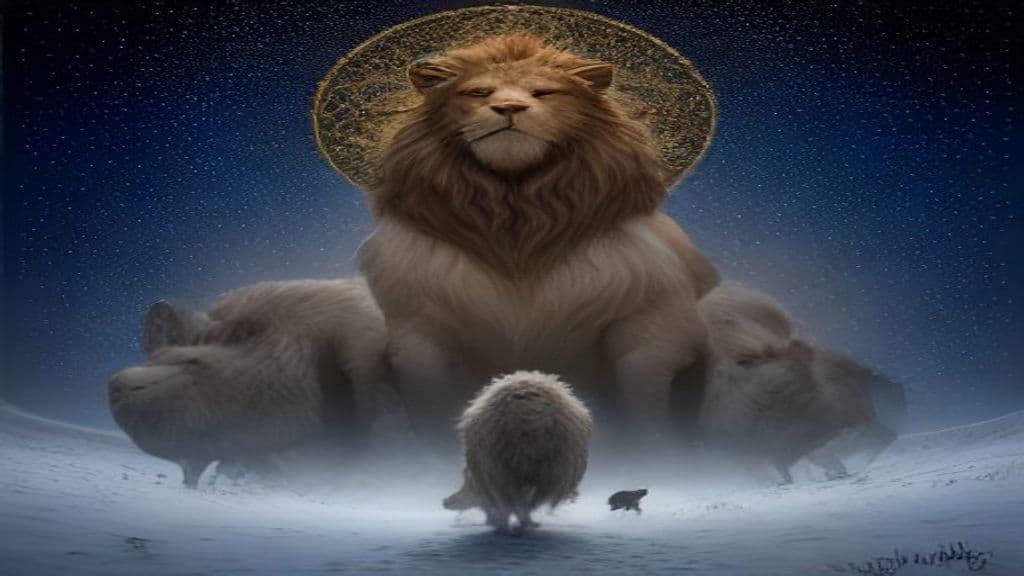
Aslan
Aslan is the singular, talking lion figure at the center of C. S. Lewis's The Chronicles of Narnia, functioning as creator, king, judge, savior, and moral authority within that fictional cosmology. The name also appears in unrelated contexts (personal names, a lion-like alien in Traveller RPG) but those are distinct referents.

Maugrim
Maugrim is a fictional Talking Animal — a large, sentient Narnian wolf — who serves as the Captain of the White Witch's Secret Police in C. S. Lewis's The Lion, the Witch and the Wardrobe. He functions as an armed enforcer of the Witch's tyranny, is described as very large and fearsome, and is ultimately killed in single combat by Peter Pevensie.

Edmund Pevensie
Edmund Pevensie is a fictional English schoolboy created by C. S. Lewis who appears as a principal human character in The Chronicles of Narnia. He begins as a spiteful, selfish child, betrays his siblings under the influence of the White Witch, is redeemed through Aslan's sacrificial intervention, and later reigns as King Edmund the Just in Narnia before returning to England.

Lucy Pevensie
Lucy Pevensie is a fictional human child and one of the four Pevensie siblings in C. S. Lewis's Chronicles of Narnia. Within Lewis's narrative cosmology she is a mortal human who travels between England and Narnia, noted for her faith, compassion, and special receptivity to Aslan; she is crowned Queen Lucy the Valiant and later enters Aslan's Country after death.
Persipnei
Persipnei (also Phersipnai, later Ferspnai) is the Etruscan queen of the underworld, consort to the underworld ruler Aita and the principal female sovereign in Etruscan netherworld iconography. She is an Etruscan analogue of the Greek Persephone and Roman Proserpina and appears chiefly in tomb frescoes.
Personifications of Death
Named, often anthropomorphic figures across cultures that embody, govern, or mediate death and the realm of the dead. Roles vary from psychopomp guide to judge or sovereign of an underworld, and forms range from skeletal reapers to regal underworld rulers and spirit families.
Perun
The highest god in the Slavic pantheon, associated with law, war, thunderstorms, and fertility. (Note: - Power tier should be Ancient -> Primordial (as he is described as the "highest god" and his attributes are cosmic in scale) - Abilities should include control over mountains, as mentioned in the sou)
Peryton
A modern literary chimera combining stag and bird anatomy, originally described by Jorge Luis Borges as a fictional species with a peculiar life-history and a prophetic association; later reused in heraldry, fantasy fiction, and gaming as a winged-deer monster or heraldic charge.
Pesanta
A Catalan legendary night creature—usually an enormous black, hairy dog or sometimes a cat—that enters houses at night and presses on sleepers' chests, causing breathing difficulty and nightmares. It is cited in comparative folklore lists alongside other sleep‑oppressive beings and appears in modern culture as an emblem of nocturnal terror.
Petbe
Petbe is attested in modern summaries as a localized deity associated with retributive justice, described as a "god of revenge" worshipped around Akhmim in central Egypt. Sources present competing etymological readings (e.g., "Sky-Ba" vs. a hybrid Pet-(Baʻl)) and offer little surviving detail about cult practice, iconography, or myths.
Petni
The female equivalent of the Bengali bhoot — the ghost of a young woman who died unmarried or before fulfilling her expected life. The Petni is more volatile and less predictable than the Shakchunni (married woman's ghost), driven by the particular bitterness of a life foreclosed rather than interrupted.
Petrosinella
Petrosinella is the human heroine of a Neapolitan fairy tale recorded by Giambattista Basile (Lo cunto de li cunti, 1634). Named for the local word for parsley, she is given to an ogress as the consequence of her mother's theft, confined in a tower, taught magic arts, and later escapes using three magical gallnuts/acorns in a classic ATU 310/313 sequence.
Pey (Tamil)
No substantive information about the Tamil term 'pey' as a supernatural entity is present in the supplied source materials. The available documents include an English-language disambiguation page and unrelated archival items; they do not describe pey's nature, appearance, abilities, rituals, or cultural context.
Phaeacians (Scheria)
The Phaeacians are the inhabitants of the mythic island Scheria (Phaeacia) in Homeric tradition, depicted as a hospitable, seafaring people who receive Odysseus near the end of his wanderings and provide him passage home. In the Odyssey they occupy a liminal, utopian-like society visited openly by gods and characterized by courtly entertainments, skilled shipcraft, and formal hospitality (xenia).
Phaeno
Phaeno (Ancient Greek: Φαινώ, Phainô) is attested in classical sources as one of the 3,000 Oceanids, daughters of the Titans Oceanus and Tethys, and listed as a companion of Persephone. The name also designates a modern science centre in Wolfsburg, Germany (Phæno), but in a folklore context the relevant referent is the Oceanid listed in mythological catalogues.
Phaeocomes
Phaeocomes is a named centaur warrior appearing in Ovid's Metamorphoses (Book XII) during the Centauromachy; he is described wearing joined lions' hides as armor and wielding an enormous wooden club, performing violent martial deeds in the epic battle. The same lexical form also appears as a species epithet in mycological taxonomy (Pyrenophora phaeocomes) in unrelated scientific literature.
Community Record
- [1]Peter Pevensie. Wikipedia: 'Peter Pevensie is a fictional character in C. S. Lewis's The Chronicles of Narnia book series.'; details on coronation, knighthood, gifts from Father Christmas, and illustration notes.wiki
- [2]Peter Pevensie (Wikidata). Wikidata entity summarizing canonical appearances and attributes.wiki
- [3]The Chronicles of Narnia: The Lion, the Witch and the Wardrobe Demo (archive notes). Archive.org demo description: children use combat skills and weaponry to defeat the Witch and her armies; supports depiction of Peter as martial leader in adaptations.other
- [4]Prince Caspian (archive item). Archive materials referencing Peter's continued role and presence across the series.other
- [5]Fan and reference pages (compilation). Fanlore summary aggregating appearances and portrayals (used for supportive detail on depiction and cultural reception).other