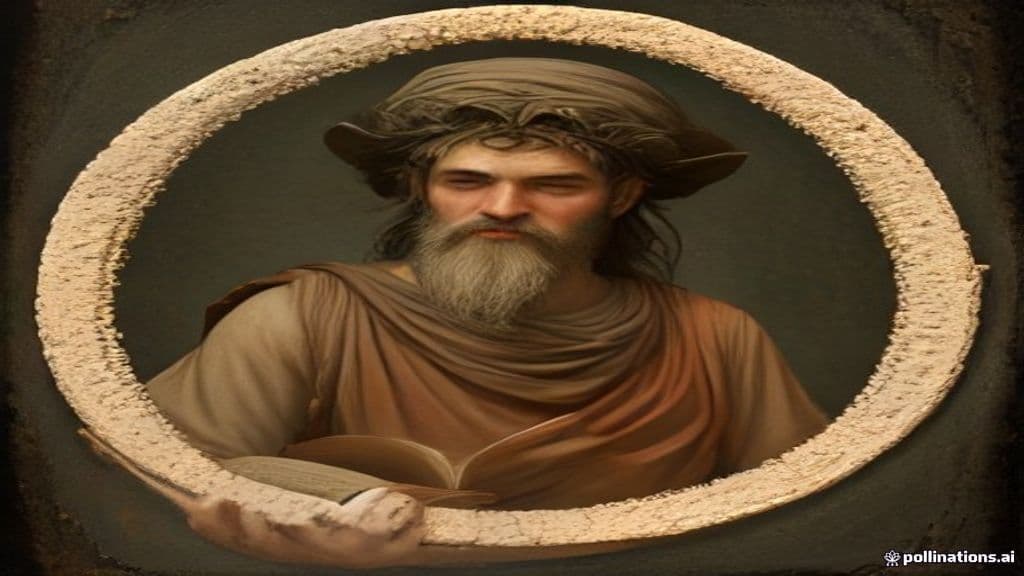
Philoetius is presented within the Homeric narrative as a member of Odysseus's oikos (household) on Ithaca who has served as the primary cowherd during Odysseus's prolonged absence. He is introduced in the return episodes: in Book 20 he is described as bringing a barren heifer and some goats to the palace, and in the climactic sequence surrounding the slaying of the suitors he appears as one of Odysseus's faithful retainers who aids the master in regaining control of his household. The sources position him as a longstanding practical member of the household workforce whose steadfastness during the twenty years of Odysseus's absence is narratively significant and rewarded by Odysseus with promises of freedom and elevated status.
The provided sources do not offer a detailed physical portrait of Philoetius (no measurements or clothing descriptions). He appears in the poem in the roleful guise of a working herdsman: arriving to the palace bringing livestock (explicitly a barren heifer and some goats in Book 20), identifiable by his occupation as Odysseus's primary cowherd and by his actions within the household and at the gates during the conflict with the suitors.
Philoetius's capacities are non-supernatural and practical: he is skilled in herding and the care of cattle as Odysseus's principal cowherd, reliably performs household duties, and obediently carries out Odysseus's tactical commands (for example, locking the palace doors and hiding the suitors' weapons). He also takes part in armed combat alongside Odysseus, Eumaeus, and Telemachus during the slaughter of the suitors and is named in the narrative tradition as killing at least one suitor (Peisander). His significance in the poem derives from loyalty, competence in pastoral and household tasks, and willingness to fight in defense of the oikos.
Weaknesses
- conditionmortal vulnerability and social dependency on the oikos
Wards
None recorded.

Phi Krasue
Phi Krasue is a nocturnal female spirit in Thai/Isan popular belief, depicted as a floating disembodied woman's head with trailing internal organs. Situated within Buddhist-syncretic and local animist worldviews, it functions as a visceral, boundary-enforcing specter in village and regional folklore and continues to appear in contemporary media.
Phi Phong
A ghostly spirit of northern Thai folklore described as the result of black magic gone awry; in modern media a related variant is depicted as a blood‑feeding nocturnal entity. It is framed in sources as arising from failed dark sorcery and appears in contemporary regional horror films.
Phi Pop
A Thai possessing spirit that inhabits a living person and compels them to consume raw entrails at night — the possessed victim may be unaware, accused by their community, and driven out.
Phi Tai Hong
Phi Tai Hong (ผีตายโหง) are vengeful, restless spirits in Thai folklore arising from people who die suddenly and violently. They are feared as especially dangerous and difficult to exorcise; the pregnant-woman variant (Tai Thang/Tai Thong Klom) is regarded as particularly malevolent.
Philippine mythical creatures
A broad, plural category of legendary beasts, monsters, and supernatural beings found across more than 140 ethnic groups in the Philippines; these beings occupy local folkloric cosmologies and are distinct from major deities and heroes. They appear in traditional tales and in contemporary retellings and media, which continue to reinterpret and popularize them.
Philoctetes
A mortal Greek hero and famed archer, son of Poeas, who inherits Heracles’ bow and arrows; abandoned because of a festering, foul-smelling wound and later recalled because possession of Heracles’ weapons is prophesied as necessary for Greek victory at Troy. His story appears across epic and tragic traditions (Homeric cycle references; Sophocles’ Philoctetes) and explores themes of suffering, divine causation, healing, and communal obligation.
Philomache (Phylomache)
Philomache (Ancient Greek: Φυλομάχη), also spelled Phylomache, is a mythological mortal woman appearing in classical Greek genealogical traditions as a Minyan princess of Orchomenus who in some accounts is named as the wife of Pelias of Iolcus and mother of Acastus and several daughters. She functions as a dynastic link in heroic-age family networks rather than as a supernatural being.
Philonis
Philonis (Ancient Greek: Φιλωνίς) is a mythic mortal woman from Greek genealogical tradition, variously identified as daughter of Daedalion or of Eosphoros and Cleoboea (and in some accounts as daughter of Deion of Phocus). She is named as the mother of Philammon by Apollo and Autolycus by Hermes and is sometimes equated with figures called Chione, Leuconoe, or Telauge in alternate traditions.
Philyra
Philyra is a homonymous name attested in several registers: as the name of multiple female figures in Greek mythology (an Oceanid mother of Chiron; a named wife of Nauplius; a daughter of Asopus and mother of Hypseus), as a Linnaean genus name applied to decapod crustaceans (e.g., Philyra globosa), and as a modern cultural reference used as an EP/album title in Mountain Goats setlists. The provided sources do not support treating Philyra as a single folkloric supernatural entity.
Phineus (son of Belus)
Phineus is a legendary Greek seer-king of the heroic age: a mortal prophet granted the gift of divination who is tormented (notably by Harpies) and appears in Argonautica-type narratives to counsel heroes such as the Argonauts. His parentage and fate vary across traditions, which attribute his blinding, harassment, and later partial restoration to different divine or heroic agents.
Phlegyas
Phlegyas is, in the provided source, a figure of Greek mythology identified as a king of the Lapiths. The material treats him as an individual human ruler within mythic genealogies rather than as a class of supernatural beings.
Phocus of Aegina
Phocus of Aegina is a mythic mortal prince of the Aeacid house, named in classical summaries and genealogies as a son of King Aeacus of Aegina and Psamathe. In the supplied sources he functions as a genealogical and political figure within the heroic-age network of kings rather than as a supernatural being or cultic figure.
Community Record
- [1]Philoetius — Wikipedia. Wikipedia, 'Philoetius' entrywiki
- [2]Philoetius — Wikidata. Wikidata entry for Philoetiusother
- [3]The Odyssey, Book 20 (Internet Classics Archive). Homer, Odyssey, Book 20 (translation available at Internet Classics Archive)literary
- [4]The Odyssey, Book 23 (Internet Classics Archive). Homer, Odyssey, Book 23 (translation available at Internet Classics Archive)literary
- [5]The Odyssey, Book XX (Butler translation, pagebypagebooks). Homer, Odyssey, Book XX, Butler translation (pagebypagebooks)literary
- [6]The Odyssey, Book XXIII (Butler translation, pagebypagebooks). Homer, Odyssey, Book XXIII, Butler translation (pagebypagebooks)literary
- [7]Bibliomania — The Odyssey: Books 20-24. The Odyssey Books 20-24 (Bibliomania online edition)literary
- [8]Swartzentrover — Homer - The Odyssey - Book 20. Homer, Odyssey Book 20 (online translation)literary
- [9]SpiritualPilgrim.net — Book 20 - Odyssey of Homer. Homer, Odyssey Book 20 (online translation)literary
- [10]Odyssey odtel 07 (users.globalnet.co.uk). Homer, Odyssey (online translation/resource)literary
- [11]Melanthius (Odyssey) — Wikipedia. Wikipedia entry for Melanthius (discusses related household figures)wiki