In the genealogical tradition preserved in literary summaries, Pleuron is born to Aetolus (son of Endymion in many accounts) and Pronoe, daughter of Phorbas. He is consistently named as brother to Calydon; together their names explain two neighbouring Aetolian cities. Pleuron is reported as married to Xanthippe, daughter of Dorus, and as father to children including Agenor, Sterope, and Stratonice. The tradition links him to the heroic/mythic age and places him among the generational ancestors used to situate later figures and local dynasties.
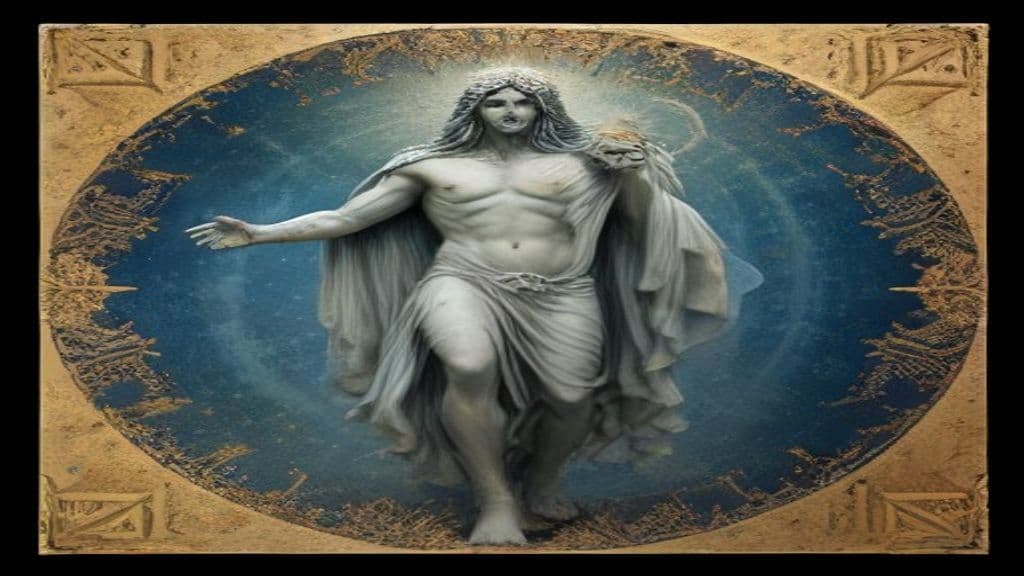
The sources provide no physical description or consistent iconography for Pleuron. He appears in texts solely as a genealogical and toponymic name rather than as a visually characterized or depicted figure.
No supernatural powers or characteristic supernatural behaviors are attributed to Pleuron in the provided material. His functional role is familial and eponymic: as an ancestor and namesake he anchors local identity and lineage. A summarized tradition records that he (with figures like Calydon) was counted among those who 'built cities in Aetola called by their own names,' reflecting the conventional founder-role assigned to eponymous heroes.
Pleisthenes of Mycenae
Pleisthenes is a mytho-historical human figure in Greek genealogical tradition, presented as a son of Atreus and Aerope and in some accounts the father of Agamemnon, Menelaus, and Anaxibia. He functions primarily as a genealogical link within Mycenaean royal descent rather than as a character with a developed narrative or cult.
Pisinoë
Pisinoë (also Peisinoe, Peisithoe) is attested in Greek mythographic sources as one of the Sirens, named among the daughters of the river-god Achelous and either the Muse Melpomene or Sterope. Surviving references are genealogical; no independent narratives, descriptions, rituals, or specific powers unique to her are preserved in the supplied sources.
Pitys
Pitys is an Oread (mountain) nymph from Greek myth who, pursued by the god Pan in classical accounts, was transformed into a mountain pine. Her story functions etiologically to explain the origin of a pine tree associated with rustic landscape and Pan.
Pitṛ (Pitris)
In Hindu religious tradition the pitṛs (Sanskrit: पितृ, pl. pitṛs or pitris) are the departed ancestors regarded as a class of beings whose welfare depends on ritual duties performed by living descendants. They occupy Pitrloka (and in some accounts Devaloka or other lokas), are sustained by offerings such as piṇḍa and śrāddha, and—when properly propitiated—are believed to confer blessings and social-religious benefits on the living.
Pixie
A class of small, landscape‑anchored supernatural beings from southwest British folklore (especially Cornwall and Devon), generally portrayed as childlike, fond of dancing and mischief, and attached to ancient/liminal places such as stone circles, barrows and moorland. They appear in local tales as helpful household spirits at times and as tricksters at others — notably in stories that 'pixy‑lead' travellers — and figure as a marker of regional folkloric identity.
Pleiades
The Pleiades is an asterism — the open star cluster Messier 45 — visible as a compact group of bright stars and, in many cultures, personified as a set of mythic figures (notably the Seven Sisters in Greek myth). It functions both as a concrete astronomical object and as a widespread cultural calendrical and mythic motif used to mark seasons, navigation, and genealogies.
Pleione
Pleione is a name applied to a figure in Greek myth (mother of the Pleiades), a star in the Pleiades cluster (Flamsteed 28 Tauri), and a genus of small orchids named after the mythic mother. Sources treat Pleione across mythic, astronomical, and botanical taxonomies rather than as a single active supernatural being.
Plexippus
Plexippus (Ancient Greek: Πλήξιππος, lit. 'striking horses' or 'one who drives/ lashes horses') is a personal name borne by several distinct mortal figures in Greek mythic genealogies (princes and nobles). The name is also reused in modern biological taxonomy as a genus of jumping spiders (Plexippus) and as the specific epithet in Danaus plexippus (the monarch butterfly).
Plouto
Plouto (Greek Πλουτώ, Ploutō, 'rich one') is a minor female figure in Greek myth attested as both a local Lydian mountain nymph of Mount Sipylos—lover of Zeus and mother of Tantalos—and as one of the many Oceanid daughters of Oceanus and Tethys. Her significance in the surviving references is genealogical and locative rather than narrative or cultic.
Pluto
Pluto is the Roman divine ruler of the underworld, an epithet and counterpart of the Greek Hades, associated both with governance of the land of the dead and with subterranean wealth; the ancient name was later applied in 1930 to the astronomical body Pluto.
Pocong
A revenant in Indonesian and Malay popular belief: the corpse wrapped in an Islamic burial shroud (kain kafan) that is said to animate when the burial knots remain tied. Pocong are described as unpredictable: some request prayers, others frighten or attack, and several local variants with distinct behaviors are attested in contemporary sources.
Poeas (Poias)
Poeas (Ancient Greek: Ποίας) is a Thessalian heroic figure of Greek myth, named among the Argonauts in many traditions and described in some sources as an outstanding archer. He appears in narratives associating him with Heracles (lighting the hero's funeral pyre and receiving Heracles' bow and poisoned arrows) and with the episode of the bronze giant Talos (in variant accounts).
Community Record
- [1]Pleuron (son of Aetolus) — Wikipedia. Wikipedia, 'Pleuron (son of Aetolus)'wiki
- [2]Pleuron — Wikipedia (general). Wikipedia, 'Pleuron'wiki
- [3]Strabo's Geography — Book X Chapter 3 (Topographical references). Strabo, Geography, Book X.3 (topographical and mythic place-name listings)literary
- [4]ToposText entry for Pleuron. ToposText, 'Pleuron' (mythographical/topographical compilation)other
- [5]Medea and Aegeus (LP0014) — archive recording (uses place-name Pleuron in travel tableau). Archive recording referencing Pleuron in a topographical/mythic passageliterary
- [6]Greek Mythology Link — Aetnaeus to Althaemenes / Calydon entries. Greek Mythology Link (genealogical summaries referencing Aetolus / Pleuron / Calydon)other
- [7]Theoi Project — Endymion (context for genealogical placement). Theoi Project, 'Endymion' (background for the Aetolian genealogy in which Pleuron appears)other