
Sources describe Psoglav as a mythic or demonic creature within Balkan popular belief rather than providing a cosmogonic origin. The surviving descriptions place it at the margins of the human world—subterranean caves or a 'dark land' without sun—associating it with death, burial transgression, and the unseen rather than with any specific creation narrative.
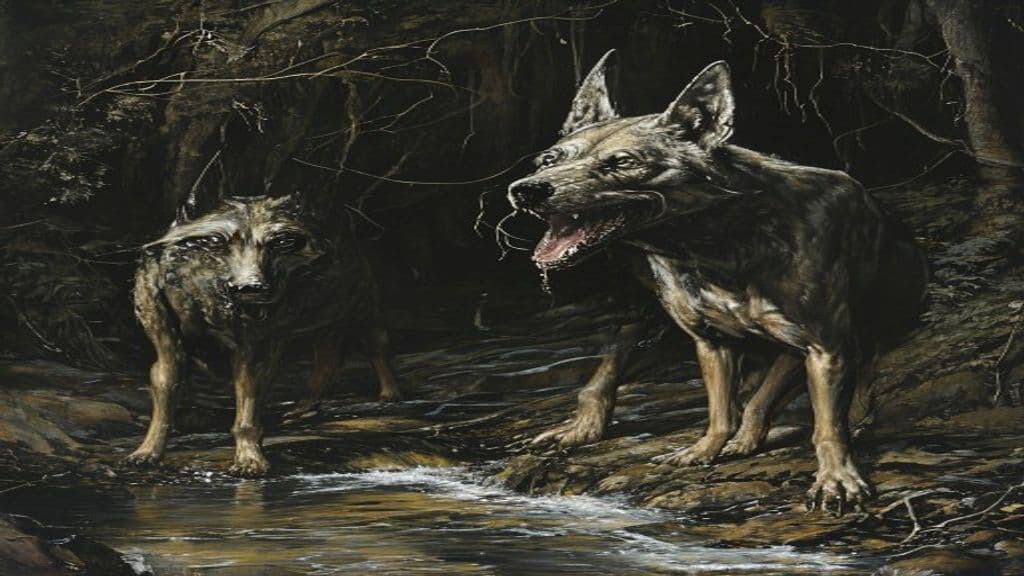
Described in available sources as having a human body, horse legs, a dog's head with iron teeth, and a single eye located on the forehead (a cyclopean feature). Regional name-variants (Croatian psoglavac, Slovene psoglavec) reflect the same dog-headed motif. Sources do not provide consistent details on coloration, size, clothing, or additional ornamentation.
Attested behaviors and capacities include anthropophagy (eating people) and exhumation/grave-robbing (digging out corpses from graves to eat them). Psoglavs are reported to inhabit caves or a sunless 'dark land' that contains gemstones. The supplied sources do not attest other supernatural powers (for example, shapeshifting, flight, or speech) beyond these corpse-eating and subterranean associations.
Cynocephalics
In Egyptian tradition, cynocephalics are human beings with dog's heads. (Note: 1. The power tier should be Primordial, given the fact that cynocephalics are described as a widely attested mythical phenomenon existing in many different forms and contexts. 2. Add an origin story b)

Ghoul
A ghoul is a demon-like or monstrous humanoid originating in pre-Islamic Arabian religion, traditionally associated with graveyards and the consumption of human flesh. The concept later entered broader folklore and has been widely reused and transformed in modern fiction and popular culture.
Prothoenor
Prothoenor (Ancient Greek Προθοήνωρ) is a mortal Boeotian leader in the Homeric Trojan War tradition, named in the Catalogue of Ships and recorded in the Iliad as being wounded and slain by the Trojan warrior Polydamas. Later mythographic summaries preserve variant genealogies and local associations with Thespiae in Boeotia.
Prothous
Prothous is a personal name borne by several distinct mortal figures in Greek mythic narrative traditions — including an Arcadian prince (one of Lycaon's sons), a Calydonian hunter, various warriors in the Theban and Trojan cycles (notably a commander of the Magnetes who led forty ships to Troy), and one of the suitors of Penelope. The bearers are ordinary heroic-age mortals whose actions are recorded in different episodic contexts rather than a single supernatural entity.
Proto-Frigg-Freyja Entity (Hypothetical)
A hypothetical entity proposed to be the common origin of Old Norse goddesses Frigg and Freyja, based on similarities between them. (Note: 1. Power tier should be Ancient (deity-level) rather than Primordial (cosmic), as the entity is hypothetical and not explicitly stated to have cosmic powers. 2. The appearance section is missing entir)
Protogeneia
Protogeneia (Ancient Greek: Πρωτογένεια, 'the firstborn') is a name borne by several mythic women in Greek genealogical tradition. Rather than a single supernatural being, the name functions as an etiological marker used in local foundation myths to link Zeus, post‑deluge human stock, and the eponymous ancestors or ruling houses of regions such as Elis, Aetolia, Opus/Locrian lines, and Attica.
Pruflas
Pruflas is a named infernal spirit attested in modern demonological lists and paraphrases of grimoire tradition. Later compilers and popular sources present Pruflas as a high-ranking catalogued spirit (titles vary) with an assigned number of legions; specific powers, appearance, and ritual texts for Pruflas are not preserved in the provided excerpts.
Prymno (Πρυμνώ)
Prymno is one of the Oceanids in Greek myth, a daughter of the Titans Oceanus and Tethys. Her name is etymologically linked to the lowermost part of things and to downward-flowing water, and sources gloss her name with senses such as "undermost, root" and a "cascade which falls down over a great height." She is attested only in name-lists of the Oceanids and has no surviving independent myths or rituals in the supplied material.
Ptah
Ptah is the principal Memphite deity of ancient Egypt, venerated as a creator god and patron of craftsmen and architects. He conceives the world 'in the design of his heart' and realizes it by speech, serves as master of ceremonies and justice in state cult, and is central to funerary and royal ritual in Memphis.
Ptah-Patek
Ptah‑Patek (Greek Pataikos) is a protective dwarf figure in late ancient Egyptian practice, represented primarily as small faience amulets and household figurines that safeguard wearers from danger and assist in childbirth. From the Late Period onward the figure is syncretic with Bes, Taweret, and aspects of Ptah and Horus/Harpocrates in popular iconography and use.
Ptah‑Sokar‑Osiris
Ptah‑Sokar‑Osiris is a syncretic funerary deity of ancient Egyptian religion, combining aspects of Ptah (Memphite creator/craftsman), Sokar (a Memphite necropolis hawk/falcon god), and Osiris (the pan‑Egyptian god of death and resurrection). The compound appears on offering formulas, statuary, papyrus containers, and temple reliefs used in mortuary and necropolis contexts, especially associated with Memphis and the Memphite necropolis, attested in material from the Late Period through the Ptolemaic era.
Pterelaus
Pterelaus is a mytho-historical king of the Taphians (Taphos) in Greek heroic legend whose family’s cattle-raid and defeat are narrated as antecedents to Amphitryon’s expedition and the circumstances of Heracles’ birth. In some variants he is described as invulnerable while a single magical golden hair remained in his head; removal of that hair (by his daughter Comaetho in some summaries) permitted his death.
Ptireus
Ptireus is listed in the cited source as a deity of Egyptian mythology. The available source provides only this single classificatory label and no additional information about the figure's nature, functions, or cult.
Puck
Puck is a northwest European liminal spirit occupying a space between household sprite and wild fairy trickster. Portrayed as a domestic helper who expects food offerings and as a nocturnal jester of the fairy court, Puck performs both useful chores and mischievous pranks in folklore and literature.
Community Record
- [1]Psoglav - Wikipedia. Wikipedia contributors, 'Psoglav,' Wikipedia, The Free Encyclopedia, https://en.wikipedia.org/wiki/Psoglavwiki
- [2]Psoglav - Wikidata. Wikidata entry Q3296927, 'Psoglav', http://www.wikidata.org/entity/Q3296927wiki
- [3]Psoglav - EP (archive listing). Archive.org item: 'Psoglav - EP', https://archive.org/details/youtube-I6grxV3CkYAother
- [4]Blood of the Dawnwalker Bestiary Psoglav Entry (archive listing). Archive.org item: 'Blood of the Dawnwalker Bestiary Psoglav Entry', https://archive.org/details/blood-of-the-dawnwalker-bestiary-psoglav-entry-by-rebel-wolves.other
- [5]Soglav (Thingiverse/3D model) (archive listing). Archive.org item: 'Soglav (4873454)', https://archive.org/details/thingiverse-4873454other