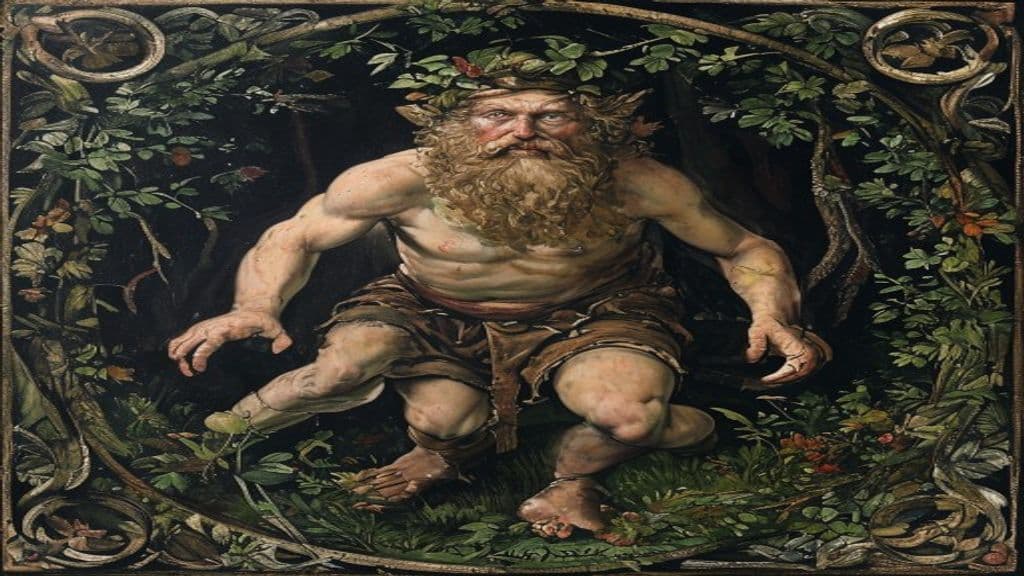
There is no single creation myth for Puck in the provided sources. Linguistically the English word puck derives from Old English puca (diminutive pucel) and has cognates in Old Norse púki (Old Swedish puke, Icelandic púki) and in Celtic languages (Welsh pwca, Cornish bucca, Irish púca). Scholars disagree about the direction of influence: the Oxford English Dictionary has favored a Scandinavian origin, while some researchers (e.g., Erin Sebo as reported in the sources) argue for early medieval Irish influence based on place-name distributions around southwest England. The sources thus record cognate terms and contested etymology rather than a cohesive origin narrative.
Traditional sources emphasize behavior and role over a fixed physical form. In folk summaries and comparative dictionaries Puck is classed with small domestic sprites (brownies, kobolds, nisse) often imagined as small, humanoid, intermittently visible household beings; older ballad tradition explicitly attributes animal-shape-taking to Puck (the broadside ballad The Mad Merry Pranks of Robin Goodfellow describes him "taking the shape of animals"). Literary representations (notably Shakespeare's A Midsummer Night's Dream) present him as agile, stealthy, and capable of transforming contextually into a nocturnal fairy jester, but the older folkloric quotations primarily record actions (carding wool, blowing out candles, tugging bedclothes) rather than detailed physiognomy.
Folkloric and literary sources describe a range from domestic labour to mischievous nocturnal pranks. Domestic services attributed to Puck include small housework such as carding wool and other quick household tasks performed while people sleep. Mischief includes blowing out candles, twitching or removing bedclothes, tattling secrets, leading travellers astray, and inspiring night-terrors in the elderly—examples listed in the broadside ballad The Mad Merry Pranks of Robin Goodfellow. He operates nocturnally and as part of fairy-court activity (described in ballad and literary sources as jester or emissary to Oberon), can make music (accounts record hearing them play on «Gyterns & Jews Harps» and ring bells), and may take animal shapes. He expects reciprocity: customary offerings (white bread and milk) are required to keep him beneficial; neglect can provoke theft or retaliatory mischief (Brewer's Dictionary summary). Contemporary commentators quoted in the sources stress that his power is culturally described as "restrained and tied," limiting him to jests and small mischief while acknowledging anxiety about potential greater harm if unrestrained.
Weaknesses
- conditionreciprocity-bound — requires customary offerings (neglect provokes mischief)
Wards
- substancewhite bread and milk (offering / appeasement)
- othereuphemistic/flattering naming (calling fairylike beings "the Goodfellows" or using names like Robin Goodfellow) as a form of social appeasement
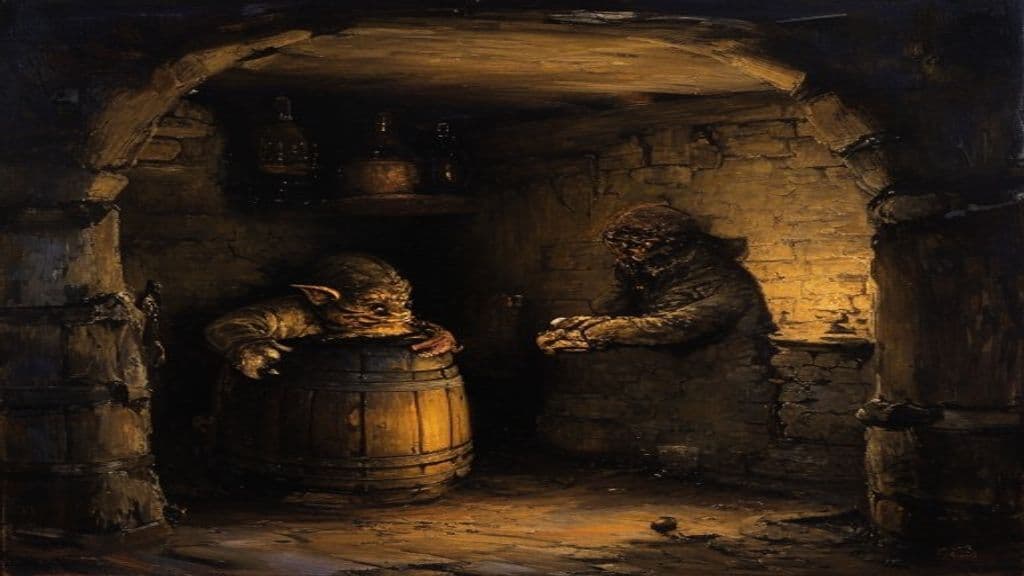
Kobold
The German household and mine spirit — a mischievous but potentially helpful small being who attaches to a household, bringing luck or disaster depending on how it is treated.
Bucca
A class of place‑bound supernatural beings attested in Cornish folklore, associated in surviving sources with coastal and mining landscapes and with local occupational culture; the surviving packet of sources is fragmentary and primarily cites an anthology excerpt (Mabel Quiller Couch).

Nisse (tomte / tomtenisse / tonttu)
A Scandinavian household and farmstead spirit tied to a particular homestead; a small, human‑like custodian who performs chores, protects livestock and property in return for annual ritual food offerings (notably Yule porridge), and who can become dangerous if offended or neglected.
Psoglav
Psoglav (Serbian Cyrillic: Псоглав; literally 'doghead') is a demonic monstrous figure in Balkan popular belief attested in parts of Bosnia and Montenegro and in numerous legends on the Istrian peninsula of Croatia. Described as a corpse-eating, grave-desecrating being that lives in caves or a sunless dark land, it is linguistically attested in regional variants such as Croatian psoglavac and Slovene psoglavec.
Ptah
Ptah is the principal Memphite deity of ancient Egypt, venerated as a creator god and patron of craftsmen and architects. He conceives the world 'in the design of his heart' and realizes it by speech, serves as master of ceremonies and justice in state cult, and is central to funerary and royal ritual in Memphis.
Ptah-Patek
Ptah‑Patek (Greek Pataikos) is a protective dwarf figure in late ancient Egyptian practice, represented primarily as small faience amulets and household figurines that safeguard wearers from danger and assist in childbirth. From the Late Period onward the figure is syncretic with Bes, Taweret, and aspects of Ptah and Horus/Harpocrates in popular iconography and use.
Ptah‑Sokar‑Osiris
Ptah‑Sokar‑Osiris is a syncretic funerary deity of ancient Egyptian religion, combining aspects of Ptah (Memphite creator/craftsman), Sokar (a Memphite necropolis hawk/falcon god), and Osiris (the pan‑Egyptian god of death and resurrection). The compound appears on offering formulas, statuary, papyrus containers, and temple reliefs used in mortuary and necropolis contexts, especially associated with Memphis and the Memphite necropolis, attested in material from the Late Period through the Ptolemaic era.
Pterelaus
Pterelaus is a mytho-historical king of the Taphians (Taphos) in Greek heroic legend whose family’s cattle-raid and defeat are narrated as antecedents to Amphitryon’s expedition and the circumstances of Heracles’ birth. In some variants he is described as invulnerable while a single magical golden hair remained in his head; removal of that hair (by his daughter Comaetho in some summaries) permitted his death.
Ptireus
Ptireus is listed in the cited source as a deity of Egyptian mythology. The available source provides only this single classificatory label and no additional information about the figure's nature, functions, or cult.
Puddleglum
Puddleglum is a fictional Marsh-wiggle who appears in C. S. Lewis's The Silver Chair (part of The Chronicles of Narnia). Portrayed as a gloomy yet steadfast companion, he guides Eustace and Jill, resists enchantment in Underland, and helps free Prince Rilian.
Pueo
The pueo is the Hawaiian subspecies of the short‑eared owl (Asio flammeus sandwichensis) and, in Native Hawaiian belief, a common physical form assumed by ʻaumākua (ancestor guardian spirits). It functions both as an endemic bird with specific ecological vulnerabilities and as a culturally significant ancestral protector and omen, mentioned in chants and mele.
Pukkeenegak
Pukkeenegak is an Inuit household goddess associated with children, pregnancy, childbirth, and the making of clothes. She functions as a benevolent overseer of domestic labor and reproductive life, providing food and clothing materials and protecting pregnant women.
Pukwudgie
A class of small humanoid 'little people' from Algonquin-language traditions, described as forest-dwelling, ambivalent beings who can help or harm humans; the Ojibwe-derived name and tales entered New England folkloric use via 19th-century publications and later local retellings.
Pulahan (Pulahanes)
A late 19th–early 20th century Visayan syncretic religious and militant revival movement in the Philippines whose adherents wore red, combined revived babaylan shamanic practices with Folk Catholic elements, and organized under charismatic 'dios-dios' leaders to pursue healing, prophecy, and armed resistance against colonial authorities.
Pulao (蒲牢)
Pulao (蒲牢) is a named mythic creature in Chinese tradition commonly listed among the 'nine sons of the dragon.' Textual references identify it as a dragon-son notable for its fondness for roaring and as an established decorative motif in Chinese material culture.
Community Record
- [1]Puck (folklore) — Wikipedia. Wikipedia, entry 'Puck (folklore)' (accessed via provided source list).wiki
- [2]The Mad Merry Pranks of Robin Goodfellow (broadside ballad) — summary in sources. Early 17th-century broadside ballad summarized in the research notes describing carding wool, leading travellers astray, taking animal shapes, blowing out candles, and other pranks.literary
- [3]Brewer's Dictionary (summary) — Puck / domestic-sprite comparison. Brewer's Dictionary summary as cited in the research notes, comparing Puck to brownies, kobolds, and nisse and noting expectation of white bread and milk.other
- [4]Quoted translation on domestic/limited mischief and music. Quoted translation cited in Wikipedia: passage describing sprites that 'abide in one place... making sundry noises, rumours, mockeries, gawdes and jests' and 'play as it were on Gyterns & Jews Harps.'literary
- [5]Erin Sebo (etymology/place-name argument) — summarized in research notes. Summary of Erin Sebo's argument for Irish-origin influence based on place-name distribution (as reported in the research notes and sources list).academic
- [6]A Midsummer Night's Dream — literary depiction of Puck. Shakespeare's A Midsummer Night's Dream as discussed in the sources, depicting Puck as part of the fairy court and emphasizing nocturnal, mischievous aspects.literary
- [7]Puck - Wikipedia (disambiguation). Wikipedia, 'Puck' (disambiguation) entry; identifies 'Puck (folklore)' as a trickster character and lists many cultural derivatives and modern uses of the name.wiki
- [8]Puck - Wikidata. Wikidata entry for 'Puck', cross-referencing the term across topics and uses.wiki
- [9]Archive: DAO-mocracy (Alex Zhang). Archive.org capture listed among provided materials; used as a supplied source file in the research notes.other
- [10]Archive: BONUS: Baratunde On Peril and Promise of AI. Archive.org capture listed among provided materials; included in the research notes as supplied context.other
- [11]Archive: Moliver v. Puck Agency, LLC. Court document capture appearing in the provided source list; demonstrates non-folkloric modern uses of the name 'Puck'.other