
The supplied materials do not include a primary or secondary narrative describing an origin story for rakshasa in Buddhist texts. No canonical creation or origin account for rakshasa is present in the provided excerpts; therefore an origin story cannot be documented from these sources.
The provided excerpts contain no direct descriptions of rakshasa appearance as adopted into Buddhist literature. No physical characteristics, iconographic details, or standard visual attributes are recorded in the supplied materials.
The available sources do not record specific powers, behaviors, or modes of interaction for rakshasa within Buddhist literature. The only directly cited general claim about 'demons' in the materials is that in some Near Eastern and Abrahamic contexts they 'may cause demonic possession, calling for an exorcism' (Source 1), but this is a cross-cultural generalization and not a rakshasa-specific statement in the supplied excerpts.
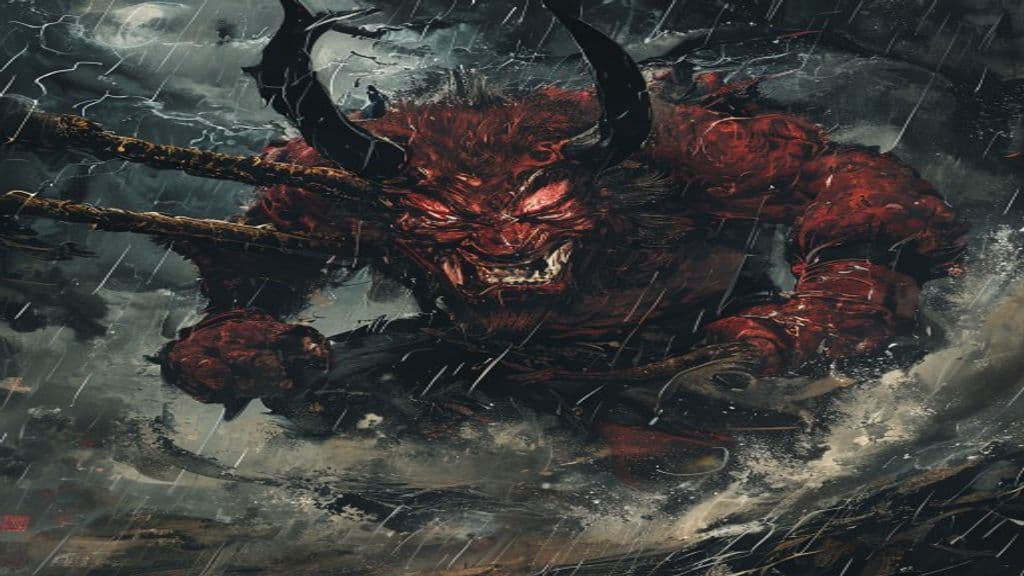
Oni
Powerful supernatural beings of Japanese folklore — associated with misfortune, disease, and the punishment of sinners in hell. Fearsome, often depicted as guardians of the underworld.

Asura
Asura (Sanskrit: असुर) are a class of supernatural beings in Indian religious traditions. In Hinduism they are described as power-seeking beings related to, and often oppositional toward, the Deva; in Buddhist cosmology they form a demigod/titan class characterized by passions such as wrath and envy. Individual asura figures (notably the asura Svarbhānu) appear in myths that produce the eclipse-entities Rahu and Ketu.
Raijū
The raijū (雷獣, 'thunder beast') is a Japanese yōkai associated with lightning and thunder and traditionally described as a companion or animated manifestation of the storm deity Raijin. Folklore links its appearances to thunderstorms and lightning strikes and records regional customs developed to mark, ward, or respond to its presence.
Raimundo
Raimundo is documented in the provided sources primarily as a male personal name borne by historical and contemporary individuals and as a modern fictional character name (not as a traditional supernatural being). The materials do not present a coherent mythological or folkloric entity named Raimundo with a consistent cosmology, appearance, powers, or ritual corpus.
Rainbow Body (Tibetan tradition)
In the Tibetan Buddhist tradition, the Rainbow Body is a level of realization where the physical body transmutes into light, indicating profound spiritual attainment. (Note: 1. Remove Primordial power tier as it's not supported by the source material, which doesn't indicate a cosmic or deity-level power. 2. Add more specific information about the Rainbow Body phenomenon a)
Rainbow Serpent (Dreamtime) — Yurlunggur / Ngalyod
A central creator-being in many Australian Aboriginal cosmologies, the Rainbow Serpent is a widespread Dreamtime motif associated with the shaping of land, the generation of living diversity, and regulatory or disciplinary power that can cause chaos when transgressed. Its identity, names, and attributes vary among different Aboriginal language groups and traditions.
Rainbow Serpent (Wagyl / Wagylu)
Ancestral, creative being central to many Aboriginal Australian cosmologies, the Rainbow Serpent is associated with the shaping of landscape, control of water and fertility, and the regulation of social and natural order. Known by numerous local names and described with regional variation, it is often linked to permanent waterholes and to rainbows as signs of its movement.
Rakhsh (Persian Tradition)
A mythological stallion and companion to the legendary hero Rostam in the Persian national epic Shahnameh. (Note: 1. Power tier: Based on Rakhsh's association with a legendary hero, it seems more likely to be Greater (deity-level) rather than Lesser. 2. Abilities: While we can infer that Rakhsh has strength and s)
Rakshasa (Himalayan variants)
A Himalayan reception of the pan-Indian rakshasa motif: hostile or disruptive non‑human beings known from Sanskrit epic and Puranic literature, here noted where Himalayan sources and discussions intersect with the broader epic tradition. The supplied sources do not document distinct, well‑attested Himalayan folklore variants; the entry therefore presents primarily the epic/legendary profile as transmitted into Himalayan contexts in general references.
Rakta Pishach
No descriptive or folkloric information about 'Rakta Pishach' is contained in the single supplied source, which is a bibliographic list of works by Hemendra Kumar Roy. The supplied material does not define, describe, or place this name within any cultural cosmology.
Raktabīja
Raktabīja is an asura antagonist in the Puranic/Devi narrative cycle (notably the Devi Mahatmya) whose boon causes any drop of his blood that falls to the ground to generate a new identical Raktabīja. He is sent by the asura kings Shumbha and Nishumbha and is defeated when the goddess Durga instructs Kali (Cāmuṇḍā) to consume his blood so no drop falls and Durga then beheads him.
Ramandu
Ramandu is a fictional celestial being from C. S. Lewis's The Voyage of the Dawn Treader who 'was once a star' and lives on Ramandu's Island at the end of the world. An elderly figure who undergoes a daily ritual of rejuvenation via 'fire-berries' delivered by white birds and who, after repeated renewal, becomes a star again, he presides over a liminal place tied to dawn and cosmic renewal.
Ramandu's daughter
A fictional immortal female figure in C. S. Lewis's Narnia who is the daughter of Ramandu (the 'star at rest'). She appears in The Voyage of the Dawn Treader as a luminous guide on Ramandu's Island, later becomes Queen of Narnia by marriage to Caspian X, is killed in The Silver Chair, and is listed among the faithful in The Last Battle. The novels never give her a personal name; a 2010 film adaptation names her 'Lilliandil.'
Rambehesht
Rambehesht (Middle Persian: Rām Vahišt; New Persian: رامبهشت), also attested as Denag (Dēnag), is presented in available sources as a 3rd-century noblewoman of the Bazrangi/Badhrangi family, wife of Sasan, mother of Pabag (Papak), and grandmother of Ardashir I. She appears in genealogical and historical accounts that construct Sasanian royal lineage and is described in chronicles (via Tabari) as possessing "beauty and perfection."
Community Record
- [1]Demon. "A demon is an evil or malevolent supernatural entity."; "...may cause demonic possession, calling for an exorcism."wiki
- [2]Ogres and their maces: Images of Oni from Onmyodo doctrines and medieval traditions. Illustrative materials and discussion of oni imagery in Japanese religious contexts (used here only as an adjacent regional comparison in the supplied notes).folk
- [3]JAPANESE MYTHOLOGY & FOLKLORE | Page on Yama/Emma. "the figure is better known from Buddhist iconography as the magisterial and judgelike Emma – that shows Chinese adaptations from the Indian Yama." (supplied excerpt)folk
- [4]Kubera - The Asura-King Who Went on to Become the God of Wealth. Discussion of Asura-related material used in the compiled notes as adjacent South Asian context for beings sometimes mapped to 'demon' in English-language discussions.other