
In Dreaming narratives the Rainbow Serpent is an ancestral creator-being that emerged from beneath the ground and, by moving through the land, formed major physical features such as ridges, mountains and gorges. It is one of the great spirits or totems active during creation (The Dreaming/Tjukurrpa/Jukurrpa), and many local groups possess their own named ancestral serpents whose actions found and encoded aspects of country. The English phrase "Rainbow Serpent" is an anthropological umbrella term, coined in modern scholarship, that groups a variety of distinct local beings and stories rather than a single unified origin tale.
Generally serpentiform and of immense proportions—large enough that its emergence and movement are said to have formed large-scale landforms. It commonly inhabits deep permanent waterholes. Regional variants show variation: some accounts describe a single-headed serpent, Arnhem Land Yurlunggur may possess a divided or double body; some traditions give it a crest, mane, or beard; others liken it to giant carpet snakes or link it to other animals in particular stories. Gendered depictions vary across groups (male, female, bigender, hermaphroditic, or unspecified), and some feminine forms are portrayed with breasts.
Creators of landscape: credited with moulding barren earth into ridges, gorges and mountains by emerging and pushing through the ground. Control over water and weather: associated with permanent waterholes, springs and rain; rainbows are frequently read as the Serpent moving between water sites. Fertility and life-giving functions: viewed as a giver of life through its association with water and sometimes connected to fecundity symbolism. Regulator and enforcer: when disturbed or offended it can bring great chaos and destructive consequences. Regional variation means not all local ancestral beings in this family are explicitly described as snakes or as literally the visible rainbow.
Weaknesses
None recorded.
Wards
- substancerainbow quartz (iridescent crystal) — associated with rituals involving the Rainbow Serpent
- substancemother-of-pearl / certain iridescent seashells — used in rituals involving the Rainbow Serpent
- conditionavoidance / respect for known Rainbow Serpent water-sites (cultural precaution noted in sources)
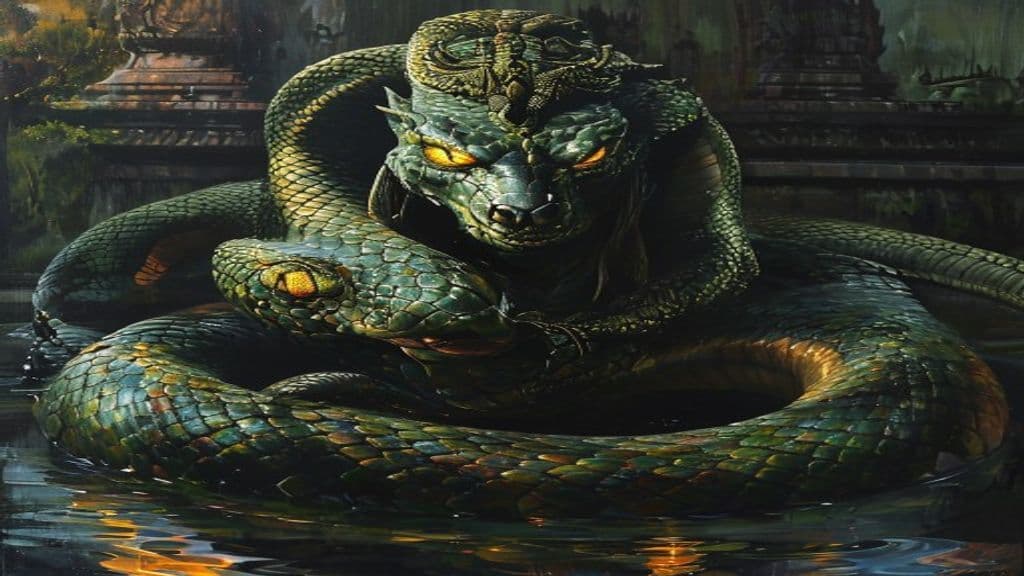
Naga
Divine serpent beings of Hindu, Buddhist, and Jain cosmology — powerful guardians of water, earth, and underground treasures. Revered as deities in South and Southeast Asia.
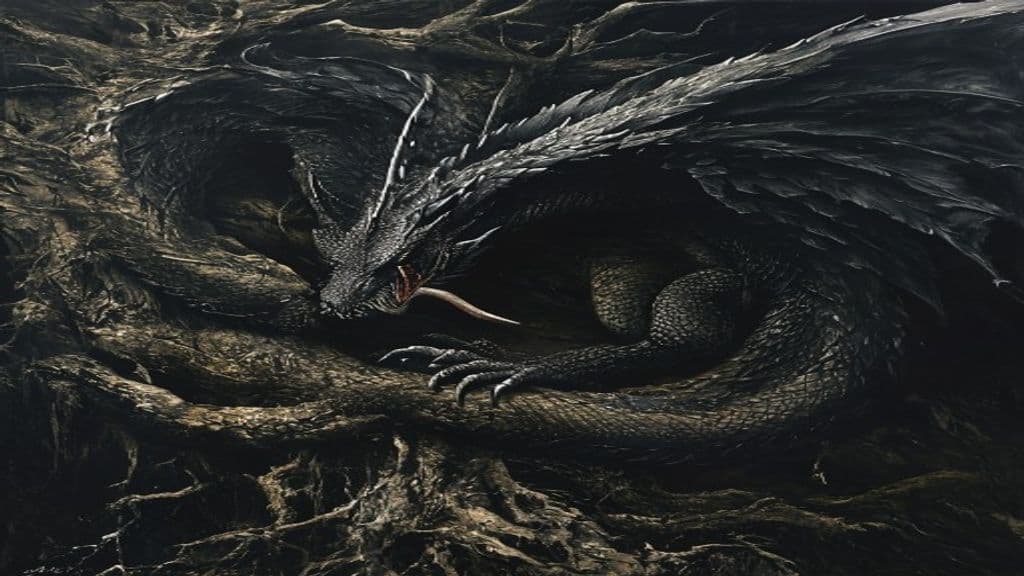
Níðhöggr
The corpse-gnawing dragon coiled around the roots of Yggdrasil, ceaselessly chewing the World Tree — and destined to survive Ragnarök and carry the dead on its wings.
Rahko
A figure in Finnish mythology associated with celestial events and the Moon, its exact nature and classification unclear. (Note: - Power tier should be Lowered from Primordial to Ancient, as it only influences lunar cycles and phases. - Origin story is partially correct; the year 1551 is accurate, but it's not clear if Rahko wa)
Rahovart
Rahovart is an infernal being named in Collin de Plancy’s Dictionnaire Infernal (1818), which cites an earlier Renaissance moralité attributed to Durzel. In those sources Rahovart is described as a companion of Satan tasked with tormenting certain moral types, associated with avalanches and ghostly torment, and said to collect souls of elderly victims into a basket until the day of judgment.
Raijū
The raijū (雷獣, 'thunder beast') is a Japanese yōkai associated with lightning and thunder and traditionally described as a companion or animated manifestation of the storm deity Raijin. Folklore links its appearances to thunderstorms and lightning strikes and records regional customs developed to mark, ward, or respond to its presence.
Raimundo
Raimundo is documented in the provided sources primarily as a male personal name borne by historical and contemporary individuals and as a modern fictional character name (not as a traditional supernatural being). The materials do not present a coherent mythological or folkloric entity named Raimundo with a consistent cosmology, appearance, powers, or ritual corpus.
Rainbow Body (Tibetan tradition)
In the Tibetan Buddhist tradition, the Rainbow Body is a level of realization where the physical body transmutes into light, indicating profound spiritual attainment. (Note: 1. Remove Primordial power tier as it's not supported by the source material, which doesn't indicate a cosmic or deity-level power. 2. Add more specific information about the Rainbow Body phenomenon a)
Rainbow Serpent (Dreamtime) — Yurlunggur / Ngalyod
A central creator-being in many Australian Aboriginal cosmologies, the Rainbow Serpent is a widespread Dreamtime motif associated with the shaping of land, the generation of living diversity, and regulatory or disciplinary power that can cause chaos when transgressed. Its identity, names, and attributes vary among different Aboriginal language groups and traditions.
Rakhsh (Persian Tradition)
A mythological stallion and companion to the legendary hero Rostam in the Persian national epic Shahnameh. (Note: 1. Power tier: Based on Rakhsh's association with a legendary hero, it seems more likely to be Greater (deity-level) rather than Lesser. 2. Abilities: While we can infer that Rakhsh has strength and s)
Rakshasa (Buddhist contexts)
A rakshasa is commonly referred to in secondary literature as a type of malevolent supernatural being found in South and East Asian traditions; the supplied sources do not contain direct, sourced descriptions of rakshasa within Buddhist canonical texts. Available excerpts only allow cautious placement of rakshasa within the broader English-language category of 'demon' as that term is discussed in the provided materials.
Rakshasa (Himalayan variants)
A Himalayan reception of the pan-Indian rakshasa motif: hostile or disruptive non‑human beings known from Sanskrit epic and Puranic literature, here noted where Himalayan sources and discussions intersect with the broader epic tradition. The supplied sources do not document distinct, well‑attested Himalayan folklore variants; the entry therefore presents primarily the epic/legendary profile as transmitted into Himalayan contexts in general references.
Rakta Pishach
No descriptive or folkloric information about 'Rakta Pishach' is contained in the single supplied source, which is a bibliographic list of works by Hemendra Kumar Roy. The supplied material does not define, describe, or place this name within any cultural cosmology.
Raktabīja
Raktabīja is an asura antagonist in the Puranic/Devi narrative cycle (notably the Devi Mahatmya) whose boon causes any drop of his blood that falls to the ground to generate a new identical Raktabīja. He is sent by the asura kings Shumbha and Nishumbha and is defeated when the goddess Durga instructs Kali (Cāmuṇḍā) to consume his blood so no drop falls and Durga then beheads him.
Ramandu
Ramandu is a fictional celestial being from C. S. Lewis's The Voyage of the Dawn Treader who 'was once a star' and lives on Ramandu's Island at the end of the world. An elderly figure who undergoes a daily ritual of rejuvenation via 'fire-berries' delivered by white birds and who, after repeated renewal, becomes a star again, he presides over a liminal place tied to dawn and cosmic renewal.
Community Record
- [1]Rainbow Serpent — Wikipedia. Wikipedia contributors, 'Rainbow Serpent', Wikipedia, The Free Encyclopedia.wiki
- [2]Rainbow Serpent — Wikidata Q50733371. Wikidata entry Q50733371, 'Rainbow Serpent'.wiki
- [3]Archive references mentioning 'Rainbow Serpent' (contextual items). Internet Archive item referencing the phrase 'Rainbow Serpent' in ancillary contexts; used only for corroboration of modern usage in non-ethnographic materials.other
- [4]Archive references mentioning 'Rainbow Serpent' (contextual items). Internet Archive item referencing the phrase 'Rainbow Serpent' in ancillary contexts; not an ethnographic source.other
- [5]Archive references mentioning 'Rainbow Serpent' (contextual items). Internet Archive item referencing the phrase 'Rainbow Serpent' in ancillary contexts; not an ethnographic source.other