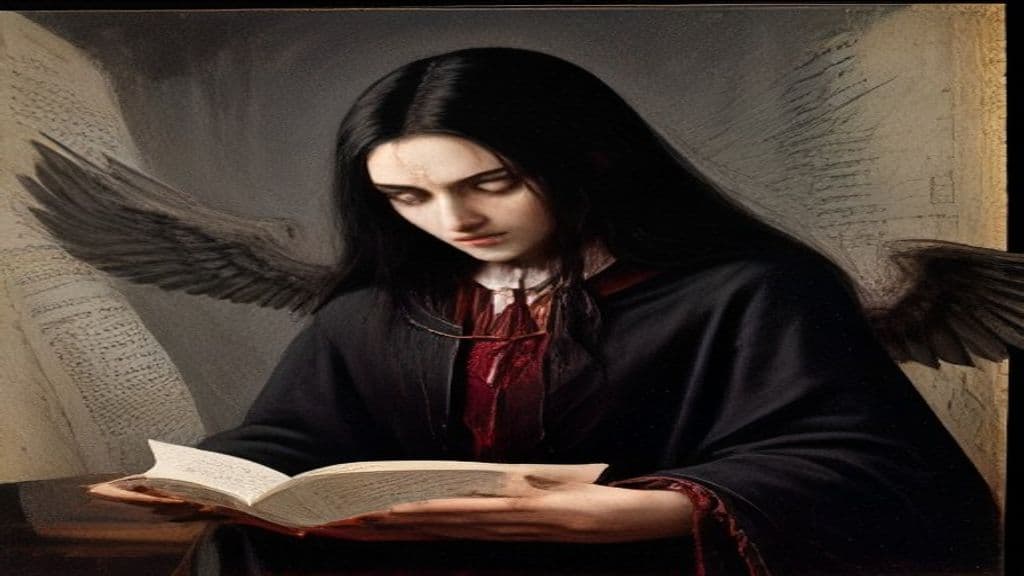
In the grimoire and demonological listings preserved in early modern ritual magic texts, Raum is catalogued as a high-ranking daemonic officer. Several sources state he "was of the order of thrones," placing him within a layered hierarchical taxonomy that parallels angelic orders while reassigning those ranks to infernal agents. The name is also glossed in the sources as derived from German—Raum meaning "space, room, chamber" and the verb räumen meaning "to vacate, empty, evacuate"—a lexical connection noted in the same literature; however the supplied texts do not establish this German etymology as the historical origin of the entity within the older grimoire tradition, and present it as a later linguistic observation alongside the cataloguing of his rank and offices (cf. grimoire summaries such as the Lesser Key of Solomon and modern reference summaries).
The traditional description in the grimoire material records: "he is seene as a crowe, but when he putteth on humane shape, at the commandement of the exorcist..." Sources consistently depict him in avian form (a crow) which can adopt a human guise upon the conjurer's request. The grimoire entries and summaries record variant spellings (Raim, Raym, Räum, Reym, Rey) alongside this visual description.
Grimoire summaries attribute a cluster of capabilities to Raum: he "stealeth woonderfullie out of the kings house, and carrieth it whether he is assigned," indicating the power to steal treasures from royal houses and transport them to where the magician directs; he "destroieth cities, and hath great despite unto dignities," indicating ability to destroy cities and to affront social/political ranks; he "knoweth things present, past, and to come," i.e., divinatory knowledge of past, present and future; he "reconcileth freends and foes" and is said to "invoke love," indicating powers over social reconciliation and love-influence. The entries further record his rank as a "Great Earl or Count" who "governeth thirtie legions," and occult correspondence mappings in some lists (e.g., Shem HaMephorash) pair him with an angelic name (Leiazel, יזאזל/ייזאל in the cited material). All these abilities and ranks are reported in the cited grimoire/demonological summaries.
Weaknesses
- otherNot specified in the supplied sources
Wards
- otherNo specific warding techniques or countermeasures are provided in the cited texts

Rape in Greek Mythology
A common motif in Greek mythology representing sexual assault by supernatural beings against mortals, particularly women. (Note: - Power tier: Change to "Ancient" since the abilities described are more in line with deity-level powers (e.g., transformation through supernatural intervention). - Appearance: Add that the entity its)
Raphael (Archangel)
Raphael is an archangel in Jewish and Christian traditions whose name means "God has healed." He appears in the Book of Tobit as a divine agent who guides Tobias and effects healing, and is commemorated in Christian liturgy as a principal angel invoked for healing, guidance, and protection of travelers.
Rapunzel
Rapunzel is a European folktale heroine of the Aarne–Thompson type 310 'Maiden in the Tower', best known from the Brothers Grimm version. She is a human maiden whose confinement in a tower, extraordinary long hair, and eventual rescue and reunion constitute the central motifs of the tale transmitted in early-modern and 19th-century European literary and oral traditions.
Raróg
A Slavic fire-associated avian supernatural being variously described in Czech, Polish, Ukrainian, and Russian summary sources as a fiery falcon or dragon and, in some Polish accounts, as a tiny pocketable bird that brings happiness. It is connected to domestic fire and treated in popular reference as part of the broader fire-bird motif in Eurasian myth.
Rashnu
Rashnu is the Avestan personification and divine agent of justice and truth (asha) in Zoroastrian cosmology. He functions as one of the post‑mortem judges of souls, an embodiment of straightness/uprightness (razishta), and a liturgical figure commemorated on the 18th day of each Zoroastrian month.
Rati
Rati is the Hindu goddess who personifies sexual love, desire, and sensual enjoyment. Presented in Puranic and epic accounts as the consort of Kama (Kamadeva), she appears in origin narratives, the episode of Kama's burning and rebirth, and in the Mayavati/Sambara story where she functions as nanny and eventual consort to Kama's rebirth, Pradyumna.
Rauni
Rauni is a sparsely attested name for a being in pre-Christian Finnish mythic material, recorded in runic-song variants and mentioned in a 1551 text by Mikael Agricola. Surviving sources preserve the name and variants but do not provide a clear, uncontested account of Rauni’s function, appearance, or rites.
Ravgga
Ravgga is attested in one source as a fish-associated fortune-telling being in Sámi mythology. Beyond a single-line definition identifying it as a 'fortune-telling fish god,' there is no supporting ethnographic or narrative detail in the supplied materials.
Raziel
Raziel is an angelic revealer in Jewish mystical literature, called the 'Angel of Secrets' and credited with transmitting esoteric books (notably Sefer Raziel) to prime ancestors; the name is also reused in modern fiction for characters and artifacts that evoke revelation or hidden knowledge.
Re'em (Jewish tradition)
A mysterious animal mentioned nine times in the Hebrew Bible, described as a creature of power and strength with unclear nature and translations. (Note: - Power tier should be Greater (as it is described with translations implying strength/ferocity comparable to powerful regional entities). - Weaknesses and wards should be addressed (not mentioned in )
Rebirth in Germanic Paganism
Concept of rebirth through naming and/or family line in pre-Christian Germanic society, tied to continuation of identity and heritage. (Note: * Power tier should be Lowered to Lesser (local spirit) as the abilities described do not suggest a cosmic or deity-level power. * Summary is accurate, but it could be more concise. * Origin story lac)
Red King (term)
“Red King” is a polyvalent label used across literature, popular media, history, science, and other fields rather than a single, coherent folkloric supernatural being. The term appears as character names (e.g., Lewis Carroll's Through the Looking-Glass), nicknames for historical figures (William II, 'Rufus'), monsters in genre media (Ultraman, comics), and non-supernatural uses (red king crab, scientific hypotheses).
Community Record
- [1]Raum — Wikipedia. Wikipedia entry 'Raum' (summarizing grimoire material such as the Lesser Key of Solomon and related demonological lists).wiki
- [2]Wikidata: Raum. Wikidata entry for Raum/Rauma (identifier Q37013) summarizing linked references.other