
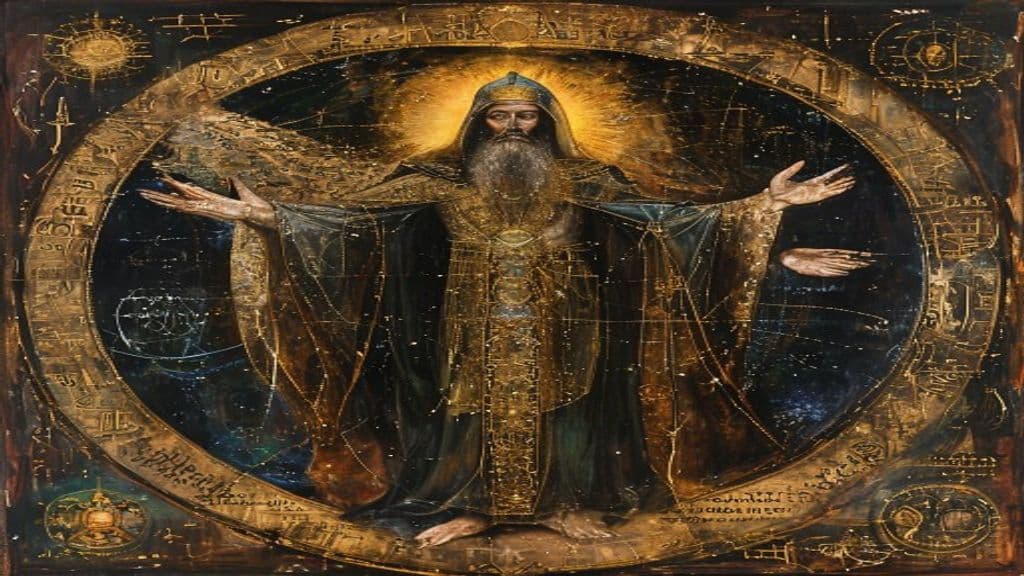
In Jewish mystical accounts summarized in the provided sources, Raziel is a high angel who stands close to God's throne and records divine speech. He is traditionally said to have given a compendium of secret knowledge, the Sefer Raziel (Sefer Raziel HaMalakh), to Adam and Eve after the Fall; that book is then involved in later transmission narratives (it is said to have been taken from Adam and cast into the sea by other angels and subsequently retrieved for humanity, and it is later associated with figures such as Enoch/Metatron, Noah, and Solomon). A related text, Sefer ha-Razim, is also attributed in some accounts to knowledge given to Noah. These narratives place Raziel as an intermediary who reveals and sometimes safeguards divine wisdom across mythic time.
Traditional source summaries do not supply a single consistent visual description; instead Raziel is described by rank and title — e.g., attendant 'close by God's throne', glossed as a cherub or associated with the Ophanim, called chief of the Erelim, and named a 'ruling prince of the 2nd Heaven' under the alternate name Gallitsur — descriptions that imply high angelic status rather than a fixed humanlike appearance. Modern popular-culture usages are distinct and narrative-specific: for example, in the Legacy of Kain game series 'Raziel' is depicted fictionally as a wraith-like revenant who wields spectral and physical blades (a portrayal of the name as a character rather than the traditional angel).
According to the mystical literature summarized in the provided source, Raziel hears and writes down what is said at God's throne, acts as a transmitter of hidden/divine knowledge (credited with giving the Sefer Raziel to Adam and with transmitting lore to other antediluvian and patriarchal figures), and is described as protecting ministering angels from certain cosmic 'living creatures' that uphold the universe. The Sefer Raziel is described as a book of secret knowledge and magic attributed to him. Modern fictional instantiations repurpose these motifs: for instance, the Legacy of Kain character named Raziel interacts with souls and weapons and in that fiction experiences alterations in perception when spectral and physical manifestations intersect (a narrative device, not a traditional attribute).
Metatron
An exalted heavenly figure in postbiblical Jewish literature, often identified with the transformed patriarch Enoch in later mystical texts and portrayed as a celestial scribe and high court official in merkabah and Kabbalistic writings.

Jophiel
An archangel in Jewish and Christian angelology, Jophiel is depicted in mystical, liturgical, and occult sources as a high-ranking celestial guardian associated with wisdom, Torah-reading, beauty, and certain Kabbalistic/ceremonial correspondences. Sources place Jophiel among the highest heavens and in roles supervising scripture, teaching languages, and serving in angelic command.
Raróg
A Slavic fire-associated avian supernatural being variously described in Czech, Polish, Ukrainian, and Russian summary sources as a fiery falcon or dragon and, in some Polish accounts, as a tiny pocketable bird that brings happiness. It is connected to domestic fire and treated in popular reference as part of the broader fire-bird motif in Eurasian myth.
Rashnu
Rashnu is the Avestan personification and divine agent of justice and truth (asha) in Zoroastrian cosmology. He functions as one of the post‑mortem judges of souls, an embodiment of straightness/uprightness (razishta), and a liturgical figure commemorated on the 18th day of each Zoroastrian month.
Rati
Rati is the Hindu goddess who personifies sexual love, desire, and sensual enjoyment. Presented in Puranic and epic accounts as the consort of Kama (Kamadeva), she appears in origin narratives, the episode of Kama's burning and rebirth, and in the Mayavati/Sambara story where she functions as nanny and eventual consort to Kama's rebirth, Pradyumna.
Raum
Raum (also Raim, Raym, Räum) is a named demonological officer in early modern grimoire tradition described as a 'Great Earl or Count' who rules thirty legions. He is portrayed as a crow that can take human form at the conjurer's command and is credited with theft from kings, destruction of cities and dignities, divinatory knowledge, reconciliation of people, and the power to invoke love.
Rauni
Rauni is a sparsely attested name for a being in pre-Christian Finnish mythic material, recorded in runic-song variants and mentioned in a 1551 text by Mikael Agricola. Surviving sources preserve the name and variants but do not provide a clear, uncontested account of Rauni’s function, appearance, or rites.
Ravgga
Ravgga is attested in one source as a fish-associated fortune-telling being in Sámi mythology. Beyond a single-line definition identifying it as a 'fortune-telling fish god,' there is no supporting ethnographic or narrative detail in the supplied materials.
Re'em (Jewish tradition)
A mysterious animal mentioned nine times in the Hebrew Bible, described as a creature of power and strength with unclear nature and translations. (Note: - Power tier should be Greater (as it is described with translations implying strength/ferocity comparable to powerful regional entities). - Weaknesses and wards should be addressed (not mentioned in )
Rebirth in Germanic Paganism
Concept of rebirth through naming and/or family line in pre-Christian Germanic society, tied to continuation of identity and heritage. (Note: * Power tier should be Lowered to Lesser (local spirit) as the abilities described do not suggest a cosmic or deity-level power. * Summary is accurate, but it could be more concise. * Origin story lac)
Red King (term)
“Red King” is a polyvalent label used across literature, popular media, history, science, and other fields rather than a single, coherent folkloric supernatural being. The term appears as character names (e.g., Lewis Carroll's Through the Looking-Glass), nicknames for historical figures (William II, 'Rufus'), monsters in genre media (Ultraman, comics), and non-supernatural uses (red king crab, scientific hypotheses).
Redcap
A malevolent small household/house-ruin spirit attested in Anglo-Scottish border folklore, described as dwelling in ruined towers and castles and attacking trespassers; tradition emphasizes a blood‑stained red cap as its identifying emblem and records Christian symbols or Scripture as effective repellents.
Reepicheep
Reepicheep is a fictional Talking Mouse in C. S. Lewis's Chronicles of Narnia. He is the martial chief of the Talking Mice, a courageous knightly figure who appears in Prince Caspian and The Voyage of the Dawn Treader and briefly in The Last Battle, whose personal quest for "Aslan's Country" functions as a spiritual exemplar within the Narnian narrative.
Reginn
Reginn is a figure in Old Norse heroic-literary tradition who functions as a foster-father, master smith, counsellor, and plotting instigator in the Sigurð/Sigurd cycle. Appearing in the Poetic Edda (Reginsmál, Dvergatal) and the Völsunga saga, he is embedded in a kin-group (son of Hreiðmarr; brother to Fáfnir and Ótr) tied to a cursed hoard.
Community Record
- [1]Raziel (Wikipedia). Wikipedia contributors. "Raziel." Wikipedia, The Free Encyclopedia.wiki
- [2]Wikidata entry: Raziel. Wikidata: Q126908916other
- [3]Archive: Soul Reaver 2 — 'Warping and bending Reality itself' excerpt. Archive.org capture referencing a Legacy of Kain excerpt concerning Raziel and the Soul Reaver.other
- [4]Archive: Legacy of Kain Defiance — Wraith Raziel scenes. Archive.org capture of Legacy of Kain Defiance related media referencing Raziel.other
- [5]Archive: 2023 Vidya Gaem Awards (Director's Cut). Archive.org capture listing modern uses of the name Raziel in popular culture.other