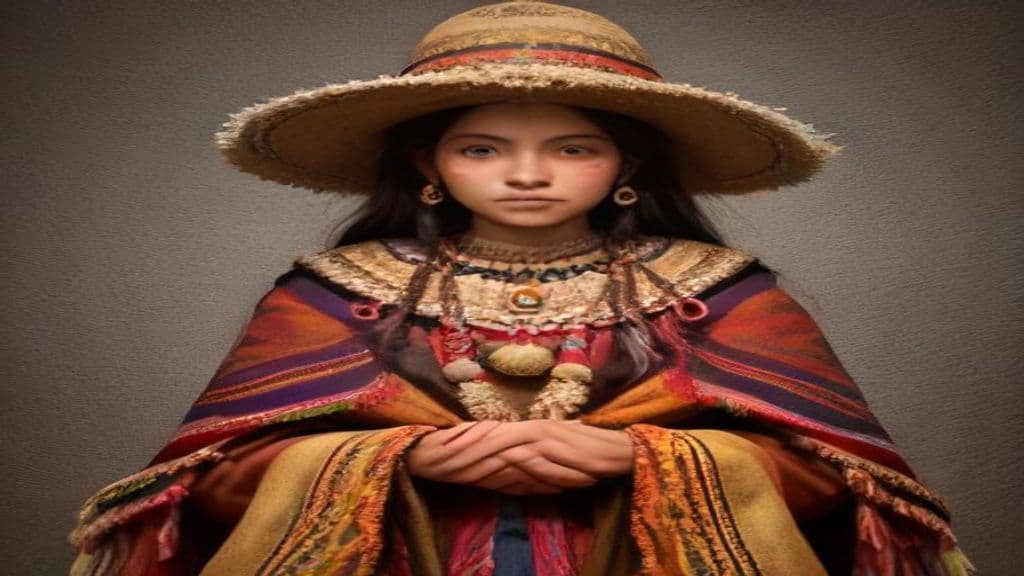
Ñusta is not a mythic originary figure but a social and political category that emerged within the Inca imperial system. As described in the source material, the term indexes women of Inca or Andean noble birth whose status was legitimized through kinship, lineage, and integration into the state religion and ceremonial life of the empire. Their roles developed as part of imperial strategies of alliance-building, dynastic maintenance, and ritual hierarchy; during the colonial encounter the category adapted to incorporate Christian rites and Spanish honorific practices (for example, baptisms and the use of Doña), reflecting continuity and transformation of elite female identity under Spanish rule.
Sources do not record fixed physical traits for ñustas; instead they emphasize dress, textiles, and workmanship as markers of status. Ñustas were renowned weavers whose clothing displayed complex patterns and high-quality textiles that signaled skill, elite identity, and regional origin. Their garments and textile production functioned as visible evidence of training, social rank, and cultural capital within elite Andean households.
Rather than supernatural powers, ñustas held social capacities and institutional roles: they were instruments of alliance-building through arranged marriages used by the state and noble houses; participants and visible actors in state religion and public ceremonies (investitures, masses, baptisms, funerals); household and economic actors noted for weaving and material production; and intermediaries in colonial encounters, at times presented to Spaniards and incorporated into negotiated kinship ties. Their behavior and life choices—especially marriage and sexuality—were regulated as matters of state policy and family honor, situating them as political actors whose personal status served broader dynastic and imperial aims.
Apu
In Andean (Inca-era and continuing) belief, an apu is the spirit of a mountain or a solitary rock, conceived as a localized, often anthropomorphic guardian presence associated with a particular peak or notable stone in Peru, Ecuador, and Bolivia.
Ciqui Ollco
Ciqui Ollco is not documented in the supplied sources as a supernatural being; the materials reference historical Inca royals (notably Topa Inca Yupanqui and Mama Ocllo Coya). Any supernatural characterization of 'Ciqui Ollco' is unsupported by the provided research notes.
Hanan (lexical element; as in Hanan Pacha)
Hanan is not attested in the provided sources as an independent goddess. In the Andean/Quechua material within the corpus, hanan functions as a lexical/ontological element meaning the 'upper' or 'higher' realm (as in Hanan Pacha, the Higher World) and appears in compound epithets linking deities (e.g., Inti Hanan Pacha) to that higher world.
Huanca
Huanca refers to two related Andean referents in the supplied sources: (A) an ethnonym for a Quechua people of the Junín region of central Peru, and (B) huanca/wanka, a sacred elongated vertical standing stone (monolith) in Andean ritual practice that is worshipped and given offerings and is believed to represent chiefs and ancestors.
Inca Human Sacrifice Entity
A supernatural force in Inca tradition believed to demand human sacrifice, particularly children, as a form of placation. (Note: 1. The summary should mention that the entity demands appeasement, not just placation. 2. Power tier should be Ancient (deity-level) instead of Primordial (cosmic). 3. The source material does not sup)
Mama Huaco
Mama Huaco is an ancestral female figure in Inca origin narratives who emerges from the cave of Paqariq Tampu/Pacaritambo among the founding siblings; sources describe her as strong and skillful and record an act in which she hurled two golden staffs northward, an action tied to territorial marking in the origin cycle.
Mama Qucha
Mama Qucha (Mama Cocha) is an Inca water mother deity, personifying the sea and other bodies of water. She functions as guardian of sailors and fishermen, provider of fish and calm seas, and is counted among the principal female elemental mothers in Inca cosmology.
Manco Cápac
Manco Cápac is the foundational ancestral figure and culture‑founder of the Inca (Quechua) tradition: remembered as the first ruler (Sapa Inca) and progenitor who, according to origin legends, established Cusco after emerging with Mama Ocllo from Lake Titicaca. Sources treat him variably as mythic ancestor, legitimizing founder, and a possibly historical early ruler.
Pacha Mama
Pacha Mama is an Andean/Inca mother-deity representing 'space-time' and a universal, life-sustaining principle tied to earth, fertility, and the totality of the cosmos. Revered across the Andes, she functions as a foundational generative presence from which major cosmological principles are said to trace their origin.
Sinchi Roca
Sinchi Roca (Sinchi Ruq'a) is presented in colonial-era and modern summaries as the second Sapa Inca of the Kingdom of Cuzco (mid-13th century). In the sources he appears as an early, possibly legendary, human ruler associated in tradition with administrative reforms, markers of nobility, and the early investiture trappings of imperial power.
Supay
Supay is an ambivalent subterranean spirit and regent of the Incan underworld (Uku Pacha / Hurin Pacha). In Quechua and Aymara tradition he embodies aspects of shadow, death, and chaos, functioning both as lord of the dead and as the archetype or progenitor of many dangerous local spirits; Spanish colonial sources later equated him with the Christian Devil.
Ukhu Pacha
Ukhu Pacha is the under- or inner-world layer in Andean (Quechua/Inca) tripartite cosmology. As a pacha it functions as a position in an integrated space–time ordering rather than as a single personal spirit or deity.
Community Record
- [1]Ñusta - Wikipedia. Wikipedia contributors, "Ñusta," Wikipedia, The Free Encyclopedia, https://en.wikipedia.org/wiki/%C3%91ustawiki
- [2]Princess (Wikidata entry referenced). Wikidata, "princess," http://www.wikidata.org/entity/Q863048other