In Egyptian linguistic and cosmological practice the term renpet was simultaneously the ordinary word for a 'year' and a personified female figure. This dual status means Renpet originates as both a lexical sign and a symbolic register: the renpet hieroglyph marks the start of phrases recording the regnal year of the pharaoh and, in art and titulary, is embodied as a youthful woman associated with cycles of renewal. Over time Renpet appears in temple, tomb and documentary inscriptions and is referenced in New Year formulations (Wep Renpet), earning epithets such as 'Mistress of Eternity' that link her to ongoing temporal cycles and renewal.
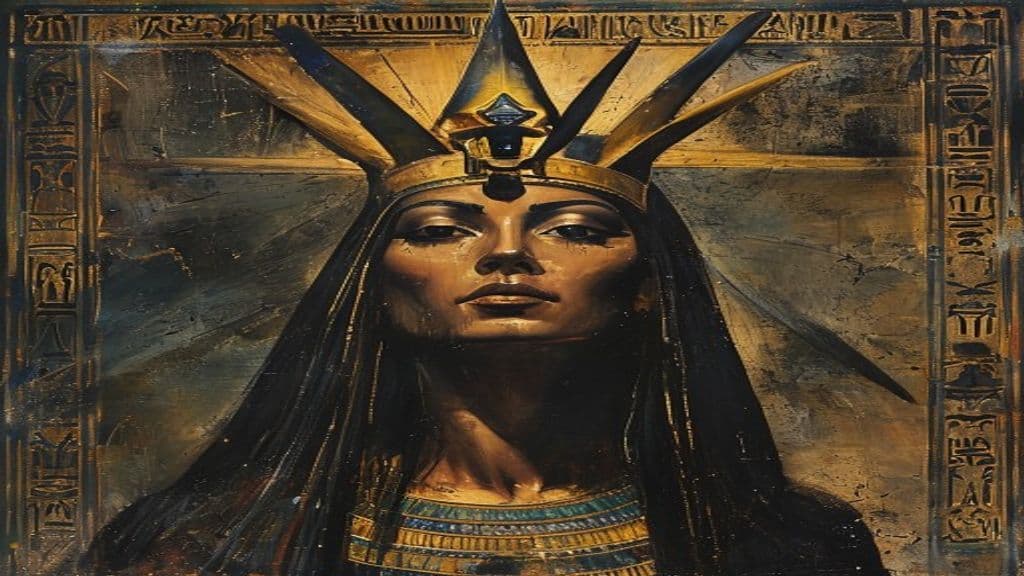
Sources portray Renpet as a young woman who wears a palm shoot over her head; the palm shoot glyph functions as the symbol of time. This figurative depiction is the standard iconography cited in reference works and appears in hieroglyphic and artistic contexts. The sources emphasize a youthful, feminine ideal associated with spring and fertility rather than animal or monstrous attributes.
Rather than narrated feats, Renpet's 'powers' are symbolic and functional: she personifies the year and thereby stands for cyclical renewal, youth, fertility and the arrival of spring. The renpet glyph's use at the beginning of regnal‑year formulas ties her to royal ideology and the calendrical ordering of time; epithets such as 'Mistress of Eternity' underline her association with ongoing temporal cycles. Sources present these as personificatory roles rather than descriptions of interventionist magical acts.

Heh
Heh is the ancient Egyptian personification of infinity or eternity, a member of the primordial Ogdoad of Hermopolis whose name originally meant "flood," referring to the primeval watery chaos Nu that preceded creation.
Sopdet
Sopdet is the ancient Egyptian personification of the star Sirius and a goddess whose roles connect celestial observation, the annual Nile inundation and fertility, and funerary guidance for deceased kings. Over time her identity becomes syncretized with major Egyptian mother and royal deities, especially Isis, and in Greco-Roman contexts she acquires dog-associated imagery.
Aani
Aani (ancient Egyptian jꜥnr) is the lexical term for the baboon in ancient Egyptian language and functions in religious contexts as an animal icon and theophoric epithet. Attested repeatedly in Egyptian texts and images, the baboon image is used to represent or denote aspects of gods such as Thoth, Hapy, Khonsu, and Osiris rather than implying the animal itself is an independent deity.
Aati
Aati (also rendered Ati) is one of the 42 judges of the dead in ancient Egyptian funerary literature, attested in the Book of the Dead tradition (notably the Papyrus of Nebsemy). Described as originating 'from Heliopolis', Aati's documented function is to question the deceased about a specific moral accusation during the Duat judgment; the funerary texts supply a formulaic denial the soul must recite.
Abadiu of Antinoe
Abadiu of Antinoe was a fourth‑century bishop of Antinoe (Antinoopolis, in Roman Egypt) commemorated as a martyr and saint in the Coptic Orthodox Church, with a feast day on 26 December. Sources record that he was killed during a theological dispute with Arian opponents and reference him in collections of Egyptian martyrs.
Abaset
Abaset is a localized ancient Egyptian goddess attested in tomb decoration at El‑Bawiti in the Bahariya Oasis during the 26th Dynasty. She is depicted anthropomorphically with a hedgehog motif incorporated into her headdress and appears on the walls of Qarat Qasr Salim, including twice in the Tomb of Bannentiu. No cult texts, myth narratives, or ritual prescriptions for her are recorded in the cited corpus.
Abib and Apollo
Abib and Apollo are Christian ascetics and hagiographic saints of Akhmim (Upper Egypt) attested in Coptic sources and the Historia Monachorum. Remembered for extreme asceticism, monastic leadership, angelic encounters, and inclusion in the Coptic Synaxarion (feast day November 4).
Abyzou
Abyzou is a female malignant supernatural figure in Near Eastern and medieval European magico-medical and demonological traditions, blamed especially for miscarriages, stillbirths, and infant mortality. She appears in literary sources (notably the Testament of Solomon) and on Byzantine and medieval amulets where her flight or subjugation is commanded by names, images, and saints/archangels.
Abāmūn of Tarnūt
A fourth‑century Coptic Christian presented in later hagiography as a martyr from the city of Tarnūt (Therenuti). Known primarily from a single late medieval Synaxarion notice, he is commemorated liturgically for his voluntary confession and violent martyrdom.
Adder Stone (Egyptian Tradition)
A type of stone with specific physical characteristics, typically glassy and containing a naturally occurring hole, primarily made of flint. Not considered supernatural in Egyptian tradition. (Note: - Remove "primarily made of flint" from Appearance section, as it is not a characteristic unique to Adder stones. - Power tier should be "None" based on the source material, but clarify that this refe)
Adim (Egyptian Mythology)
In Egyptian mythology, Adim is a king and son of Budasheer who appears after the Great Flood. He has problem-solving skills and consults with his father's ghost for guidance. (Note: 1. The power tier should be Lesser (local spirit) as Adim is described as a king of Egypt, but not as having deity-level abilities. 2. Add sensory cues such as "consulting his father's ghost" and poss)
Agathos Daimon (Agathodaemon)
A beneficent household and civic daemon attested in classical Greek and Graeco‑Egyptian religion. In domestic Greece it is a household spirit honored with post‑meal libations; in Ptolemaic Alexandria it appears prominently in serpentine civic and household forms and is syncretised with various Egyptian protective and fate deities in late antiquity.
Ahmed al-Badawī
Ahmed al-Badawī (Aḥmad al-Badawī, al-Sayyid al-Badawī) was a 13th-century Arab Sufi mystic and founder of the Badawiyyah order. Born in Fes to a Bedouin tribe and later settled in Tanta, Egypt, his tomb remains a major site of visitation and he is regarded as one of the most popular Sufi saints in Egypt (sources emphasize his historical sainthood and pilgrimage cult rather than detailed folkloric attributes).
Ahmose‑Nefertari
Ahmose‑Nefertari was an 18th‑Dynasty Egyptian queen who, after her death, received institutionalized cult worship and was venerated in the Theban necropolis and Deir el‑Medina. Sources present her both as a historically attested royal (great royal wife and king's mother) and as a deified figure given epithets such as 'Goddess of Resurrection', 'Mistress of the Sky', and 'Lady of the West'.
Community Record
- [1]Renpet - Wikipedia. Wikipedia contributors, 'Renpet,' Wikipedia, The Free Encyclopedia.wiki
- [2]Renpet | Ancient Egypt Online. Ancient Egypt Online — entry on Renpet.other
- [3]Sopdet - Alchetron (summary referencing Wep Renpet). Alchetron entry on Sopdet; discusses Egyptian New Year (Wep Renpet) connections.other
- [4]This Is How The Ancient Egyptians Celebrated The New Year - Chip Chick. Chip Chick, 'This Is How The Ancient Egyptians Celebrated The New Year' (summary of Wepet Renpet timing; calendrical details marked uncertain in notes).other
- [5]Le papyrus de Nefer Renpet : un Livre des morts. Archive bibliographic listing for 'Le papyrus de Nefer Renpet : un Livre des morts' ( XVIIIth dynasty papyrus in museum holdings).other
- [6]12 Min. = 1 Jahr der Verjüngung - der Segen von Renpet, der Göttin der Zeit und Jugend - 888 Hz. Archive item referencing Renpet as goddess of time and youth (audio/modern compilation).other