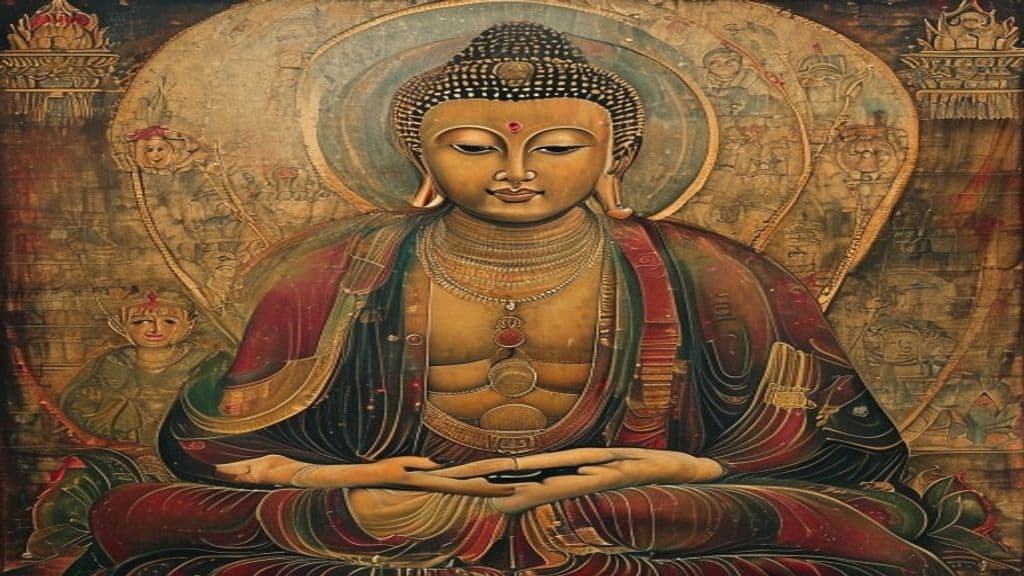
The term arhat is a Sanskrit present participle from the verbal root √arh 'to deserve' (Pāli arahant). The etymology indicates someone 'worthy' or 'deserving' of honor because of spiritual attainment. The sources attest that the word and concept predate Buddhist doctrinal refinements: in pre‑Buddhist contexts (e.g., usage in the Ṛgveda and Indian śramaṇa milieu) the term was associated with saintly ascetics and, in some accounts, with miraculous powers; Buddhist authors subsequently shaped the concept into a soteriological category denoting one who has eradicated the fetters and attained nirvāṇa.
There is no single canonical physical description of arhats as a class in the provided sources. Scriptural and doctrinal texts define arhats by status (enlightenment, cessation of rebirth) rather than by fixed bodily traits. In devotional and artistic contexts, especially in East Asia, arhats are depicted as named, individualized figures (e.g., the Sixteen Arhats or Eighteen Arhats, called luohan/lohan) with varied iconographic conventions; these group portraits and temple statues develop local visual types, but such depictions reflect later hagiography and artistic tradition rather than a uniform canonical bodily description.
Doctrinally the central 'ability' of an arhat is final liberation: having gained insight into the nature of existence, an arhat has realized nirvāṇa and will not be reborn. Narrative and hagiographic literature sometimes ascribes supernormal or psychic powers to particular arhats—examples in secondary sources include accounts like Arhat Cūḷapanthaka appearing in many forms to a messenger—yet encyclopedic sources note that miraculous powers became less central to the arhat identity in many Buddhist developments. Across schools there is variation: Theravāda emphasizes eradication of unwholesome roots and non‑rebirth; some early schools and Mahāyāna writings debate the perfection or fallibility of arhats compared with buddhas and bodhisattvas.
Weaknesses
- otherNot framed as vulnerable to supernatural wards (canonical literature does not present arhats as entities requiring warding); doctrinal critique—some schools argue arhats are fallible or a lesser ideal compared to buddhas/bodhisattvas (e.g., Mahāsāṃghika, Sarvāstivāda positions)
Wards
None recorded.

Buddha (Siddhartha Gautama)
Siddhartha Gautama, most commonly called the Buddha, is presented in the provided sources as a historical wandering ascetic and religious teacher of the 6th–5th century BCE who attained nirvana, taught Dharma, and founded the monastic community (sangha) that became Buddhism.

Bodhisattva
A bodhisattva is a being or practitioner in Buddhist thought who has generated bodhicitta — the wish and compassionate intention to attain awakening (bodhi) for the benefit of all sentient beings. In Early/Theravāda contexts the term often denotes the Buddha in his pre‑awakening lives, while Mahāyāna expands it into an ideal and category of spiritually advanced, active helpers and devotees.
Akshobhya
Akshobhya is a transcendent buddha of Mahāyāna and Vajrayāna Buddhism, one of the Five Wisdom (Dhyāni) Buddhas. He personifies 'mirror knowledge' (ādarśa-jñāna), is conventionally placed in the East, and is lord of the eastern Pure Land Abhirati; in esoteric texts he is associated with the eastern Vajra division and invoked in mantra/mandala ritual contexts.
Amitābha
Amitābha is a central celestial Buddha of Mahayana Buddhism who presides over the western Pure Land called Sukhāvatī. Devotional practices invoking his 'measureless' light and life (nianfo/nembutsu) are presented in Pure Land traditions as a path by which beings may be reborn in his buddhafield and quickly attain Buddhahood.
Anantacāritra
Anantacāritra (Sanskrit: अनन्तचारित्र) is a bodhisattva figure in the Lotus Sūtra, identified as one of the four great perfected bodhisattvas who attend Gautama Buddha. The name is glossed as "Boundless Practice" and, in Tiantai commentary, is read as representing eternity.
Anuruddha
Anuruddha is presented in the supplied sources primarily as a personal name borne by two overlapping non‑supernatural figures: (1) Anuruddha the Theravādin elder — one of the Buddha’s eminent disciples appearing in suttas and Vinaya anecdotes; and (2) Anuruddha the ruler — a chronicle figure in Pali/Thai histories associated with the Dvaravati cultural sphere and Arimadhanaburi (Nakhon Pathom). The materials do not treat Anuruddha as a spirit or other supernatural creature.
Avalokiteśvara
A central Mahāyāna and Vajrayāna bodhisattva who embodies great compassion (mahākaruṇā), Avalokiteśvara hears the cries of sentient beings and manifests in many forms to relieve suffering. Venerated across South, Central, and East Asia, the figure functions devotionally (mantra and sutra recitation) and iconographically in multiple gendered and regional guises.
Aṅgulimāla
Aṅgulimāla is a figure from early Buddhist literature: a notorious human brigand who wore a 'finger necklace' and, after an encounter with the Buddha at Sāvatthī, renounced violence, ordained as a monk, and is presented in the tradition as attaining liberation. In later South and Southeast Asian popular religion he is also invoked as a protector in childbirth and associated with fertility.
Bhaisajyaguru
Bhaisajyaguru (Bhaiṣajya‑guru; Medicine Buddha) is a Mahāyāna buddha associated with healing, medicine, and a pure land called Vaiḍūryanirbhāsa (Pure Lapis Lazuli). He functions as a therapeutic savior whose remedies operate through the "medicine of his teachings," vows, devotional practice, and radiance associated with lapis‑lazuli light.
Bhaiṣajyarāja (Medicine King Bodhisattva)
Bhaiṣajyarāja (Sanskrit: Bhaiṣajyarāja; Chinese: 藥王 Yào Wáng) is a Mahāyāna bodhisattva associated with healing, medicine, and supreme self‑offering. He appears in the Lotus Sūtra and in visualization/contemplation sutras and is often connected ritually and iconographically with the Medicine Buddha (Bhaiṣajyaguru) and with the paired bodhisattva Bhaiṣajyasamudgata.
Bhaiṣajyasamudgata
A Mahāyāna bodhisattva associated with the therapeutic activity of the Buddha and invoked in visualization (Guan) sūtras. He is named alongside the Medicine King (Bhaiṣajyarāja) and is the co-subject of a dedicated contemplation sūtra used in meditative-healing practice.
Cintāmaṇicakra (Nyoirin Kannon / Ruyi-lun Guanyin)
Cintāmaṇicakra is a bodhisattva-manifestation of Avalokiteśvara (Guanyin), identified with the wish-fulfilling jewel (cintāmaṇi) and wheel (cakra). In Mahāyāna sources the figure functions as one of six Avalokiteśvara forms tied to deliverance across the six realms (especially the deva realm) and is invoked through a dhāraṇī for karmic purification, protection, and fulfillment of aspirations.
Dharmapāla
In Buddhist traditions, a dharmapāla is a protective deity or guardian whose role is to defend the Dharma (the Buddha's teaching) and to avert obstacles to spiritual practice. Appearing across Mahāyāna and Vajrayāna contexts (notably Tibetan, Chinese, and Japanese), dharmapālas range from local worldly guardians to wrathful enlightened emanations invoked in tantric ritual.
Eight Legions (Aṣṭasenā / Hachi Bushū)
The Eight Legions (Sanskrit aṣṭasenā; Japanese Hachi Bushū 八部衆) are a grouped category of Buddhist divine and semi-divine beings assembled from multiple non-human classes whose described function in Mahāyāna sources is to protect the Dharma. They appear as part of the Buddha's audience in sutras such as the Lotus Sutra and the Golden Light Sutra and are represented in temple iconography with locally variable memberships.
Community Record
- [1]Arhat (Wikipedia). "In Buddhism, an Arhat (Sanskrit: अर्हत्) or Arahant (Pali: अरहंत्, 𑀅𑀭𑀳𑀦𑁆𑀢𑁆) is one who has gained insight into the nature of existence, has achieved nirvana, and has been liberated from the endless cycle of rebirth."; etymology and sectarian discussion.wiki
- [2]Arhat (Wikidata). "in Buddhism, one who has gained insight into the true nature of existence" (Wikidata summary).wiki
- [3]Sixteen Arhats (Wikipedia). Discussion of the Sixteen Arhats as a legendary group brought to China and Tibet and their role in East Asian iconography.wiki
- [4]Q&A: Arhat Cūḷapanthaka's display of psychic powers. Secondary discussion of a narrative account in which an arhat displays psychic/miraculous ability (Cūḷapanthaka appearing as many).other
- [5]Q&A: Do Arhats sleep?. Discussion page noting debates or questions about whether arhats sleep in the ordinary way; presented as a topic of discussion rather than settled doctrine.other
- [6]City of 10,000 Buddhas - The Vajra Sutra with Commentary. Representative Mahāyāna material referenced among sources regarding doctrinal contexts where arhats and bodhisattvas are contrasted.other