
Sandalphon does not appear in the canonical scriptures; he emerges in later rabbinic, midrashic, and Kabbalistic writings. Some early sources and later summaries identify him as the prophet Elijah transfigured and risen to angelic status, and other traditions pair or compare him with Metatron (sometimes described as a twin or overlapping figure). His name and attributes are discussed in medieval and later mystical texts rather than in biblical narrative.
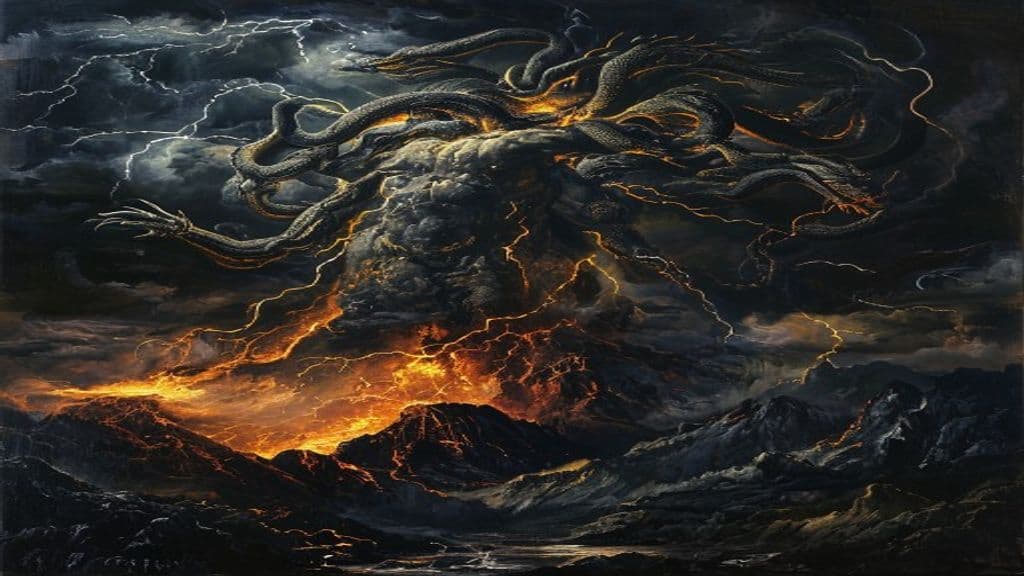
Descriptions vary across sources but commonly emphasize prodigious height: later rabbinic material says his head reaches Heaven (Babylonian Talmud, Hagigah 13b) and traditions compare his stature to other towering heavenly figures (e.g., exceeding Hadraniel by a '500-year foot journey'). He is also linked to the merkavah wheel imagery and is called Ophan ("wheel"), and some ritual-theurgical sources (e.g., the Greater Key of Solomon as cited in secondary summaries) describe him as a left-hand feminine cherub of the Ark of the Covenant. Overall, sources present differing iconography but repeatedly note extreme size and occasional wheel/cherubic associations.
Sources attribute to Sandalphon the gathering of human prayers and conveying them to God—he is explicitly credited in Sukkot liturgy with making a garland of prayers and adjuring them to ascend as an orb to the King of Kings. He is named a Hazzan (master of heavenly song) and is described in the Zohar as 'chief of the Seventh Heaven.' In Kabbalistic schema he represents the sephirah Malkuth and appears before the Shekhinah. Other attributions in the mystical corpus include acting in embryonic formation (bringing about differentiation of sex in the embryo) and engaging in a ceaseless struggle with Samael, analogous to Michael's opposition to that adversarial figure. Comparative commentary in the sources notes affinities of his towering stature with figures like Israfil and Typhon.
Ariel
Ariel is named in the provided materials as an angel appearing primarily in Jewish and Christian mysticism and apocrypha. The supplied sources give the Hebrew form אֲרִיאֵל (romanized ʾÁrīʾēl) and identify Ariel as an angelic figure but do not provide further doctrinal, narrative, or ritual detail.
Barachiel
Barachiel (Hebrew: בַּרַכְאֵל, Baraḵʾēl, 'God has blessed') is an archangelic figure in Jewish mystical literature and in Byzantine Catholic and Eastern Orthodox Christian devotion, traditionally associated with blessings, guardianship of family and married life, and as chief of guardian angels. Mystical texts place him over the second heaven and attended by a vast retinue of ministering angels; Christian iconography portrays him with symbols of blessing such as a white rose, rose petals, a bread basket, or a staff.
Binah (בינה)
Binah (Hebrew: בִּינָה Bīnā, "understanding") is the third sephirah on the Kabbalistic Tree of Life, a non-personal divine attribute that receives, contains and structures the undifferentiated creative impulse (Chokmah). It functions as an intellectual/metaphysical principle in Kabbalistic cosmology and psychology rather than as an independent, anthropomorphic spirit.
Chochmah
Chochmah (Heb. חָכְמָה; also Chokmah/Chokhmah) is a metaphysical principle in Jewish Kabbalistic thought: the second of the ten sefirot, described as the primordial point of divine wisdom — the first flash of conscious intellect that issues from Keter and becomes intelligible through Binah.
Chokmah
Chokmah (חָכְמָה, 'wisdom') is the second sefirah on the Kabbalistic Tree of Life, described in classical kabbalistic texts as the primordial point of divine wisdom that emerges from Keter and precedes differentiation by Binah. It functions as an abstract metaphysical principle and cognitive archetype rather than a personified spirit in the provided sources.
Daʻat
Daʻat (Hebrew: דַּעַת, "knowledge") is a Kabbalistic locus or mystical state on the Tree of Life in which the sefirot are united; it functions as a mediating point between the transcendent Keter and the manifest sefirotic structure and as a correlate of certain human cognitive-emotional capacities.
Ein Sof
Ein Sof (אֵין סוֹף, ʾēn sōf) is the Kabbalistic designation for the pre‑manifest, nameless divine principle—literally “no end” or “infinite”—from which the Ohr Ein Sof (Infinite Light) and the ten sefirot are said to emanate. It is described apophatically: beyond names, attributes, form, space and time.
Ein Sof Aur
A Kabbalistic metaphysical formulation linking Ein Sof (the Infinite) with ʾOr (divine 'light'), used to discuss divine emanation and the manifestation of revealed divine names (e.g., YHWH Elohim) rather than a personified folkloric being.
Gevurah
Gevurah (Hebrew: גְּבוּרָה, Găḇūrā) is the fifth sephirah on the Kabbalistic Tree of Life, an emanation representing the divine principles of judgment, limitation, and disciplined strength. It functions as a structural attribute within Jewish mystical cosmology rather than an individual personal spirit.
Haniel
Haniel is an angelic figure in Jewish and later Western angelology, traditionally counted among the seven archangels. The figure is associated with the planet Venus and is described as the governing archangel of the Kabbalistic sephirah Netzach, embodying qualities of grace, charm, and joy and appearing in later Renaissance esoteric apparatus such as John Dee's Sigillum Dei Aemeth.
Keter
Keter (Hebrew: כֶּתֶר, "crown") is the highest of the ten sefirot in Jewish Kabbalistic cosmology, the first emanation from the Ein Sof that functions as the primal divine will or initial impulse toward creation. It is described as utterly concealed — "the most hidden of all hidden things" — and as the origin point from which subsequent sefirot emerge.
Malkuth (מַלְכוּת)
Malkuth is the tenth sefirah on the Kabbalistic Tree of Life, the lowest sphere representing the manifest world or 'Kingdom'. It functions as the receiving endpoint of the divine emanations, the realm of material existence (the World of Assiah), and a symbolic locus for humility, embodied action, and the Shekhinah in Zoharic material.
Community Record
- [1]Sandalphon — Wikipedia. Wikipedia, 'Sandalphon' (summary of rabbinic, midrashic, Zoharic, and Kabbalistic traditions)wiki
- [2]Sandalphon — Wikidata. Wikidata entry for Sandalphon (metadata summary)wiki
- [3]The Complete Poetical Works (archive listing referencing Longfellow's 'Sandalphon'). Archive.org bibliographic listing referencing Longfellow's poem 'Sandalphon' (cultural reception)literary
- [4]DJ-Sandalphon - Extasy Album (2005) (archive listing). Archive.org entry for a modern musical use of the name 'Sandalphon' (popular-cultural reception)other