
The Santa Compaña is presented in local tradition as an ancient spectral host moving through parish paths at night. Folklorists and popular accounts frame it as the Iberian manifestation of a pan‑European motif (the Wild Hunt) and compare it to other death‑announceing figures such as the Breton Ankou and the Irish Banshee. Etymological variants reinforce this deep-rooted image: names like Estantiga are linked (in the cited material) to Latin hostis antiquus, 'ancient host', while Güestia derives from Asturian güeste 'host', suggesting a continuity between ecclesiastical language of a 'company' or 'host' and older beliefs in wandering hosts of the dead.
Accounts commonly describe a nocturnal procession beginning around midnight composed of multiple figures bearing candles and moving in a line along village tracks or lanes. Many source versions depict participants wearing white, hooded cloaks and the living leader carrying a cross or a cauldron of holy water, but descriptions vary by locality and witness: some observers report only floating points of candlelight (compared to ignis fatuus or will‑o'‑the‑wisp) rather than clearly seen bodies. The procession is therefore treated in the tradition as a liminal, partly visible phenomenon whose precise visual form differs across tellings.
In folklore the Santa Compaña's primary function is as an omen: its procession is believed to announce impending death and to visit the homes 'where death is due'. A distinctive motif is that the host is led by a living parishioner who, under a mysterious compulsion or curse, must leave each night in a trance‑like state to guide the company and who typically has no memory of the walks by morning; failure to pass on the burden leads to progressive wasting and eventual death, at which point the compulsion transfers to another parishioner. Transmission is likewise part of the tradition: during the nocturnal walk the leader may hand the cross or cauldron to another person met on the way, thereby transferring the burden. Sources also record variant folk explanations for why some people perceive the Compaña while others do not (for example, ritual error at baptism or particular sensitivity to hidden things).
Weaknesses
- ritualentering Solomon's Circle / protective circle with Seal of Solomon (chalk)
- conditionlie face-down on the ground until the procession passes
- othertying a black cat in the procession's path as a diversion (folk remedy)
- symbolapotropaic hand gestures (horn gesture; fig sign)
Wards
- ritualSolomon's Circle (drawn in chalk with Seal of Solomon / six-pointed star sometimes altered into a cross)
- conditionlying face-down on the ground until the procession passes
- othertying a black cat in the path of the procession and fleeing
- symbolmaking apotropaic gestures — horn gesture or fig sign
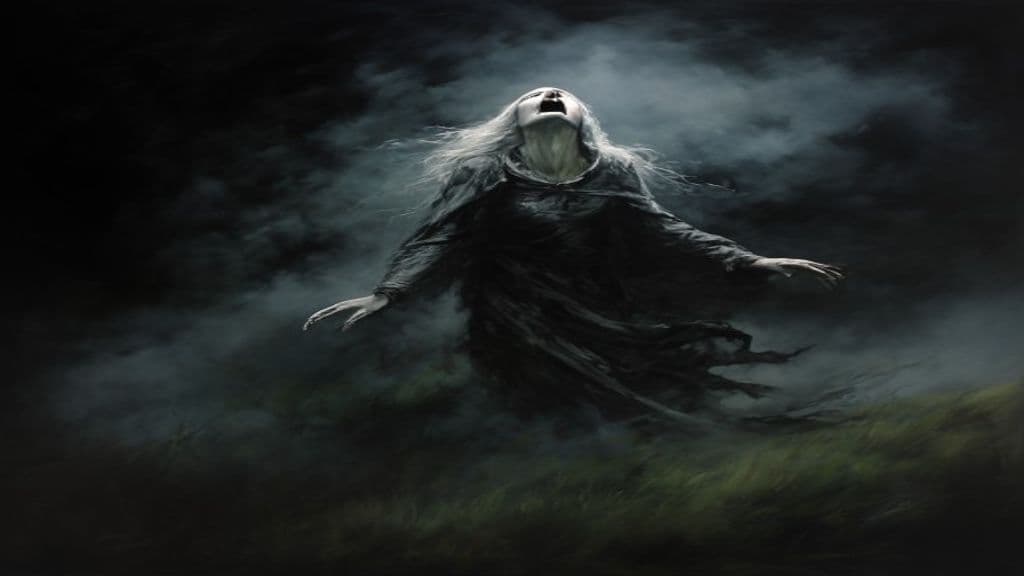
Banshee
A female spirit of Irish and Scottish folklore whose wail heralds an impending death in a family of Gaelic descent. Not a cause of death — a witness to it.
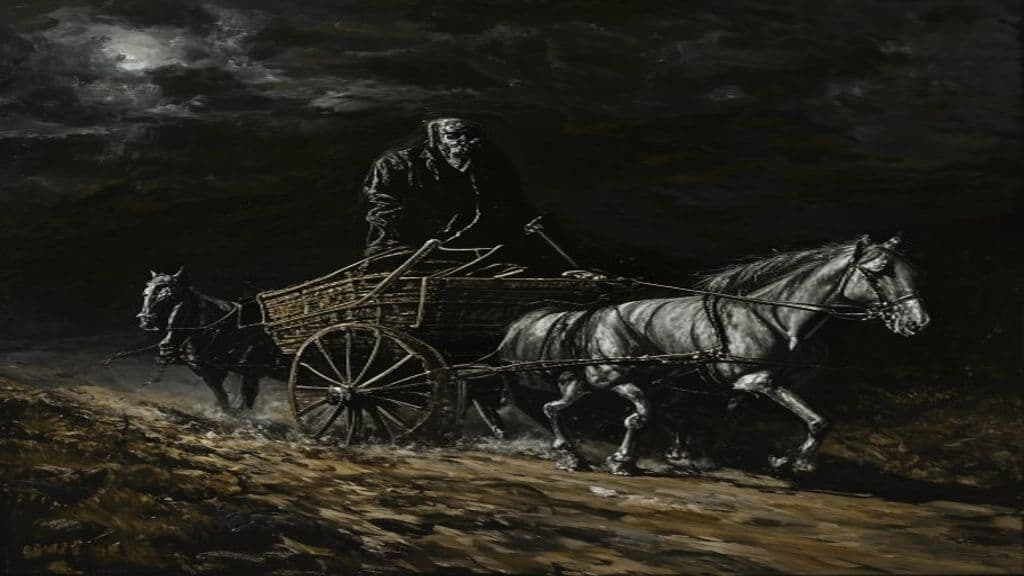
Ankou
The Breton personification of death — the last person to die in a parish each year who drives a creaking cart collecting the dead, whose appearance or sound presages death.
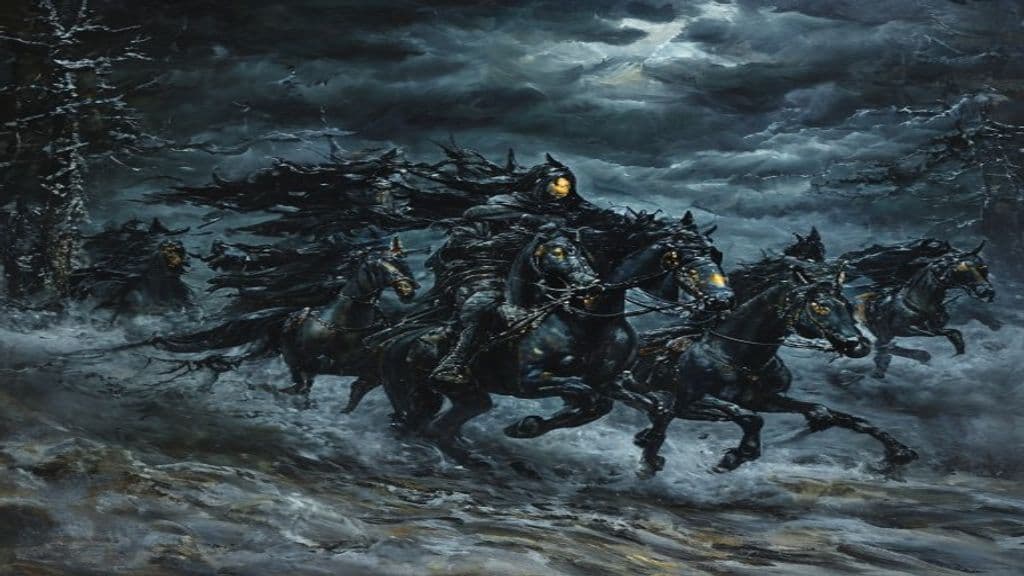
Wild Hunt
A fearsome spectral cavalcade of the dead sweeping through the winter sky — those who see it risk being carried off or killed, and its passage foretells war, plague, or catastrophe.
San Martin Txiki
A trickster figure from Basque mythology with a strong connection to the natural world, particularly agriculture. (Note: - Power tier should be Ancient (deity-level), as San Martin Txiki is a trickster figure who stole secrets from deities and is described as inventing new tools. - Sensory cues are not mentioned in the )
Sandalphon
Sandalphon is a highly elevated angelic figure in later Jewish and Christian mystical literature (rabbinic, midrashic, and Kabbalistic), often ranked among the chief angels. He functions as an intermediary who gathers human prayers and transmits them to God, is associated with heavenly song, and is placed in Kabbalah as representing the sephirah Malkuth and as chief of the Seventh Heaven.
Sanjna
Sanjna (also Samjñā, Saranyu) is a Hindu goddess best known as the chief consort of the sun-god Vivasvant/Surya whose mythic actions (flight, transformation into a mare, and leaving a substitute/Chhaya) link her to themes of motion, identity, and the origins of several important progeny (Yama, Yami, Manu, the Ashvins).
Sanki Daigongen (三鬼大権現)
Sanki Daigongen (三鬼大権現) is a named gongen — a syncretic manifestation concept in Japanese religion — cited in festival and shrine listings for Itsukushima (Miyajima). The name literally combines characters for "three" (三), "oni/spirits" (鬼), and "great gongen" (大権現), placing the figure within the cultural category of a buddha manifesting as a local kami in the shinbutsu‑shūgō framework.
Sankōbō
Sankōbō is attested in a single cited source as a type of tengu in Japan. The available record provides only this classificatory label and supplies no further description, narratives, or ritual information.
Sanmoto Gorōzaemon
Sanmoto Gorōzaemon is a named figure noted on a character list page for the modern manga Nura: Rise of the Yokai Clan. The cited source is a general roster of characters in that fictional work and does not supply narrative, descriptive, or ritual detail specific to this name.
Santelmo
Santelmo in Philippine contexts is a luminous fireball or glowing phenomenon treated variously in sources as a folkloric apparition or as a cultural interpretation of the meteorological St. Elmo's fire. It appears in popular media and folklore inventories alongside other Philippine supernatural beings, and accounts emphasize its fiery appearance and association with storms and pointed objects.
Saraca asoca (Buddhist tradition)
A sacred tree in Buddhist tradition, significant to Buddha's life and the Four Trees of his life. (Note: - Power tier should be Ancient (associated with Buddha's life and significant spiritual value) - Origin story needs more detail or context from source material - Appearance is not supported by source )
Saraswati
Saraswati is a principal Hindu goddess (Devi) whose portfolio encompasses knowledge, learning, speech (vac), the arts (poetry, music), language and purification. Originating in Vedic literature as a river goddess, later texts reframe her primarily as the divine personification and patron of speech, learning and creative/intellectual order; she is venerated across Hindu, Buddhist and Jain contexts.
Sariel
Sariel (Heb. Śārīʾēl) is a named angel attested in Jewish apocryphal literature and in late‑antique apotropaic contexts. He is listed among a small group of prominent angels charged with oversight functions (e.g., set over spirits who sin) and appears as an invoked protective name in ritual artefacts and sectarian practice.
Sarlagab
Sarlagab (also spelled Zarlagab) is attested in the Sumerian King List as a Gutian ruler of southern Mesopotamia, recorded as ruling for six years in the late third millennium BCE. Modern summaries place him roughly c. 2200–2202 BC and note a debated identification with a Gutian king named in an Akkadian year-name as having been captured by Šar-kali-šarri.
Sarpa Kavu
Sacred site or grove in Hindu tradition, inhabited by nagas and other snakes. (Note: - Power tier: Primordial (Sarpa Kavu is a sacred site with deep cultural significance, not just a regional power) - Sensory cues: Provide specific details on how one might sense the presence or energy)
Community Record
- [1]Santa Compaña. Wikipedia: Santa Compañawiki
- [2]Santa Compaña. Wikidata: Santa compañawiki
- [3]Romance de lobos, comedia bárbara - Ramón del Valle Inclán. Valle-Inclán, Romance de lobos (literary reference)literary
- [4]Santa Compaña of the Iberian Peninsula | Into Horror History | J.A. Hernandez. J.A. Hernandez, popular history essayother
- [5]Santa Compaña: A Procession of Souls - Follow the Camino. Follow the Camino, travel/folklore articleother
- [6]The Mysterious Santa Compaña, the Ghostly Procession of Souls in Spain. Mysterious Universe, popular articleother
- [7]Monster Wiki — Santa Compaña. Fandom/Monster Wiki entryother
- [8]A Santa Compaña (Wikipedia Spanish/related). Wikipedia: A Santa Compaña (related entry)wiki