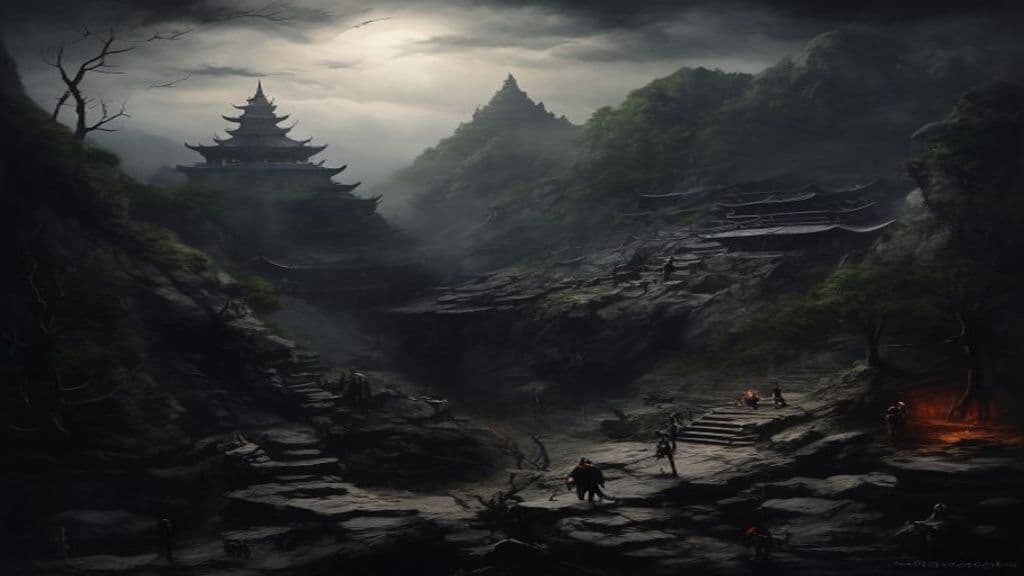
There is no physical description of the seonangdang.
The seonangdang have spiritual significance and are dedicated to a deity, but do not possess supernatural powers or interact with humans in an extraordinary way.
Jeonggamnok
The Jeonggamnok is a compilation of prophetic works describing a messianic figure known as the 'True Man' with the surname Jeong, expected to bring about a new utopian dynasty. (Note: - Power tier: Primordial (due to the "messianic figure" and the scope of its prophetic works) - Origin story: missing - Appearance: missing - Abilities: should describe how it is believed the 'True Ma)
Korean Mythological Pantheon
A diverse pantheon of deities and spirits in Korean mythology, worshipped through shamanic rituals. (Note: - Power tier is too high; a Primordial/Cosmic power tier typically implies entities that create or govern the universe, but Korean mythology doesn't describe such roles for its deities. - Abilities an)
Tangun Mausoleum
The Tangun Mausoleum is a historical site in North Korea, honoring the founder of Gojoseon, Korea's first kingdom. (Note: 1. "Primordial" power tier is likely too high given that it's a historical site without supernatural powers. 2. Appearance should be updated to say "no information available" or removed altogether. 3.)
Selma (Seljordsormen)
Selma, known in Norwegian as Seljordsormen ('the Seljord serpent'), is a localized lake‑monster tradition associated with Lake Seljord (Seljordsvatnet) in Seljord municipality, Telemark, Norway. Traditionally described as a serpentine sea‑serpent inhabiting the lake, Selma appears in folklore, eyewitness reports (the oldest cited written account dates to 1750), modern cryptozoological investigations, and as a civic emblem of Seljord.
Semele
Semele is a figure of ancient Greek myth: a Theban princess, daughter of Cadmus and Harmonia, mother of Dionysus by Zeus, who dies after seeing Zeus in his full divine form and is later raised to divine status as Thyone. Her name and aspects of her cult have been linked by scholars to non‑Greek (Thraco‑Phrygian or Phrygian) earth‑goddess terminology, though the etymology is debated.
Semin-hwangje bon-puri
A shamanic narrative associated with funeral ceremonies on southern Jeju Island, classified as one of the special bon-puri in Korean tradition. (Note: - The power tier should be adjusted to Lesser (local spirit) based on the source material, which describes a narrative associated with a specific geographic location and ceremonial context, rather tha)
Seng-gut Deities
Central figures in the Korean shamanic narrative that shape creation and development of the world. (Note: - Power tier: Primordial claims are not supported as no evidence indicates they have cosmic powers (only creation and intervention in human affairs). - Abilities: The description is too broad; specifi)
Senoy, Sansenoy and Semangelof
A triad of named spirit-agents in Jewish folkloric summaries attested as protecting women during and shortly after childbirth and safeguarding newborn infants from attacks attributed to the night demon Lilith. Secondary and modern sources sometimes label them as angels or "medicinal angels," but primary ritual, linguistic, and iconographic data are not preserved in the supplied materials.
Seonangshin
Korean patron deity of protection and war, guarding villages from harm. (Note: * Power tier should be Ancient, not Primordial, as the description implies a deity-level power but does not describe cosmic or universal implications. * Appearance is missing, but since it's not provi)
Sephirot
In Kabbalah, the Sephirot (Sefirot) are the ten fundamental emanations or modes through which the Infinite (Ein Sof) reveals and manifests itself. They function as the structural channels of divine activity that mediate between absolute transcendence and the created world, ordering the descent of reality through the metaphysical Four Worlds (seder hishtalshelut).
Seraph (seraphim)
A seraph (Hebrew: saraph; plural seraphim) is a class of heavenly, non‑human beings in ancient Jewish scripture and later Jewish, Christian, and Islamic angelologies, associated with proximity to the divine throne, perpetual liturgical praise, and a burning or purifying quality tied to the root meaning of their name.
Serapis
Serapis is a deliberately syncretic Graeco‑Egyptian deity formed from the fusion of the Egyptian Osiris‑Apis cult (Demotic wsjr‑ḥp / Coptic Userhapi) with Greek divine elements. Promoted in the Ptolemaic period as a civic cult figure, Serapis embodied chthonic rulership, healing, protection/asylum, and themes of abundance and resurrection, and his cult spread through the Hellenistic and Roman worlds.
Community Record
- [1]