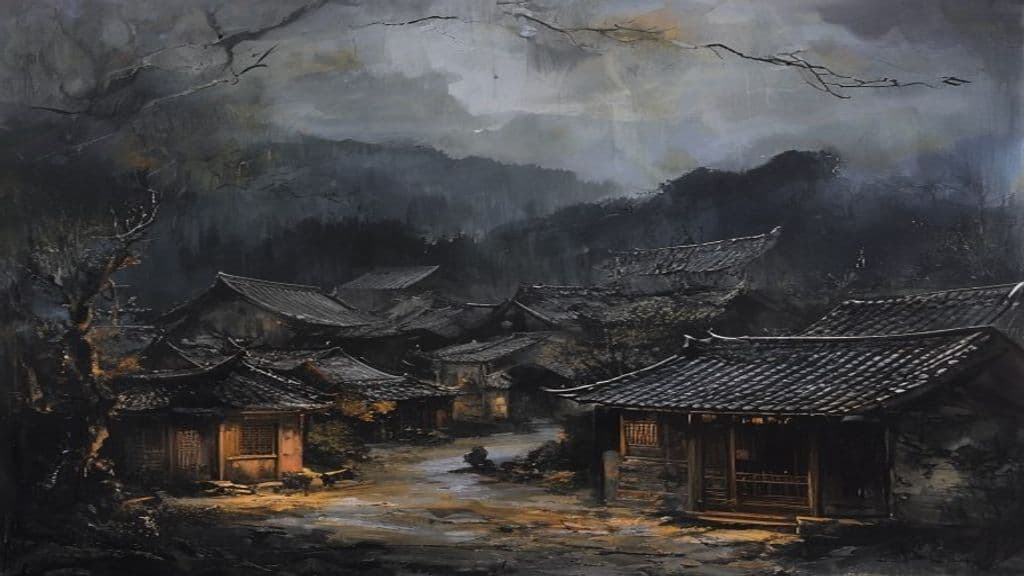
Seonangshin is the goddess of war and protection, embodying the protective aspects of villages and their people. Her role as a patron deity reflects the importance of community and defense from external threats in traditional Korean culture.
No description provided for Seonangshin's physical appearance.
As the goddess of war, Seonangshin may be associated with conflict resolution and defending her people against external threats. Her role as a protector suggests that she is deeply connected to the village and its inhabitants, providing them with security and safeguarding their well-being.
Bulgae (Korean Fire Dog)
A mythical Korean fire dog said to cause eclipses by biting the Sun and Moon. (Note: * The power tier is incorrect; according to the source, Bulgae cause eclipses by biting both the Sun and Moon, but there's no indication that they're on a primordial level. It should be at least Ancie)
General Sinui
A legendary figure in Korean tradition who attempted to cheat death, but failed. (Note: 1. Power tier: Incorrectly classified as Minor Spirit. Given that General Sinui is a legendary figure who defied death, it's likely he should be categorized as a Greater (powerful regional) or at leas)
Gunungsin (War Gods)
Korean deities associated with war and conflict, possibly connected to the Jakjaegeon myth. (Note: 1. Power tier should be Primordial only if it's supported by source material; based on the provided sources, the power level is unspecified. 2. Abilities are unknown or unspecified in source material,)
Haneunim / Hananim
Haneunim (하느님) or Hananim (하나님) is the sky god in Korean mythology presented as the supreme heavenly deity. The figure functions as the Lord of Sky in older Korean cosmology, appears in the Dangun foundation myth (via the closely related Hwanin/Hwanung genealogy), and is identified in syncretic religious contexts with high deities such as Indra (Śakra), the Jade Emperor (Okhwang Sangje), and is named in modern Korean religions including Cheondoism and Jeungsanism; the terms have also been used as Korean translations for the Christian concept of God.
Onjo and Biryu's Baekje Creation Myth
The creation myth of Baekje revolves around the two brothers, Onjo and Biryu, who founded the dynasty. They possess human capabilities like decision-making and leadership skills. (Note: 1. Power tier: Greater (Onjo and Biryu's actions drove the founding of an entire kingdom) 2. Abilities: Add that their abilities also include diplomatic efforts and negotiations with other kingdoms 3.)
Samsin Halmeoni
A Korean goddess associated with childbirth and fate, revered for her connection to family lineage. (Note: * Power tier: Lesser (based on the description of being a localized spirit) * Abilities: Add that she has no specific abilities or behaviors described * Sensory cues: None listed in source material * )
Sosamshin
In Korean mythology, Sosamshin is a household deity and the goddess of the birth of cattle. She occupies an important place in the cosmology of her source culture. (Note: * Power tier: Lesser (not Greater), given that Sosamshin is a household deity and not described as having deity-level powers. * Summary: While it's mentioned she occupies an important place in her sou)
Tan'gun
Legendary founder and first king of Gojoseon, considered divine with heavenly ancestry. (Note: - Power tier should be Primordial (but with caution, as it's not explicitly stated) - Appearance should note that no physical description exists - Abilities should specify that there is no information)
Senoy, Sansenoy and Semangelof
A triad of named spirit-agents in Jewish folkloric summaries attested as protecting women during and shortly after childbirth and safeguarding newborn infants from attacks attributed to the night demon Lilith. Secondary and modern sources sometimes label them as angels or "medicinal angels," but primary ritual, linguistic, and iconographic data are not preserved in the supplied materials.
Seonangdang
A term in Korean tradition referring to sacred stone cairns or trees dedicated to the deity Seonangshin. (Note: 1. Power tier: Primordial (given it's a term referring to sacred structures dedicated to a deity) 2. Abilities: Add that they are considered holy and serve as a connection between humans and Seonangsh)
Sephirot
In Kabbalah, the Sephirot (Sefirot) are the ten fundamental emanations or modes through which the Infinite (Ein Sof) reveals and manifests itself. They function as the structural channels of divine activity that mediate between absolute transcendence and the created world, ordering the descent of reality through the metaphysical Four Worlds (seder hishtalshelut).
Seraph (seraphim)
A seraph (Hebrew: saraph; plural seraphim) is a class of heavenly, non‑human beings in ancient Jewish scripture and later Jewish, Christian, and Islamic angelologies, associated with proximity to the divine throne, perpetual liturgical praise, and a burning or purifying quality tied to the root meaning of their name.
Community Record
- [1]Seonangsinwiki