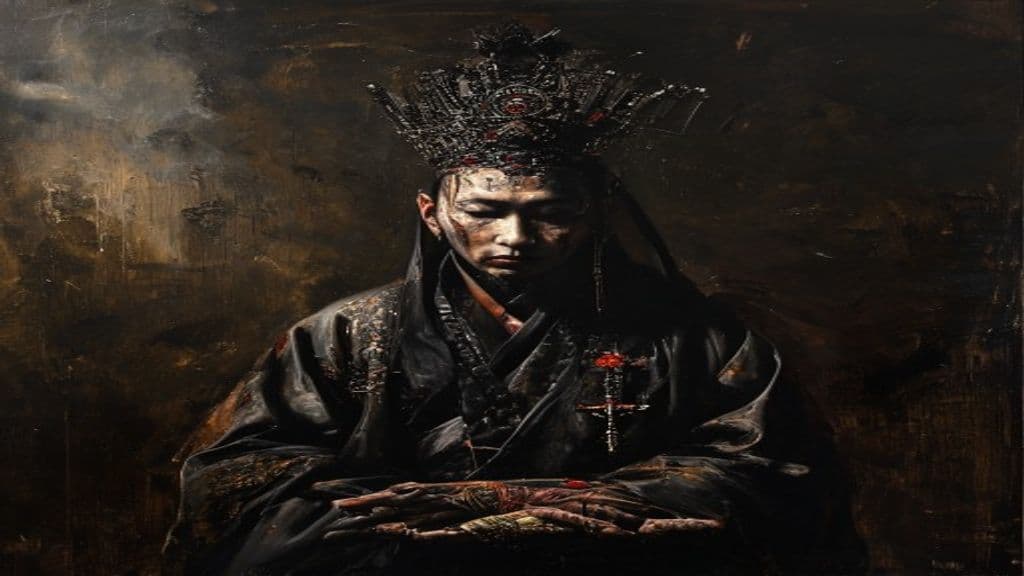
The Semin-hwangje bon-puri is a part of the Korean shamanic tradition and is associated with funeral ceremonies on southern Jeju Island.
No physical description of the Semin-hwangje bon-puri is provided in the source material.
The narrative of Semin-hwangje bon-puri is associated with guiding the deceased or assisting in their transition to the afterlife. However, its specific powers and behaviors are not described in the source material.
Weaknesses
- unknown
Wards
- unknown
Igong Maji (Korean tradition)
A god of flowers in Korean shamanism, associated with natural cycles and fertility. (Note: 1. Power tier should be Ancient (deity-level) instead of Primordial, since it's described as "the god of flowers" and has a significant role in specific rituals. 2. The origin story is too vague; the )
Korean Creation Narratives
A category of shamanic stories that recount the mythological beginnings of the universe, including tales from mainland Korea and Jeju Island. (Note: - Power tier should be Ancient (deity-level), as the creation narratives describe mythological beginnings of the universe. - Origin story is not entirely unclear; specific stories from various regions)
Song of Dorang-seonbi and Cheongjeong-gaksi
A Korean shamanic narrative about two supernatural entities associated with the natural world and fertility. (Note: 1. Power tier should be "Minor Spirit" -> not supported (based on lack of information about powers/abilities) 2. Remove power_tier as it's unclear 3. Add sensory_cues, wards, and weaknesses sections w)
Selaphiel
Selaphiel is an archangel venerated in Eastern Orthodox devotional and liturgical imagination as a heavenly intercessor associated with prayer and worship. He is named in Hebrew tradition (Šəʾaltīʾēl, "I have asked God") and appears in iconography as a humble, prayerful figure sometimes holding a thurible.
Selene
Selene is the ancient Greek goddess and personification of the Moon, who drives her moon-chariot across the heavens. Daughter of the Titans Hyperion and Theia and sister to Helios and Eos, she embodies both the luminous aspect of the Moon and its function as regulator of the month.
Selkie
A seal-being from northern Atlantic coastal folklore said to shift between seal and human forms by removing or donning a seal skin. Tales focus on intimate relations with humans, the selkie's longing for the sea, and the narrative motif of a hidden skin that prevents return to the ocean.
Selma (Seljordsormen)
Selma, known in Norwegian as Seljordsormen ('the Seljord serpent'), is a localized lake‑monster tradition associated with Lake Seljord (Seljordsvatnet) in Seljord municipality, Telemark, Norway. Traditionally described as a serpentine sea‑serpent inhabiting the lake, Selma appears in folklore, eyewitness reports (the oldest cited written account dates to 1750), modern cryptozoological investigations, and as a civic emblem of Seljord.
Semele
Semele is a figure of ancient Greek myth: a Theban princess, daughter of Cadmus and Harmonia, mother of Dionysus by Zeus, who dies after seeing Zeus in his full divine form and is later raised to divine status as Thyone. Her name and aspects of her cult have been linked by scholars to non‑Greek (Thraco‑Phrygian or Phrygian) earth‑goddess terminology, though the etymology is debated.
Seng-gut Deities
Central figures in the Korean shamanic narrative that shape creation and development of the world. (Note: - Power tier: Primordial claims are not supported as no evidence indicates they have cosmic powers (only creation and intervention in human affairs). - Abilities: The description is too broad; specifi)
Senoy, Sansenoy and Semangelof
A triad of named spirit-agents in Jewish folkloric summaries attested as protecting women during and shortly after childbirth and safeguarding newborn infants from attacks attributed to the night demon Lilith. Secondary and modern sources sometimes label them as angels or "medicinal angels," but primary ritual, linguistic, and iconographic data are not preserved in the supplied materials.
Seonangdang
A term in Korean tradition referring to sacred stone cairns or trees dedicated to the deity Seonangshin. (Note: 1. Power tier: Primordial (given it's a term referring to sacred structures dedicated to a deity) 2. Abilities: Add that they are considered holy and serve as a connection between humans and Seonangsh)
Seonangshin
Korean patron deity of protection and war, guarding villages from harm. (Note: * Power tier should be Ancient, not Primordial, as the description implies a deity-level power but does not describe cosmic or universal implications. * Appearance is missing, but since it's not provi)
Community Record
- [1]Semin-hwangje bon-puri. Wikipedia article on Semin-hwangje bon-puriwiki