
In local origin narratives recorded in ethnographic and popular summaries, a Jakun clearing is halted when an old woman leaning on a stick admonishes the group for not seeking the permission of spirits; when the stick is planted a fountain of water issues from the hole and the flow over years creates Tasik Chini. The log that had been lodged in the ground is revealed to be a nāga called Seri Gumum. Variant love-tale versions relate that a princess and prince leave a sealed Forbidden Garden, transform into two nāga (Seri Gumum and Seri Kemboja) as they cross the boundary, and when daylight catches them they become islands (accounts identify Tioman and Lingga in some tellings). (Sources: Wikipedia summary; origin and love-tale quotations as recorded in source summaries.)
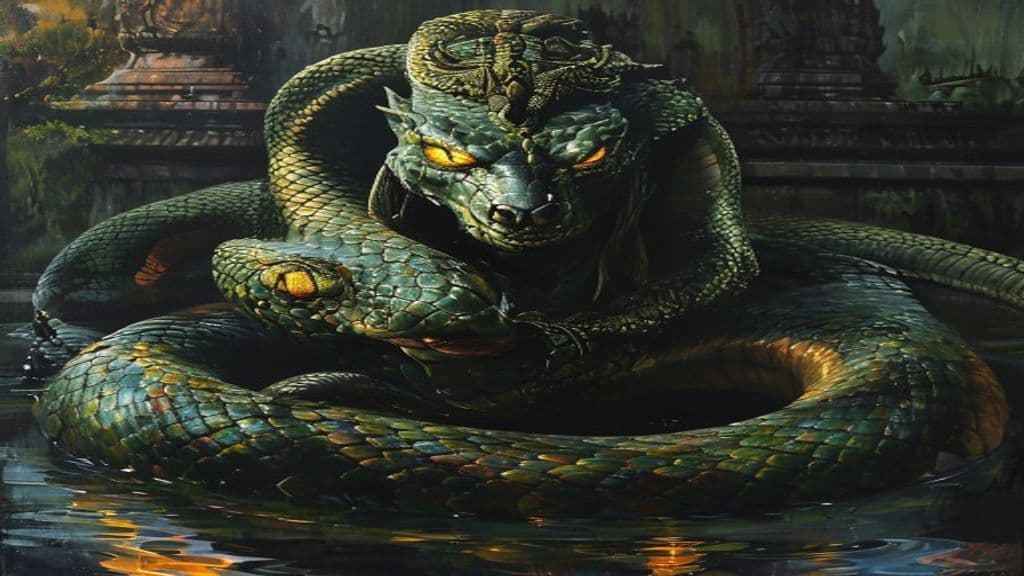
Traditional descriptions consistently identify Seri Gumum as a large legendary serpent or nāga commonly taking the form of an Asian dragon. Modern cultural depictions (murals and tourist imagery) portray a large greenish-blue dragon-like creature. A 1959 eyewitness report summarized in cryptozoology sources describes a dragon-like creature with red eyes that appeared from the water and peered into a boat; later summaries claim witnesses found huge footprints the next day. (Sources: Wikipedia; street art/tourism commentary; Cryptid Wiki and cryptozoology summaries.)
Folkloric accounts attribute landscape-forming and transformative agency to Seri Gumum: the nāga is said to have produced the spring that created Tasik Chini and to have been involved in island-formation in romantic origin variants. It is associated with weather and hydrological phenomena—villagers interpret thunder, lightning and floods as connected to the nāga's movements, and tradition holds that rulers might dream of the nāga as an omen of major floods. Ethnographic reporting records historical beliefs that human sacrifice around a pillar of rock in the lake had been practiced to pacify the nāga. Modern cryptozoological reports frame additional behaviors (surfacing at night, retreat when fired upon) as animal-like sightings, but those belong to later reportage rather than the traditional corpus. (Sources: Wikipedia; Stewart Wavell account as cited on Wikipedia; cryptozoology summaries; origin/love-tale sources.)
Weaknesses
- ritualappeasement by sacrifice (historical reports)
- conditionseeking permission of local spirits before altering land (preventive ethic)
Wards
- ritualsacrifice around the lake pillar (historical practice)
- otherasking or gaining permission of local spirits before clearing land
Seonangshin
Korean patron deity of protection and war, guarding villages from harm. (Note: * Power tier should be Ancient, not Primordial, as the description implies a deity-level power but does not describe cosmic or universal implications. * Appearance is missing, but since it's not provi)
Sephirot
In Kabbalah, the Sephirot (Sefirot) are the ten fundamental emanations or modes through which the Infinite (Ein Sof) reveals and manifests itself. They function as the structural channels of divine activity that mediate between absolute transcendence and the created world, ordering the descent of reality through the metaphysical Four Worlds (seder hishtalshelut).
Seraph (seraphim)
A seraph (Hebrew: saraph; plural seraphim) is a class of heavenly, non‑human beings in ancient Jewish scripture and later Jewish, Christian, and Islamic angelologies, associated with proximity to the divine throne, perpetual liturgical praise, and a burning or purifying quality tied to the root meaning of their name.
Serapis
Serapis is a deliberately syncretic Graeco‑Egyptian deity formed from the fusion of the Egyptian Osiris‑Apis cult (Demotic wsjr‑ḥp / Coptic Userhapi) with Greek divine elements. Promoted in the Ptolemaic period as a civic cult figure, Serapis embodied chthonic rulership, healing, protection/asylum, and themes of abundance and resurrection, and his cult spread through the Hellenistic and Roman worlds.
Serapis Bey
Serapis Bey is presented in modern Theosophical and Ascended Master movements as an Ascended Master and the Chohan (lord) of the Fourth Ray, described in these traditions as overseeing the Ascension Temple and guiding students in the qualities associated with that ray (purity, discipline, mastery). Sources place him among Egyptian-associated Brothers and within the internal organizational language of Ascended Master/theosophical brotherhoods.
Sergestus
Sergestus is a human Trojan companion of Aeneas in Virgil's Aeneid, presented as one of the minor members of Aeneas's retinue who participates in the funeral games (Book V). Later literary adaptations preserve him as a minor character; Roman tradition/gens Sergia regarded him as an eponymous ancestor.
Serpent Deities of the Book of Gates
In ancient Egyptian tradition, serpent deities are guardians of gates that the newly deceased soul must pass through on its journey into the next world. (Note: * Power tier: Primordial is too strong; Greater or Ancient would be more fitting for serpent deities associated with gates and not explicitly described as having cosmic power. * Origin story and Appea)
Serpents in Jewish Tradition (Biblical Context)
Symbolic representation of evil and positive aspects, reflecting the complex nature of their symbolism. (Note: - Power tier: Downgrade to Greater (they are described as representing "evil power" but also have positive aspects) - Appearance: Add note that there is no physical description provided in source mate)
Seth
Two distinct traditional personae share the name 'Seth' in the supplied corpus: (1) the Abrahamic Seth, the third son of Adam and Eve and an antediluvian patriarch associated in later traditions with righteous lineage and transmission of knowledge; and (2) the Egyptian god Set/Seth, a powerful deity ritually opposed in the cult of Osiris, for whom a temple rite titled 'The book of the victory over Seth' prescribes the making of a red-wax figure to effect his downfall.
Seven Deadly Sins
A classificatory schema in Christian theological and monastic tradition that groups seven principal vices—capital or 'head' sins—understood as formative dispositions that incline persons to further wrongdoing and threaten their relationship with God.
Seven Great Lords of Narnia
A group of seven Telmarine noblemen in C. S. Lewis’s The Chronicles of Narnia who were sent beyond the Eastern Ocean during Miraz’s reign and disappeared; their fates (goldification, dragon-related death, enchanted sleep, nightmare-entrapment, and settlement) are the central quest of The Voyage of the Dawn Treader.
Seven Hathors
A grouped manifestation of the Egyptian goddess Hathor appearing as seven attendant female deities associated with birth, fate, and the transition of souls. They are attested in temple iconography and literary tales as visitors who foretell a newborn's destiny and appear in liminal contexts between life and death.
Community Record
- [1]Seri Gumum Dragon - Wikipedia. Wikipedia: 'In Pahang Malay folklore, the Seri Gumum Dragon (in Jawi script ناݢ سري ݢوموم) is a legendary giant serpent locally called Nāga...' (accessed sources summarized origin tale, sacrificial practice references)wiki
- [2]Seri Gumum | Cryptid Wiki | Fandom. Cryptid Wiki summary of the 1959 Arthur Potter sighting and later cryptozoology reports (names and brief sighting details summarized)other
- [3]Chini Lake - Wikipedia. Wikipedia: contextual information on Tasik Chini and local traditions linked to the lake (used for locale and cultural context)wiki
- [4]The Giant Greenish-Blue Dragon Mural That Comes to Life on a Three-Storey Building - STREET ART UTOPIA. Contemporary depiction of Seri Gumum in mural and tourist-facing imagery (used to document modern iconography)other
- [5]The Death of Seri Gumum Dragon in Tasik Chini Basin – FAScinate. Popular-science/ecology piece referencing Seri Gumum in discussions of Tasik Chini's cultural and environmental historyother
- [6]Naga Tasik Chini : The Lake Dragon - Mythlok. Summary of local tales linking Seri Gumum and Seri Kemboja in island-formation love-tale variants and other folkloric motifsother
- [7]CRYPTOZOOLOGY ONLINE: Still on the Track: CRYPTOLINK: Home of Naga Seri Gumum under threat. Cryptozoology blog and commentary on modern monster/cryptid framing of Seri Gumum reports (used for modern reportage context)other