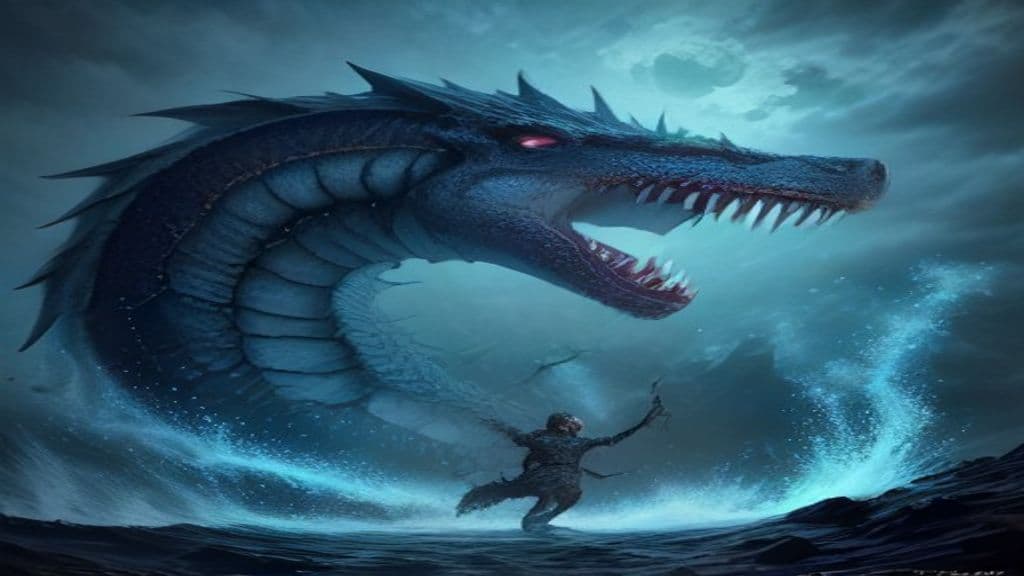
In Orcadian retellings (preserved by collectors such as Walter Traill Dennison and Ernest Marwick and later popularized in children’s anthologies), the Mester Stoor Worm is presented as a perennial calamity afflicting the kingdom of Leegarth. The tale frames the worm as a protracted, existential threat: it terrorizes the shores and countryside, prompting the king’s council to seek remedies and to offer tribute. The youngest son‑hero Assipattle, a resourceful youth of the household at Leegarth, undertakes a plan to confront the beast. His successful killing of the worm is narrated etiologically: the carcass and the effects of the combat are used to explain the formation of local islands and other large natural features (retellings state the story "describes how Orkney and Shetland were formed, and the smouldering volcanoes of Iceland!"). Sources situate the story within 19th–20th century collections and later popular retellings rather than as a single canonical medieval text.
Told as serpent‑like or dragonlike and an inhabitant of the sea, the creature is described in Dennison's long text and later retellings as of enormous, almost incalculable length ('beyond telling, and reached thousands and thousands of miles in the sea'). Some accounts characterize its head as 'like a great mountain.' Variants record its eyes differently: Dennison's variant says the eyes 'glowed and flamed like a ward fire,' a modern retelling describes them 'like round lochs, very deep and dark,' and some versions note it had only one eye. It is further said to possess a prehensile, forked tongue used like tongs to seize ships, houses or people, and to emit a putrid, poisonous breath that contaminates plants and kills animals and humans. In the Assipattle tale its teeth and body are narrated to form islands and lands after its death.
Attested powers and effects include a contaminating, poisonous breath that damages plants, animals, and people (sources describe it as capable of ‘‘contaminating plants and destroying animals and humans with its breath''). In narrative function it brings wide devastation to the kingdom of Leegarth, creating famine and turmoil that force the community to consider tribute and extraordinary measures. The worm’s presence is also linked in retellings to large‑scale landscape change; the combat with the hero and the disposition of the beast’s carcass are offered as etiological explanations for islands and volcanic phenomena in local lore. The creature thus operates both as a direct physical menace and as a mythic cause of major environmental transformations.
Weaknesses
- substanceburning peat thrust into its liver (Assipattle's method of killing the beast)
Wards
- ritualweekly offering of seven virgins
Stheno and Euryale
Stheno and Euryale are two immortal sister Gorgons from Greek myth, members of a three‑sister triad with Medusa. In the surviving classical record they are monstrous, snake‑haired figures able to petrify with their gaze and are chiefly attested as pursuing Perseus after Medusa's beheading.
Stihi
Stihi is an Albanian folkloric storm-associated female supernatural being described as a fire-breathing demon or dragon that is sometimes represented as a treasure-guardian. Sources present it as a dangerous elemental force linked to storms and compared to the kulshedra.
Stilbe
Stilbe (Ancient Greek: Στίλβη, Stílbē, 'glittering, gleaming') is a named female figure in Greek myth, usually presented as a nymph or mortal woman whose primary role in surviving accounts is genealogical: mother of eponymous ancestors and notable offspring by gods (principally Apollo, and in some traditions by Hermes or mortals). Sources preserve variant parentages and progeny but do not ascribe cult, powers, or iconography to her.
Stilt-owl (Grallistrix)
Grallistrix, commonly called the 'stilt-owl' or 'owl on stilts', is an extinct genus of true owls (family Strigidae) known from subfossil remains on the Hawaiian Islands. Described by paleontologists from skeletal material, these owls are reconstructed as long-legged, primarily ground-foraging predators that inhabited multiple Hawaiian islands during the Late Quaternary.
Stolas
Stolas is named in modern reference works as a demon associated with the Ars Goetia and is used as a character in contemporary media. In the animated series Helluva Boss Stolas is presented as a Goetial demon of Hell who possesses an ancient book that enables travel between Hell and the human world.
Stoneco (Stone people / Rock spirits - lesser-known stone sentinels)
No evidence in the provided sources supports the existence of a Lakota supernatural entity named "Stoneco" or a folkloric tradition of "stone people" or "rock spirits." The materials supplied refer to corporate entities or municipal contractor listings that include the string "Stoneco" or "StoneCo," and an unrelated corporate Wikipedia page; they contain no ethnographic or folkloric information about Lakota stone spirits.
Storsjöodjuret
A regionally anchored lake monster of Jämtland, Sweden, variously attested as a bound sjöorm (lake‑serpent) depicted in local rune lore and as a troll‑created cat‑headed serpent; it figures in 17th‑century manuscripts, runestone tradition, later folktales and recurring modern eyewitness/cryptid reports from the 19th century onward.
Stratichus (Stratius)
Stratichus (Ancient Greek: Στράτιχος), also called Stratius, is a minor mythological figure — a prince of Pylos and one of the sons of King Nestor. He is named among Nestor's children in Homeric and mythographic listings (notably in contexts summarizing The Odyssey and in genealogical compilations such as Apollodorus) but is not the subject of independent myths in the provided sources.
Stratobates
Stratobates (Ancient Greek: Στρατοβάτην) is a Mycenaean prince in Greek genealogical tradition, recorded as one of the sons of King Electryon and Anaxo. He is primarily attested in lists of Electryon's children and is reported to have been killed, along with his brothers, by the sons of Pterelaus during a dynastic dispute that frames the ancestry of Alcmena and the later story of Heracles.
Straw Millionaire
A supernatural entity representing moral lessons in frugality and cleverness, appearing in Japanese Buddhist folk tales to illustrate the power of resourcefulness and determination. (Note: - Power tier: Lower to Greater (The Straw Millionaire's abilities are more in line with a regional entity, given its focus on moral lessons and resourcefulness rather than cosmic power.) - Origin stor)
Stray Sod
A clump of enchanted grass attributed to faeries in Celtic tradition, causing disorientation and loss of direction. (Note: - Power tier: Primordial (not Lesser), as the effect described is far-reaching, causing disorientation even in familiar surroundings. - Abilities: Add that the effect can persist even after leaving th)
Stree
A vengeful female spirit from Chanderi who abducts men during festival nights. Warded off by the inscription 'O Stree, kal aana' — her legend, still practised on walls across Madhya Pradesh, inspired the 2018 Bollywood horror-comedy.
Community Record
- [1]Stoor worm — Wikipedia. Wikipedia article 'Stoor worm'wiki
- [2]Assipattle and the Stoor Worm — Wikipedia. Wikipedia article 'Assipattle and the Stoor Worm' summarising Walter Traill Dennison's versionwiki
- [3]The Stones Are Hatching — archive.org (Geraldine McCaughrean). Geraldine McCaughrean, The Stones Are Hatching (modern literary retelling referencing the Stoor Worm)literary
- [4]Stoor Worm, Cropped — archive.org. Archive image/text related to Stoor Worm summariesother
- [5]The Stones Are Hatching — archive.org (full). Archive record of McCaughrean's work referencing the Stoor Wormliterary
- [6]Mythology StackExchange discussion: 'nine fearful curses' of Orcadian folklore. Online discussion citing Dennison's placement of the Stoor Worm among great scourgesother
- [7]Lands of the Stoor Worm's teeth and liver — Orkney International Science Festival. Event description linking the tale's etiological geography to islands and Icelandother
- [8]Mester Stoor Worm | Hellripper | Peaceville. Contemporary musical reference to the Mester Stoor Wormother
- [9]Stoor Worm — My Voyage Scotland. Popular summary of the Stoor Worm tradition and Dennison's talefolk
- [10]The Scottish Fairy Book (Dennison material referenced in anthologies). The Scottish Fairy Book (anthologized Orcadian tales and summaries)folk
- [11]Assipattle and the Mester Stoorworm (children's retelling). Children's retelling 'Assipattle and the Mester Stoorworm' (retells Dennison/Marwick material)literary
- [12]The Kingfisher treasury of monster stories (retelling). Modern anthology retelling summarizing the tale and its etiological scopeliterary
- [13]Orkney’s folklore: 5 Orcadian folktales from The Outrun (blog summary). Blog summary noting the tale's place in Orcadian traditionother