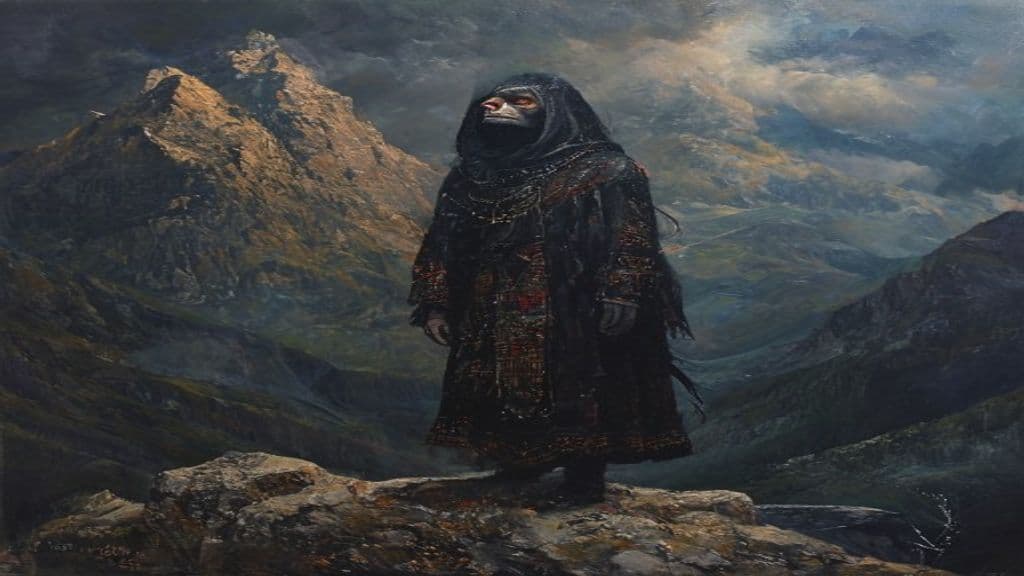
There is no specific description of Taki Unquy individuals as supernatural entities, but rather as people who believed themselves to have divine ancestry and spiritual authority.
Taki Unquy adherents resisted Spanish colonization through armed conflict, performed spiritual purification rituals, and sought to restore their ancestors' rule over the Andean regions through cultural revitalization efforts.
Weaknesses
- external suppressionSpanish colonization
- internal conflictsideological differences
Wards
None recorded.
Huacas (Mountain Deities)
In the Quechua mythology, Huacas are mountain deities revered as protectors of regional ethnicities and central figures in myths. (Note: 1. Power tier: Primordial seems too high given that Huacas are mountain deities and not cosmic entities. 2. Appearance: Should be added that there is no physical description provided for the Huacas, b)
Inkarri
Supernatural vengeful entity that resurrects and avenges Atahualpa's death, restoring balance between Pacha Mama and humanity. (Note: 1. Power tier: Inkarri's abilities don't suggest Primordial level; it seems more like Greater or Ancient. 2. Appearance: Add a description of what Inkarri looks like after resurrecting (e.g., how its )
Pachakutic
Transformative event in Inca tradition, marking the end of one era and the beginning of another. (Note: - Power tier: Primordial (not Greater), as it represents a cosmic change in the sun or Earth's movement, which is on a universal scale. - Appearance: Remove statement about no physical description exi)
Paqariq Tampu
Sacred cave and birthplace of the Ayar Brothers, ancestral beings responsible for creating humans in Inca mythology. (Note: * Power tier should be Ancient instead of Primordial, as the Ayar Brothers are considered ancestral beings but not cosmic entities. * Origin story is accurate, but it could be more specific: "Accordin)
Qantu (Cantua buxifolia)
A culturally significant evergreen shrub with pink flowers in the Inca tradition. (Note: 1. Add origin story based on the Inca tradition. 2. Change Power tier to Greater: Qantu's cultural significance, association with Andean shamanism, and connection between music and flowers suggest a m)
Yanantin
In Inca tradition, Yanantin is a philosophical concept representing the interdependent and essential parts of a harmonious whole, based on complementary opposites. (Note: 1. Power tier should be Ancient (deity-level), as it's a fundamental concept in Andean thought. 2. The appearance section is correct ("no physical description"). 3. Abilities section needs to reflect )
Tainui (waka)
Tainui is the ancestral ocean-going waka (canoe) in Māori tradition in which Polynesian migrants voyaged from Hawaiki to Aotearoa approximately 800 years ago. The name denotes both the specific voyaging canoe commanded by Hoturoa and, by extension, the confederation of descendant iwi (the Tainui confederation) whose whakapapa, territorial claims, and political identity rest on that voyage.
Taishang Laojun
Taishang Laojun (also rendered Daode Tianzun) is a principal deity in the Taoist pantheon, identified in the sources as a deified form of the philosopher Laozi and as one of the Three Pure Ones (highest immortals) in Taoist cosmology. He is traditionally associated with moral teaching and is the legendary author-attributor of the didactic text 'Tai Shang’s Treatise on Action and Response.'
Takatāpui
In Māori tradition, Takatāpui is an identifier for individuals who identify with non-heterosexual and/or non-cisgender characteristics. (Note: 1. Power tier should be revised or removed, as there is no indication in the source material that Takatāpui individuals possess supernatural abilities. 2. Appearance should be revised to "No physical )
Takṣaka
Takṣaka is a named serpent- or dragon-figure in South Asian epic, Purāṇic, and Buddhist literature. He functions as a serpent-king among the nāgas, an actor in Mahābhārata cycle episodes (notably the death of King Parīkṣit and the subsequent sarpa-yajña), and appears in Buddhist Avataṃsaka commentary as a Dragon King who praises the Buddha.
Talaus
Talaus (Ancient Greek: Ταλαός) is a mortal figure in Greek mythic-genealogical tradition, presented as a king of Argos in some accounts and named among the crew of the Argonauts. He appears in lineage lists and heroic inventories rather than as a deity or supernatural being.
Tam Kung
Tam Kung (譚公; Tam Tai Sin 譚大仙) is a localized immortal and sea patron in southern Chinese popular religion, particularly in Hong Kong, Macau and diaspora communities. He is traditionally invoked for weather forecasting, healing, maritime protection, and community welfare and is celebrated in temples and annual birthday festivals.
Community Record
- [1]Taki Unquywiki